
When a crypto wallet says it’s “open source,” it basically means anyone can look at the code. But that doesn’t automatically mean someone has checked it, or that the app on your phone was actually built from that exact code. Reproducible builds give you a way to check that the two match. The catch is that doing this verification yourself can be quite technical and time-consuming, much more work than the simple “open source” label might suggest.
Listen to this article, about 13 minutes. A synthetic voice reads the article and announces each section title as it begins; tables are read row by row and the questions at the end are left out.
Recorded 10 October 2026 from the article as published that day. Press a chapter to jump there; the highlighted line is what is playing. A play button sits beside every section heading, and once you scroll past this player a bar at the bottom of the screen keeps the controls in reach. Tap or click any sentence to hear the reading start from there.
On this page: a detailed comparison table of wallet reproducibility, a checklist for non developers, and a timeline of community build verification efforts.
Think you already know this? Five questions, one minute.
Every answer is on this page. Answer from what you know now; the page fills in the rest.
-
1. What is the main limitation of a wallet simply being open source?
Publishing code allows anyone to inspect it, but it does not mean someone has checked it. For example, some firmware is published under a Commons Clause licence which allows inspection but restricts commercial redistribution. Read the section
-
2. What did the Milk Sad disclosure reveal about open source wallet code?
The Milk Sad disclosure detailed how a vulnerability, tracked as CVE-2023-39910, existed in Libbitcoin Explorer even though the code was completely public. Read the section
-
3. How can users verify that their Bitcoin Core download matches the official source code?
Users can verify releases against signed hashes in the guix.sigs repository as explained on the Bitcoin Core download page. Read the section
-
4. Which of the following is true regarding reproducible builds on iOS devices?
According to WalletScrutiny’s methodology, no iPhone wallet app has achieved a reproducible build. Read the section
-
5. What is Ledger’s justification for not making its secure element firmware fully open source?
Ledger explains in its explanation of why it is not fully open source that the code interacting with its secure element chip is under a non disclosure agreement. Read the section
Checked on 13 September 2026 using the wallet makers’ own documentation and public GitHub records. Most “best crypto wallet” lists treat “open source” like just another feature, something to tick off alongside price, design and colour choices. But being open source is more than a tick in a comparison table. This page looks at what that label actually means and how much trust it really gives you.
What does open source actually prove about a crypto wallet?
It proves the source is published, so anyone with the skill and the patience can inspect it. That is a genuine good. A wallet that hides its code asks you to trust the company’s engineering blind, and one that publishes it at least lets outsiders look. The trouble is the distance between “can look” and “did look”, and a second, quieter distance between the code on GitHub and the file on your device.
One wrinkle: Coldcard licenses its firmware under MIT with the Commons Clause, which withholds the right to sell it, so purists call it source available. For security that barely matters. What protects you is being able to read and rebuild the code, and that licence allows both.
Why is code you can read not the same as code someone has checked?
Two public records make the point. Libbitcoin Explorer, a command line bitcoin tool with its code in the open, generated seeds in versions 3.0.0 through 3.6.0 from a random number generator seeded with 32 bits of system time. The Milk Sad disclosure describes funds taken from affected wallets in 2023, logged as CVE-2023-39910. The code was readable the whole time.
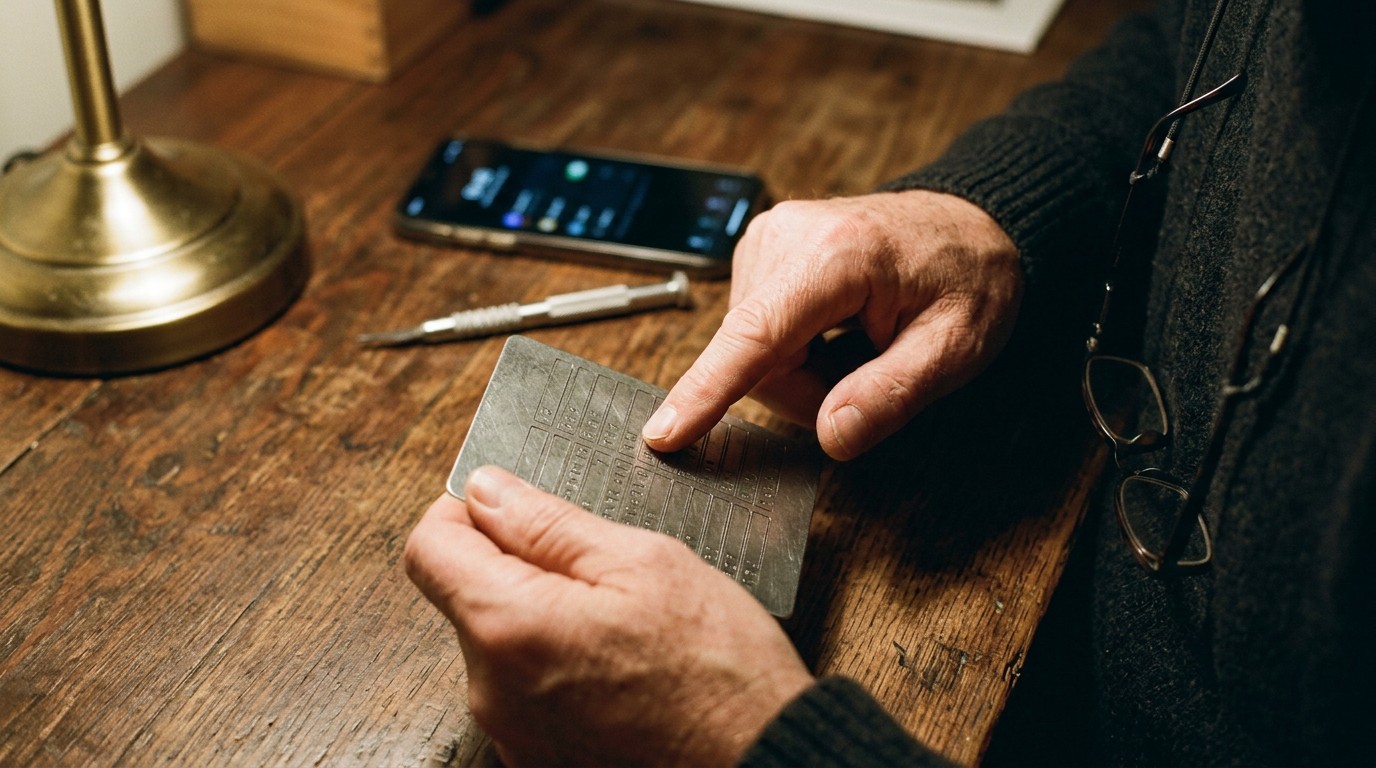
The second record is closer to home for hardware wallet owners. Coldcard’s firmware is published, and its repository carries instructions for rebuilding it byte for byte. The seed entropy defect disclosed in July 2026 still affected, according to Coinkite’s Coldcard security status page as last updated on 6 September 2026, Mk4 and Mk5 standard firmware before 5.6.0, Q standard firmware before 1.5.0Q, and Mk2 and Mk3 firmware before 4.2.0. That page states that updating firmware does not repair a seed already generated on affected firmware. If you own one of these devices, follow that page directly rather than any summary, including this one.
A reproducible build would have recreated the firmware exactly as it was, including the bug. That’s because reproducibility only shows that the app or firmware matches the published source code. It does not tell you whether that source code itself is safe or free of mistakes. Our cold-wallet explainer explains what happened and how even people who followed the recommended steps could still be affected.
How do you know the app you installed was built from that code?
This is the gap no ranking page for this search names. A company can publish clean code and ship a different file, by design, by accident, or because someone got into its pipeline. Ledger’s own incident report for 14 December 2023 describes the distribution version: a former employee whose npm access had not been revoked was phished, and malicious versions 1.1.5 to 1.1.7 of the Ledger Connect Kit library were published. Ledger puts the active draining window at under two hours.
A reproducible build is the defence against the build half of that. Independent people compile the published source with a pinned toolchain and confirm they get the same bytes as the official release, signature aside. When several unconnected builders match, a quietly altered binary is very hard to hide. KeepKey, for one, prints the pinned build command and the expected hash in each recent release note, which our KeepKey wallet review reads release by release.
Bitcoin Core is the reference case. Its releases are built with Guix, several named builders publish signed hashes in the guix.sigs repository, and the Bitcoin Core download page explains checking a release against those signatures.
Even a pass has limits. WalletScrutiny’s methodology, updated on 11 September 2026, says a reproducible verdict covers the binary they tested, not later releases. It also says no iPhone wallet app has achieved a reproducible build, which is worth remembering when an app store listing mentions open source in its second sentence.
What can you actually verify for each wallet today?
Compiled from each vendor’s own documentation or public repository on 13 September 2026. It records what an outsider can check. It is not a ranking and not a recommendation of any product.
| Wallet | What is published | Rebuild and compare? | What an owner can check | Source |
|---|---|---|---|---|
| Trezor devices | Firmware | Yes, documented for six models | Release hash with signature zeroed, against a local build | Trezor build docs |
| BitBox02 | Firmware | Yes, Docker build from the release tag | Firmware hash on the device screen; signed build assertions | BitBox guide |
| Coldcard | Firmware, MIT plus Commons Clause | Yes, a repro build step | SHA 256 hashes in a PGP signed file | Coldcard repro notes |
| Blockstream Jade | Firmware | Guide exists; 2023 mismatches reported, said to be fixed in 2024 | Local build against the release | Jade repository |
| OneKey | Firmware | No independent match in the open issue; 293 bytes apart in September 2025 | Vendor hash instructions | issue 579 |
| Ledger devices | Apps and developer kit, not the secure element OS | Not for the closed layer | Vendor signed updates for that layer | Ledger explanation |
| Bitcoin Core | Node and wallet software | Yes, Guix builds by several builders | Signed hashes from builders you pick | guix.sigs |
| Sparrow | Desktop wallet software | Not described on the download page | Signed manifest and hash, checkable in the app | Sparrow downloads |
The vendors that document reproducible builds also give ordinary owners a smaller check, a hash on the screen or a signed manifest, and that is the check most people will actually do. The BitBox02 bootloader is one of the few that will show that hash before it runs the firmware, which our BitBox02 review sets against the gaps in its published audit record. A build guide, though, is only as good as the last independent person who followed it.
What do people who tried to reproduce wallet firmware report?
We read five public GitHub issue threads, about 60 comments in all, from people who tried to rebuild wallet firmware and match the official release, plus the BitBox02 release record. This is what contributors report, not audited findings, and a failed attempt can be the builder’s mistake as easily as the vendor’s.
In September 2023 a user reported on the Blockstream Jade tracker that a build on an Apple M2 Mac, following the repository’s reproducibility guide, differed from official firmware 1.0.21 by more than the signature, and that Ubuntu 23.04 gave the same result. A maintainer replied the next day that this was not expected, and in January 2024 said it was hopefully resolved by a related fix.

In November 2023 a WalletScrutiny contributor reported non determinism in Jade builds: out of ten compilations, up to two produced a binary that did not match the release, even though the build itself succeeded. The issue was closed in March 2024.
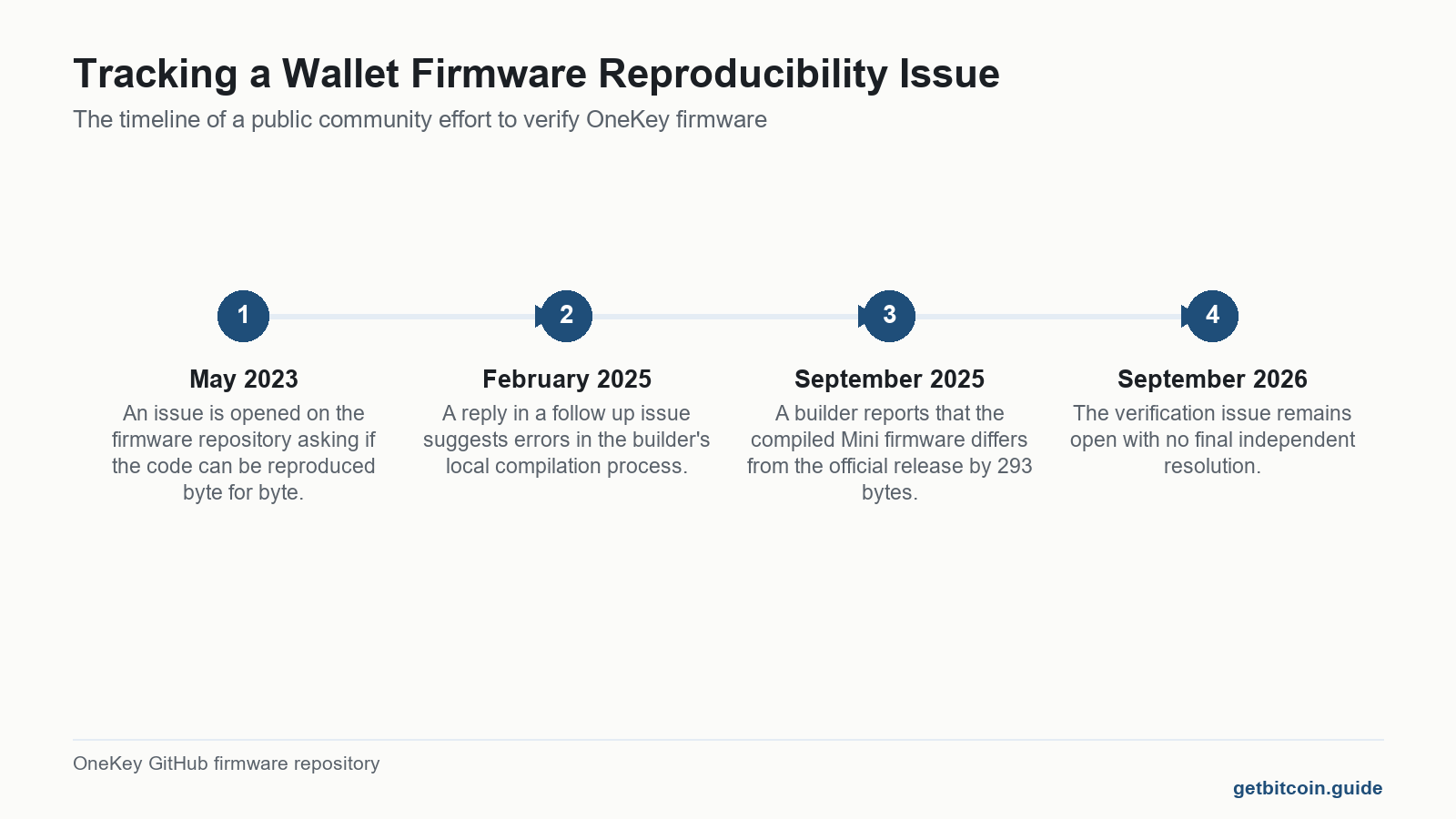
The longest record is an issue opened on OneKey’s firmware repository in May 2023 asking whether its firmware could be reproduced byte for byte. Over 45 comments and sixteen months, builders describe Docker failures, clock faking errors and a script that printed success and failure on the same line. The effort moved to a follow up issue, where a February 2025 reply suggested errors in the builder’s process, and in September 2025 a builder reported OneKey Mini firmware 3.10.0 differing from the release by 293 bytes. It was still open on 13 September 2026. That records an unfinished verification, not evidence that anything is wrong with the firmware.
At the other end of the range, in December 2021 a Trezor user could not match the official fingerprint for Model T firmware, then worked out within about five hours how it is calculated, and a maintainer pointed to a tool that does it. That thread is nearly five years old, so read it as how the process used to look. And the BitBox02 releases folder carries signed assertions, up to firmware 9.27.1, that each binary was reproduced from its tagged source.
Where the accounts agree with the official guidance: reproducible builds work, and mismatches get fixed once a maintainer engages. Where they differ from what the guidance implies: this is specialist work measured in evenings, and a build guide can sit for years without independent confirmation.
Is closed firmware automatically less safe?
No, and here we part company with the ranking pages in both directions. Ledger says in its explanation of why it is not fully open source that the code talking to its secure element sits under a non disclosure agreement with the chip maker. Its chief technology officer, Charles Guillemet, argued in an essay published on 6 August 2026 that open source is an inspection property rather than a security property, and that professional researchers review code when someone pays them to. Ledger does not publish that layer, so it is hardly neutral.
He is half right. Open code did not save Coldcard or Libbitcoin Explorer owners. But inspection is the only way outsiders find a flaw before an attacker does, and a reproducible build is the only way anyone but the vendor can confirm what shipped. A closed layer removes both, leaving the vendor’s own testing and disclosure record. The NGRAVE ZERO is the sharpest version of that trade: its firmware is not published at all, and we traced what its EAL7 certificate actually covers to a third party kernel rather than the device. Our Trezor and Ledger comparison sets both companies’ security bulletins side by side, which says more than either licence.
What should a non developer check instead?
You do not need to compile firmware to benefit from the people who do. This checklist is derived from the vendor documents in the table above.
- Download wallet software only from the vendor’s own site, and check the signed manifest or hash when one is offered. Sparrow builds that check into the app for downloads.
- Update firmware through the vendor’s official app, and where the device shows a firmware hash or fingerprint, compare it with the one the vendor publishes.
- Look for a public reproducible build guide and for independent confirmations dated within the last year, not merely a link to a repository.
- Check the vendor’s security status page against the firmware version your seed was generated on. A patched device does not fix a seed made before the patch.
- Never type your recovery phrase into any website, app or tool that claims to verify a wallet. No legitimate verification step needs it.
- Treat open source in an app store listing as a claim until someone independent has rebuilt it.
For everything else worth weighing before picking any wallet, our guide to choosing a crypto wallet without being sold one covers the rest, and the guide to storing your recovery phrase covers the part that no amount of verified code can protect.
Non Developer Wallet Verification Checklist
You do not need to be a developer or compile code from scratch to protect yourself. Use these practical steps to verify your wallet’s integrity.
Ticks are saved on this device only.
Frequently asked questions
Is Bitcoin Core open source and reproducible?
Yes. Bitcoin Core’s code is public, and its releases can be rebuilt to check that the published code matches the software people download. Independent builders also publish signed hashes, giving users more than one source to compare against instead of having to rely on a single company.
Does open source mean a wallet has been audited?
No. Open source simply means the code can be inspected. An audit is a separate, professional review of a particular version of that code at a particular time. If a wallet says it has been audited, check the actual audit report, when it was done and which version was reviewed.
Can a phone wallet app be reproducible?
Sometimes. Some Android wallet apps have been independently rebuilt and matched with the published version. However, according to the WalletScrutiny methodology page updated in September 2026, no iPhone wallet app had achieved a reproducible build at that time.
What is a firmware fingerprint?
It is basically a short code, called a hash, that identifies a particular firmware version. When your device shows this fingerprint, you can compare it with the one published by the manufacturer or produced by an independent build. If they match, you have stronger evidence that you are installing the expected firmware.
Is source available the same as open source?
Not always. Some projects let you see and rebuild their code but place restrictions on what you can do with it, such as selling or redistributing it. For someone mainly concerned with checking what their wallet is actually running, the important part is being able to see the code and independently rebuild it.
Does verifying my firmware protect a seed I generated earlier?
No. Firmware verification tells you whether the firmware you are using now matches the expected version. It cannot go back and fix a seed that was created using faulty or compromised firmware. If you are worried about an older seed, check the wallet maker’s security notices for the firmware version that was installed when you created it.
Finished the page? The same five questions from the top, to see what stuck.
This article is general information for education and is not personal financial advice. Nothing here is a recommendation to buy, sell or hold anything. For decisions about your own situation, speak to a qualified professional.
Leave a Reply