
A multi currency wallet holds many coins under one recovery phrase by giving each chain its own derivation path. That is convenient, and it has a trap: restore the phrase into an app that scans different paths and you can see a zero balance while every coin is still on the blockchain.
Listen to this article, about 13 minutes. A synthetic voice reads the article and announces each section title as it begins; tables are read row by row and the questions at the end are left out.
Recorded 10 October 2026 from the article as published that day. Press a chapter to jump there; the highlighted line is what is playing. A play button sits beside every section heading, and once you scroll past this player a bar at the bottom of the screen keeps the controls in reach. Tap or click any sentence to hear the reading start from there.
On this page: a detailed derivation path table, public user reports of zero balances, and a step by step safety checklist.
Think you already know this? Five questions, one minute.
Every answer is on this page. Answer from what you know now; the page fills in the rest.
-
1. What is the primary role of a derivation path inside a multi currency wallet?
The wallet uses your master seed to derive different keys along specific paths for each coin, as defined in BIP44. Read the section
-
2. Which derivation path prefix does native SegWit (bc1q) use for Bitcoin?
Native SegWit addresses begin with bc1q and use the m/84′ prefix, as specified in the BIP84 document. Read the section
-
3. What is the standard BIP44 gap limit that tells a wallet to stop scanning empty addresses?
As defined in the standard, BIP44 sets the gap limit at 20 unused addresses before it stops scanning. Read the section
-
4. In the March 2026 thread, what did support suggest could hide a user’s funds after a reset?
According to a March 2026 r/ledgerwallet thread, wrong paths, higher account indexes, or different address types can hide funds. Read the section
-
5. How does adding an optional BIP39 passphrase affect the wallet backup?
The optional passphrase acts as a 25th word, creating an entirely different seed and wallet. Read the section
Checked on 14 September 2026 against the Bitcoin Improvement Proposals, the SLIP-0044 coin type registry and wallet vendors’ own documentation. The pages ranking for this search are, in order, a project promoting its own wallet, a business account for holding euros and dollars, and several lists of the same seven apps. Not one of them mentions the thing that makes people think their coins have vanished.
What does multi currency actually mean inside a wallet?
IA crypto wallet does not actually hold a collection of different coins inside it. Your recovery phrase is turned into one master seed, and that seed is used to generate the private keys for your different cryptocurrencies. The coins themselves remain safely recorded on their respective blockchains. The wallet’s job is simply to use your seed to find the right keys and show you your balances. The route it follows to find those keys is called a derivation path.
Most wallets use a system called BIP44, which gives each key a specific path. For example, a first Bitcoin address can use a path like m/44'/0'/0'/0/0. You don’t need to understand every number here. The important part is that these numbers tell the wallet where to look for your funds.
One of those numbers identifies the cryptocurrency. Bitcoin uses 0, Litecoin uses 2, Dogecoin uses 3, and Ethereum uses 60. So, even though the same recovery phrase is being used, changing this number leads the wallet to a completely different set of keys. This is how one recovery phrase can work with many different cryptocurrencies.
Why can a restored wallet show zero when your coins are still safe?
This is one of the most frightening things that can happen after restoring a wallet. You enter your recovery phrase, but the new wallet shows nothing. That does not automatically mean your coins are gone. Before any of that, make sure the app you are restoring into is the self custody one at all, since the custodial Coinbase account has no phrase, as our page on which Coinbase product has a seed phrase explains.
The recovery phrase gives the wallet the seed, but it does not necessarily tell the new app which paths your old wallet used. If your old wallet stored your funds using a path that the new wallet does not check, the new wallet may simply report a zero balance because it is looking in the wrong place.
There are a few common reasons for this.
The first is the Bitcoin address type. Bitcoin can use several different address and key schemes, and each can use a different derivation path.
The second is account numbering, especially with cryptocurrencies such as Ethereum. Different wallets may organize and number accounts differently, even when they are using the same recovery phrase.
The third is the gap limit. This tells the wallet how far it should keep looking for used addresses. If your old wallet used many addresses with unused ones in between, a new wallet may stop scanning too early and miss your funds.
There is also another important reason why a restored wallet might appear empty. It has nothing to do with derivation paths at all, and that’s worth looking at separately.
Which derivation paths do common chains use?
Compiled on 14 September 2026 from the specifications and vendor pages linked on each row. Coins appear here only as examples of different chains. This is not a list of anything worth holding.
| Chain and scheme | Coin type | First receive address path | Address begins | Source |
|---|---|---|---|---|
| Bitcoin, legacy | 0 | m/44’/0’/0’/0/0 | 1 | BIP44 |
| Bitcoin, nested SegWit | 0 | m/49’/0’/0’/0/0 | 3 | BIP49 |
| Bitcoin, native SegWit | 0 | m/84’/0’/0’/0/0 | bc1q | BIP84 |
| Bitcoin, Taproot | 0 | m/86’/0’/0’/0/0 | bc1p | BIP86 |
| Litecoin, BIP44 | 2 | m/44’/2’/0’/0/0 | Varies by script type | SLIP-0044 |
| Dogecoin, BIP44 | 3 | m/44’/3’/0’/0/0 | D | SLIP-0044 |
| Ethereum, MetaMask default | 60 | m/44’/60’/0’/0/0, then /1, /2 | 0x | MetaMask help |
| Ethereum, Ledger Live accounts | 60 | m/44’/60’/0’/0/0, then 1′, 2′ at account level | 0x | Ledger Live issue 1185 |
Two things jump out. Bitcoin has four rows for one coin, and the BIP84 document gives bc1qcr8te4kr609gcawutmrza0j4xv80jy8z306fyu as the first native SegWit address for its test phrase, which is how a developer checks their wallet does it properly. And the two Ethereum rows share a first address and then part company, which is exactly the kind of difference that stays invisible for months.
What does a zero balance restore look like, worked through?
Take a phrase set up in a wallet that defaults to native SegWit. It is the default in Trezor Suite, according to Trezor’s account types guide, and the coins were received at m/84’/0’/0’/0/0, an address beginning bc1q. Now restore that phrase in an older app that only scans legacy paths.
- The app derives m/44’/0’/0’/0/0 and shows an address beginning 1. It is a real address belonging to your phrase, and nothing was ever sent to it.
- It checks addresses 0 to 19 on that path, finds 20 unused in a row, and stops. BIP44 sets the gap limit at 20 and tells wallets to stop scanning after that many empty addresses.
- The balance reads zero. The coins are still at m/84’/0’/0’/0/0, one purpose number away.
- The fix is to add a native SegWit account, or choose the path at restore time. The receive address that appears should begin bc1q and match one from your old records.
The gap limit causes a subtler version even on the right path. Suppose your old wallet handed out addresses 0 to 21, and only address 21 ever received anything. A restoring wallet reaches 20 unused in a row at address 19 and gives up two short of your coins. It is rare, and it usually belongs to people who generated invoices or donation addresses in bulk.
One wallet sits outside the scheme entirely. Electrum’s documentation states that Electrum does not generate BIP39 seeds, and its own phrases carry a version number instead. So a phrase created in Electrum will not open the same wallet in an app that expects BIP39, however carefully you type it.
What do people who hit a zero balance restore actually report?
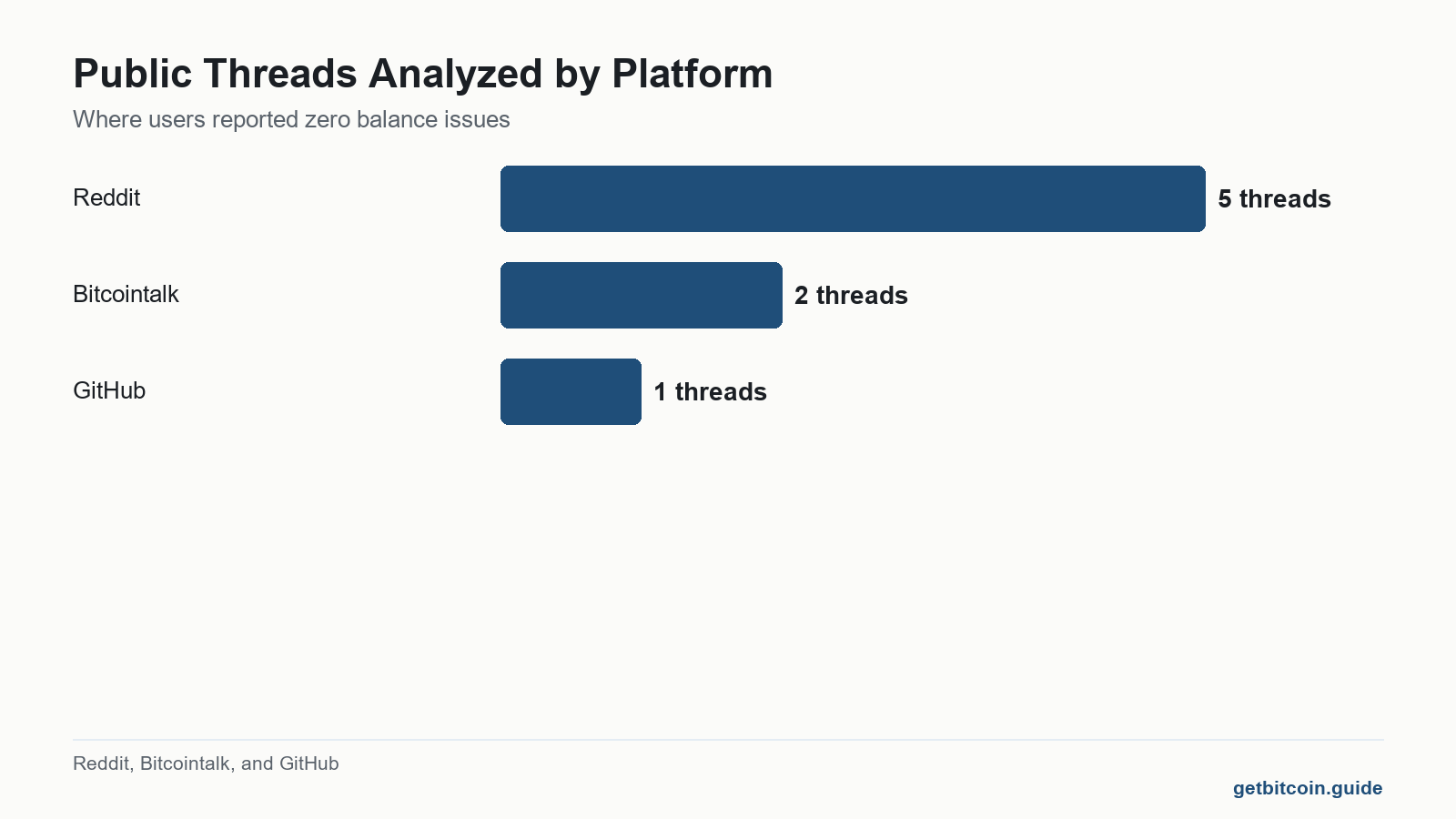
We read eight public threads: five on Reddit, two on bitcointalk.org and one on Ledger’s GitHub tracker. These are accounts from users, not verified findings. Derivation paths explained some of them, a different phrase explained others, and in one the balance was zero because the coins had been spent.
In a March 2026 r/ledgerwallet thread with more than 100 comments, a Nano S Plus owner said the device reset during a firmware update, accepted the phrase as valid, and then showed new addresses with zero balance while the old ones still held BTC and ETH on the blockchain. A Ledger support account replied that a wrong derivation path, a higher account index or a different address type can each hide funds. Other commenters pointed out that a phrase with a wrong word can still pass the checksum. The thread ends unresolved.
In a May 2026 thread, someone who had moved from a Nano S bought around 2015 to a newer device said Bitcoin and Ethereum came back but Dogecoin, XRP and Stellar did not, after checking more than 20 addresses on each of several paths. A Ledger support reply said Dogecoin uses the standard BIP44 path, that XRP and Stellar offer no alternative path to pick, and that an empty result almost always means a different phrase was used back then.
The account that most clearly is a path problem is a November 2025 post from a long time user whose Polygon funds sat on the older path used by MyEtherWallet. The Ledger support reply said the current app does not support that legacy path. The user asked, reasonably, how to move funds from an address the app will not open. The path argument is not new either: a July 2018 issue on Ledger’s tracker recorded Ledger Live counting Ethereum accounts differently from Trezor and MyEtherWallet.
And the counterweight, older but instructive: in a February 2021 bitcointalk thread a user restored a 12 word phrase into Electrum, saw an empty wallet, worked through path and passphrase theories with replies, and finally found on a block explorer that the 2016 coins had been spent. Sometimes empty means empty.
Where these accounts agree with the specifications: the phrase plus the path always gives the same addresses, and the fix for a genuine path mismatch is to scan the right one. Where they add something the documents do not: vendors narrow the paths their apps support over time, and the first explanation offered is often a different phrase, which leaves the owner unsure which of the two they are dealing with.
Does one phrase for every coin concentrate the risk?
Yes, and no wallet list mentions it. Every chain’s keys come from the same seed, so anyone who reads your phrase can derive all of them, on every path, with free software and no hurry. Spreading coins across chains does nothing for security if they share a phrase. Our guide to the ways people actually lose a recovery phrase covers protecting it, and the explainer on what non custodial really means covers who else could hold a copy.
An optional passphrase changes the picture, and causes the fourth kind of zero balance. BIP39 mixes it into the seed, so every different passphrase opens a different, valid, empty wallet. Our guide to the Ledger 24 word seed explains that 25th word in detail.
How do you check a wallet’s paths before trusting it with a restore?
This checklist is derived from the BIP44 gap limit rule and the account type guidance in the table above.

- Write down which wallet app created the phrase, the year, and the address type, next to the words. That line is what a future restore needs.
- Note the first receive address for each chain you use. After any restore, that address should match exactly.
- Look in the wallet’s own documentation for the paths it supports before restoring a phrase from elsewhere. If it does not say, treat that as an answer.
- Rehearse a restore with a small amount first, while your original device still works.
- If a balance reads zero, look up your old address on a block explorer before doing anything else. It tells you whether the coins are still there.
- Never type your recovery phrase into a website, a browser extension, or any tool offered by someone who contacted you. A support agent who asks for it is not a support agent.
If you use a phone keystore, our look at the Samsung Blockchain Keystore shows how the same path question applies when a phone maker holds the app.
Wallet Restore Preparation Checklist
Before trusting a new wallet with your recovery phrase, use these steps to ensure you can safely restore your funds.
Ticks are saved on this device only.
Frequently asked questions
Can I use the same recovery phrase in two different wallet apps?
Usually, if both follow BIP39 and scan the same derivation paths. Where they differ, the second app may show only some of your accounts, or none. Every app that holds the phrase is also another place it can leak from.
What is a coin type number?
The second level of a BIP44 path, identifying the chain. The numbers are registered in SLIP-0044: 0 for Bitcoin, 2 for Litecoin, 3 for Dogecoin and 60 for Ether, among thousands of others.
Why do my Bitcoin addresses start with different characters in different apps?
Each script type has its own prefix: 1 for legacy, 3 for nested SegWit, bc1q for native SegWit and bc1p for Taproot. The same phrase can produce all four, from different derivation paths.
What is the address gap limit?
The number of unused addresses in a row after which a wallet stops scanning. BIP44 sets it at 20. Coins received after a longer run of unused addresses can be missed by a restoring wallet.
Does a zero balance after restoring mean my coins were stolen?
Not necessarily. Check your old receive address on a block explorer. If the coins are still there, the problem is the path, the passphrase or the phrase itself. If they moved, the explorer shows when.
Is a multi currency wallet less secure than a single coin wallet?
The cryptography is the same. The difference is exposure: one phrase unlocks every chain at once, and the app has more code for more chains. How the phrase is generated and stored matters far more.
Finished the page? The same five questions from the top, to see what stuck.
This article is general information for education and is not personal financial advice. Nothing here is a recommendation to buy, sell or hold anything. For decisions about your own situation, speak to a qualified professional.
Leave a Reply