The BitBox02 is a Swiss made hardware wallet from Shift Crypto, built around two chips and sold in Multi and Bitcoin only editions that cannot be swapped later. Its August 2026 Dixence update fixed two severe firmware flaws, and the vendor’s own advisory says the Bitcoin only edition escaped one of them.
Listen to this article, about 13 minutes. A synthetic voice reads the article and announces each section title as it begins; tables are read row by row and the questions at the end are left out.
Recorded 5 October 2026 from the article as published that day. Press a chapter to jump there; the highlighted line is what is playing. A play button sits beside every section heading, and once you scroll past this player a bar at the bottom of the screen keeps the controls in reach. Tap or click any sentence to hear the reading start from there.
On this page: the chips named in BitBox’s own datasheets and security page, the three issues disclosed in the 17 August 2026 Dixence advisory with the exact firmware ranges each one hit, prices read off the vendor’s shop on 5 October 2026, and five dated accounts from Trustpilot and the public issue tracker.
Think you already know this? Five questions, one minute.
Every answer is on this page. Answer from what you know now; the page fills in the rest.
-
1. Which secure chip does BitBox name for the BitBox02, and which for the Nova?
Per the BitBox security page, read on 5 October 2026, the microcontroller is the same Microchip ATSAMD51J20A in both, while the secure element differs between the two lines. Read the section
-
2. Which firmware version does the Dixence advisory say is clear of all three issues?
The Dixence advisory of 17 August 2026 states that all BitBox devices on firmware versions from 9.26.5 are not affected. The newest release at the time of writing is 9.27.1, published 31 August 2026. Read the section
-
3. Why does BitBox say the Bitcoin only edition escaped the memory corruption issue?
That is the vendor’s own wording in the Dixence advisory. The same edition was still inside the affected range for the bootloader and silent payments issues, so it was not untouched. Read the section
-
4. Can a Multi edition be turned into a Bitcoin only edition later?
The BitBox02 product page states the editions are two different products that cannot be converted later, and the bootloader refuses firmware built for the other edition. Read the section
-
5. What is missing from the published claim that the firmware was externally audited?
The security page names Census Labs as the auditor but gives no date, scope or published report, and the firmware repository has no published security advisories either, checked 5 October 2026. Read the section
What is the BitBox02, and which editions are on sale?
Two product lines carry the name today. The original BitBox02 connects by USB-C only, and the BitBox02 Nova adds a glass display, an optional Bluetooth path and support for iPhone and iPad, which the original does not. Each comes in a Multi edition and a Bitcoin only edition. Read off the vendor’s own shop on 5 October 2026, the BitBox02 was listed at 124.17 euros and the Nova at 145.83 euros, both excluding VAT, each with a two year warranty.
The sentence that matters most on those pages is the dullest one. BitBox writes that the editions “are two different products that can’t be converted later”, so the choice is made at checkout and not in software. Multi adds Ethereum and ERC20 tokens, Cardano, Litecoin, what the shop describes as 1500 or more further tokens, and FIDO U2F login. The Bitcoin only edition strips all of that out, which BitBox frames as removing attack surface rather than features.

How does the dual chip design actually protect the seed?
Every hardware wallet page says “secure chip” and stops there. The useful detail is which chip, and what it is allowed to know. The firmware repository names the microcontroller as a Microchip ATSAMD51J20A, a 120 MHz Cortex-M4F, talking to a separate secure element over I2C. The security page, read on 5 October 2026, names that element: ATECC608B in the BitBox02, OPTIGA Trust M V3 in the Nova.
The split is the point. BitBox states that three secrets are needed to reach the encrypted wallet seed: one held on the secure chip, one on the microcontroller, and the device password, which lives only in the owner’s head. The seed stays encrypted in RAM while the device is in use and is decrypted only for as long as a signature takes. A monotonic counter in the secure chip caps password attempts and password stretching makes each guess slow, which is how a short password survives contact with a patient thief.
The Nova datasheet adds the parts a buyer can check: five sources of entropy for seed generation, an attestation key written at the factory so the app can spot a counterfeit, a bootloader that refuses unsigned firmware, downgrades and firmware built for the other edition, and the option to display the firmware hash before it runs. Both chips sit under security grade epoxy, and the casing pins break if the halves are prised apart. None of that is exotic in 2026. All of it being published still is not standard. The firmware is reproducible and WalletScrutiny tests that claim independently, a subject the guide to open source crypto wallets goes into properly.
What did the August Dixence update fix, and on which editions?
On 17 August 2026 BitBox published the Dixence update and firmware 9.26.5, disclosing three security issues. The advisory says they were found during internal audits, including with what it calls frontier AI models, that there are no reports of stolen user funds, and that “Your existing wallet seed is not affected in any way”. Bitcoin Magazine covered it the next day. This is the part no affiliate review carries, because a security notice sells nothing.
The three issues, as the vendor describes them. A bootloader flaw that could have been used to walk an owner into installing malicious firmware on a genuine device, after a successful phishing step; it was fixed earlier, in the Oeschinen release, and the Nova was never affected because of the age of the bootloader versions involved. A memory corruption issue that applies only to a Multi edition with no wallet set up on it yet, plugged into a malicious host, where it could allow arbitrary code execution. And a silent payments flaw that could have locked coins to an unintended address, a ransom scenario rather than a theft. The affected ranges are specific, so here they are as the advisory states them, with the fixing release and its date from the public release record.
| Issue | Who was affected | Fixed in | Release date |
|---|---|---|---|
| Bootloader, malicious firmware install | BitBox02 on firmware through 9.26.1; Nova not affected | 9.26.2, Oeschinen | 8 July 2026 |
| Memory corruption on a device not yet set up | Multi edition of BitBox02 and Nova through 9.26.4 | 9.26.5, Dixence | 17 August 2026 |
| Silent payments, coins locked to a wrong address | BitBox02 and Nova, 9.21.0 through 9.26.4 | 9.26.5, Dixence | 17 August 2026 |
| All three | Nothing from 9.26.5 onward, per the advisory | Latest is 9.27.1 | 31 August 2026 |
Two footnotes worth having. BitBox credits external researcher Jan Wütherich of SySS GmbH with independently reporting the bootloader issue after its own engineers had found it. Separately, the trade press credited a CertiK researcher with an out of bounds write in the USB path; the release notes for firmware 9.26.3, dated 8 July 2026, do record “Fixed potential out of bounds write”, but the Dixence advisory does not name CertiK, so treat that attribution as reported rather than vendor confirmed.
Does the Bitcoin only edition really have less attack surface?
“Less code means less attack surface” is the kind of line that usually means nothing. In August 2026 it briefly meant something measurable. The memory corruption issue did not apply to the Bitcoin only edition, and the reason BitBox gives is refreshingly literal: “its firmware does not contain the affected code”. KeepKey is only now heading the same way, and its first Bitcoin only build is still a pre release, as our check on whether KeepKey firmware is still maintained sets out.
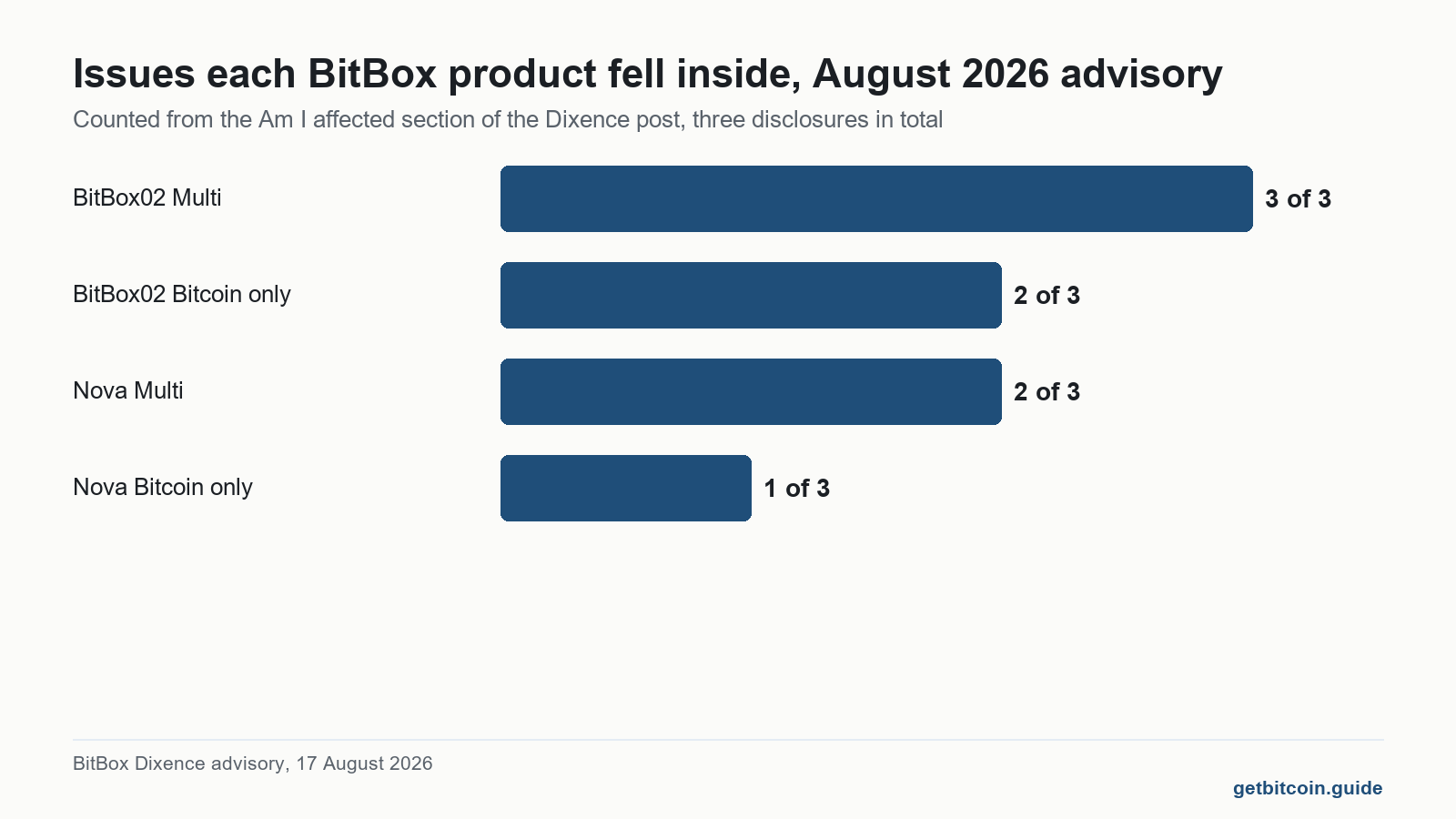
That is one issue out of three, though, and the honest reading cuts both ways. A Bitcoin only BitBox02 was still inside the affected range for the bootloader issue and for the silent payments issue. Counting the three disclosures across the four products shows how the editions differ, and it is a crude count on purpose: an issue tally is not a severity ranking, and one bootloader flaw matters more than two that need a hostile computer and a device nobody has set up.

What do BitBox02 owners actually report?
We read about thirty seven Trustpilot reviews of bitbox.swiss and one long thread on the public issue tracker, on 5 October 2026. The headline numbers: 4.8 out of 5 across 2,162 reviews, one star reviews at 2 per cent, two star reviews under 1 per cent. These are accounts of what people say happened to them, not findings, and most of the positive ones praise the support team rather than the device, which is what a solicited review pile tends to look like. Five of them, dated.
- A two star reviewer in May 2024 reported the touch slider misreading their input badly enough to burn four of their ten password attempts. A one star reviewer in May 2023 described the touch edges as too sensitive to use, and another in October 2024 reported the touch interface malfunctioning.
- A one star reviewer in February 2025 reported a 69 dollar UPS brokerage fee landing after a 129 dollar purchase, taking the total to roughly 200 dollars. Another in December 2025 put theirs at about 250 dollars. Both were shipping into the Americas.
- A one star reviewer in July 2024 reported the device rejecting their password after they had lost the microSD card, and losing access as a result. That is the backup story every custody guide tells, arriving in the post.
- Reviewers in September 2026, rating four and five stars, still flagged entering a long passphrase on the device as the awkward part, alongside praise for the hardware and the support.
- On the BitBoxApp tracker, a contributor opened issue 4053 on 24 April 2026 arguing that the app records the existence of passphrase protected wallets in its accounts file and its log, which undercuts a hidden wallet if the computer is later examined. Maintainers replied through 30 April that the app cannot currently tell a passphrase keystore apart without device side changes, that the upkeep would be permanent, that support staff rely on the logs, and that an incognito mode would be the cleaner fix. The issue is open and low priority.
Where the accounts agree with the documentation: the microSD backup is the single point of recovery, and the people who lose access are the people who lost the card. Where they add something it does not say: the touch slider is the part that goes wrong in the field, and on a device with a documented ten attempt limit a slider that misreads a gesture is a custody risk rather than an annoyance. Import duty is the other one, nobody’s fault and real money all the same. If a long passphrase is part of the plan, the guide to what a recovery phrase is and how to store it is worth reading first.
How does the BitBox02 compare with the Nova and the alternatives?
Prices were read from the vendors’ own stores on 5 October 2026. The chip and connectivity rows come from vendor datasheets and security pages, not from review sites.
| Device | Secure chip | Connectivity | Editions | Listed price |
|---|---|---|---|---|
| BitBox02 | ATECC608B | USB-C only, no iPhone support | Multi or Bitcoin only | 124.17 euros ex VAT |
| BitBox02 Nova | OPTIGA Trust M V3, EAL6+ | USB-C plus optional BLE, works with iPhone | Multi or Bitcoin only | 145.83 euros ex VAT |
| Trezor Safe 5 | EAL6+ secure element | USB-C | One device, Bitcoin only firmware optional | See the Trezor Safe 5 review |
| Blockstream Jade | No secure element, a blind oracle instead | USB-C and Bluetooth | One device | See the Jade review |
The Nova’s Bluetooth deserves a sentence, because Bluetooth on a signing device sounds alarming. BitBox calls the implementation Whisper and describes it as a minimal trust architecture: end to end encrypted, running on a separate chip with no memory and no access to wallet secrets, and able to be disabled entirely. That is a vendor design claim rather than an audited finding, and the owner can switch it off. If the whole category is new, start with what a cold wallet is, and if an air gap matters more than convenience the Coldcard Q takes a different route again.
Which BitBox02 does your situation point to?
This restates what BitBox publishes about its own four products. It is about hardware and connectivity only, it says nothing about what to hold or whether to buy anything, and nothing on this page will ever ask for your recovery words.
Information only, not financial advice, and not a recommendation to buy anything. Remember the editions cannot be converted after purchase.
What does the BitBox02 security page leave unanswered?
For a page this detailed, the audit line is remarkably thin. In full, it says the BitBox02 firmware “was audited by Census Labs along with consulting done by multiple third-party security firms”. No date, no scope, no published report to read, and we could not find one. Every ranking page repeats “independently audited” without noticing that the claim, as written, cannot be checked by a reader. The same trick runs through certification badges, which is why we went looking for the document behind the NGRAVE ZERO EAL7 claim and found it covers an operating system rather than a wallet.
The second gap is where disclosures live. Checked on 5 October 2026, the firmware repository has no published GitHub security advisories, so there is no CVE feed to subscribe to and no notification unless you read the blog or run the app that prompts you. BitBox also wrote that it “may share more technical information in a writeup at a later time”, which had not appeared when we checked. Set against the published threat model, the schematics, the x-rays and the named chips, those are small gaps. They are still the two a careful owner would want closed.
The practical conclusion is the boring one, and it holds for every brand covered here: the firmware version on the device is the security feature. BitBox says it will never ask for the recovery words, and nothing legitimate ever will, so an update prompt arriving by email rather than inside the app is a phishing attempt and not a favour.
Frequently asked questions
Which BitBox02 firmware version fixes the August 2026 vulnerabilities?
Firmware 9.26.5, released as the Dixence update on 17 August 2026. The advisory states that no BitBox device on 9.26.5 or later is affected by any of the three issues, and the most recent release at the time of writing is 9.27.1, published on 31 August 2026.
Can a Multi edition BitBox02 be converted into a Bitcoin only edition?
No. The shop pages state that the editions are two different products that cannot be converted later, and the bootloader refuses firmware built for the other edition. The decision is made at purchase.
Does the BitBox02 work with an iPhone?
The original BitBox02 does not, and the vendor says so on the product page. The BitBox02 Nova does, over USB-C with the included Lightning adapter or over its optional Bluetooth Low Energy path.
Is the Nova Bluetooth connection a weakness?
BitBox describes its Whisper architecture as end to end encrypted, running on a separate chip with no memory and no access to wallet secrets, and says Bluetooth can be disabled completely. That is the vendor design claim rather than a published audit result, and owners who do not need it can switch it off.
What happens if the device password is forgotten?
The security page names a ten attempt limit imposed by the microcontroller, backed by a monotonic counter in the secure chip, and does not spell out the behaviour on the final attempt. Treat the microSD backup or the written recovery words as the only route back into the wallet.
How is a BitBox02 checked for tampering before it is used?
Each device is loaded with a secret attestation key at the factory, so the BitBoxApp can verify authenticity on every connection. The casing pins break if the halves are separated, and the bootloader can display the firmware hash before running it.
Finished the page? The same five questions from the top, to see what stuck.
This article is educational and is not financial advice. Nothing here is a recommendation to buy, sell or hold anything. You are responsible for your own security decisions.
Leave a Reply