Bitget Wallet is the self custody app once called BitKeep, run separately from the Bitget exchange. Its standard wallet makes the keys on your phone and backs them up with a 12 to 24 word phrase only you hold. Its newer Google, Apple and email login wallet keeps key material in the cloud, which changes who you are trusting.
Listen to this article, about 11 minutes. A synthetic voice reads the article and announces each section title as it begins; tables are read row by row and the questions at the end are left out.
Recorded 28 October 2026 from the article as published that day. Press a chapter to jump there; the highlighted line is what is playing. A play button sits beside every section heading, and once you scroll past this player a bar at the bottom of the screen keeps the controls in reach. Tap or click any sentence to hear the reading start from there.
On this page: the three kinds of Bitget Wallet side by side with who holds the key in each, Bitget’s own words on the cloud stored login wallet, the BitKeep APK hack and the September 2026 exchange breach in one timeline, and what ten dated reviews report.
Think you already know this? Five questions, one minute.
Every answer is on this page. Answer from what you know now; the page fills in the rest.
-
1. What was Bitget Wallet called before the rebrand?
Cointelegraph reported on 29 March 2023 that BitKeep would rebrand as Bitget Wallet after a $30 million investment from the Bitget exchange. KeepKey is an unrelated hardware wallet. Read the section
-
2. How does Bitget’s own article say you recover a social login wallet on a new phone?
Bitget Wallet’s article of 3 December 2025 says that if you change devices you simply log in again with your account, and that your keys are securely stored in the cloud. Read the section
-
3. Which version of BitKeep was swapped for a malicious one in December 2022?
According to Cointelegraph’s account of BitKeep’s statements, attackers replaced the 7.2.9 APK update on 26 December 2022, while the App Store and Google Play versions stayed safe. Read the section
-
4. Which wallets did Bitget say the September 2026 attacker drained?
Bitget’s incident page describes unauthorised transfers from hot and warm wallets from 24 September 2026, and Bitget Wallet’s post said the self custody app was not affected. Read the section
-
5. A bitcoin address you received to begins with bc1p. Which address type is it?
bc1p addresses are Taproot, bc1q native SegWit, 3 nested SegWit and 1 legacy. The phrase itself follows the BIP39 word list standard, but the address type decides where a restore looks. Read the section
Checked on 28 October 2026 against Bitget Wallet’s own security, protection fund and product pages, Bitget’s statement on the September 2026 exchange breach, and ten dated user reviews. Most pages that rank for this name are either Bitget’s own marketing or affiliate reviews that list 130 chains and a swap feature, then never mention that the app now contains two quite different ideas of who holds your key. That difference is the whole story.
Is Bitget Wallet the same thing as the Bitget exchange?
No, though they share a name, an owner and a lot of orange buttons. Bitget Wallet started life as BitKeep, an independent multichain wallet. Cointelegraph reported on 29 March 2023 that BitKeep would rebrand as Bitget Wallet after a $30 million investment from the Bitget exchange at a $300 million valuation, and CoinMarketCap’s coverage of the rename records the new name arriving later that year, in August 2023.
The exchange is custodial: your balance there is a number in Bitget’s books, and Bitget holds the coins. The wallet app is meant to be the opposite, the kind of non custodial wallet where the keys never sit with the company. There is a gentle irony in an exchange funding the app that tells you to take your coins off exchanges, but it is the same lecture several exchanges now give, usually just above a button to deposit more. If you are weighing an exchange balance against an app generally, our guide to who holds the keys on Binance walks through the same question for the biggest exchange.
Where does Bitget Wallet keep your keys?
It depends which of its wallets you created, and the app offers more than one. Three models appear in Bitget’s own material.
The standard wallet is the familiar one. You write down a recovery phrase, and Bitget Wallet’s security technology page says that only you have control and access to your private key and mnemonic phrase, with a passcode needed to view keys or send. Lose the phone and the phrase rebuilds the wallet. Lose the phrase and the phone, and there is nobody to call, which is the price of nobody else being able to move your coins.
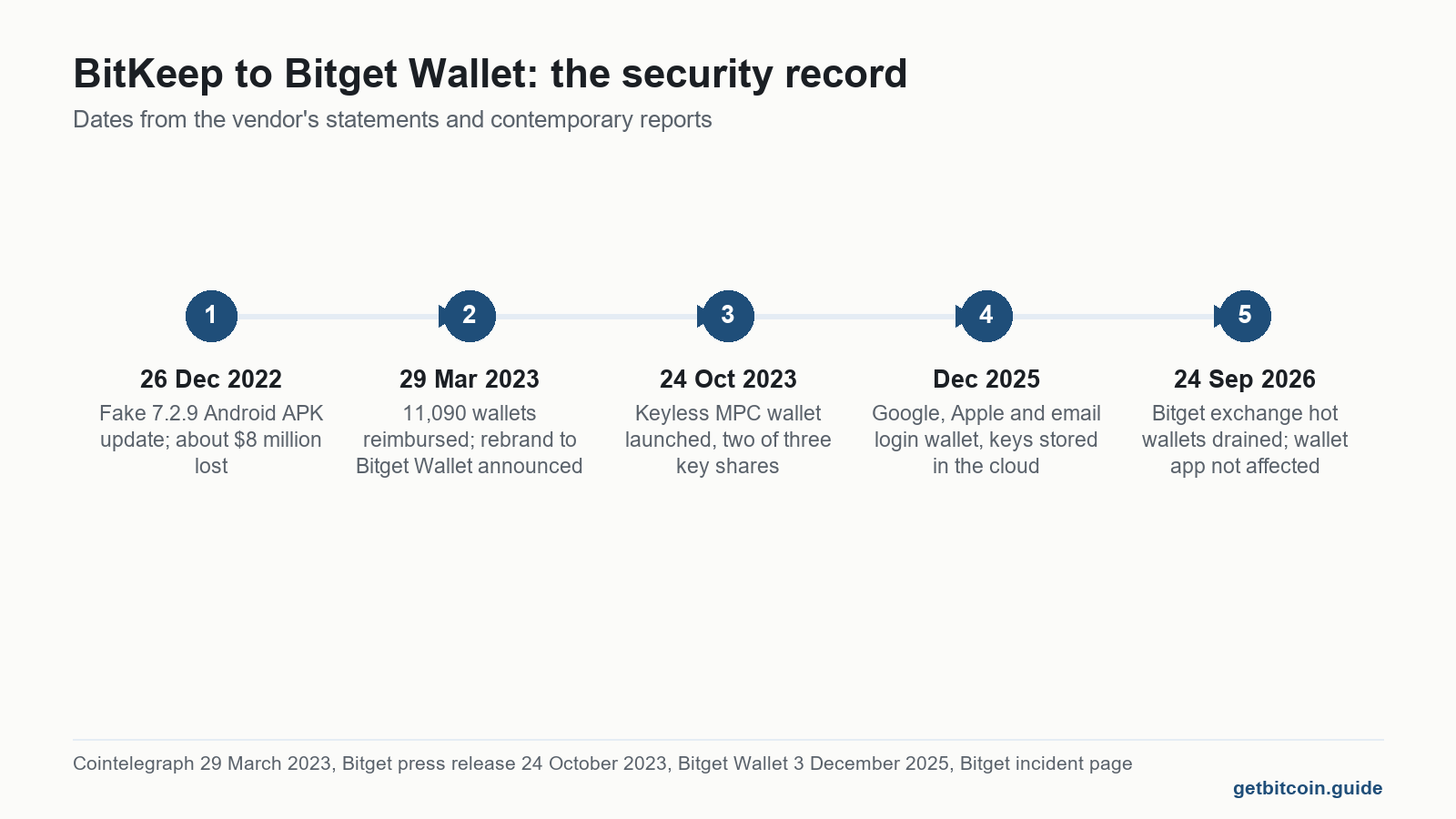
The second model, a keyless MPC wallet, was announced in October 2023. Bitget’s press release of 24 October 2023 described an email sign up with no phrase to store, the key generated as shares by multi party computation, and an optional cloud backup of the user’s shares, with a threshold of two of three shares. Whether new users are still offered this model, or whether it has been folded into the next one, Bitget’s pages did not say when checked.
The third is the social login wallet, launched in December 2025. Bitget Wallet’s own article dated 3 December 2025 says it uses Trusted Execution Environment technology to protect your private key at the hardware level and that your keys are securely stored in the cloud. The same page says the keys are not stored on any centralized server. Those two sentences sit uneasily together. The Block’s report of 4 December 2025, drawing on details from the team, says the design uses AWS Nitro Enclaves, which are cloud servers, while also describing a secure enclave on the device. What is clear is the recovery method: a new phone gets the wallet back by logging in again. A wallet that comes back from a Google or Apple login has, by definition, something stored away from your phone.
| Bitget Wallet type | Where the key lives, per Bitget | How you recover it | What you are trusting |
|---|---|---|---|
| Standard phrase wallet | Encrypted on your device; only you hold the phrase | Your written 12 to 24 words | Your phone and your paper |
| Keyless MPC wallet (2023) | Split into shares, two of three needed | Email login plus your backed up share | Bitget’s share and your cloud backup |
| Social login wallet (2025) | TEE protected, stored in the cloud | Log in again with Google, Apple or email | Bitget’s enclave and that login account |
| Bitget exchange balance | Bitget’s hot, warm and cold wallets | Your exchange account | Bitget entirely |
None of this makes the login wallet a scam or a custodial account in the legal sense; Bitget calls it self custody, and the enclave design is meant to keep the key from Bitget too. It does mean your Google or Apple account has become part of your security, and that is a thing to decide on purpose. Our piece on Zengo covers the same trade from another vendor that also skips the phrase.

Which Bitget balance do you actually have?
Pick how you got in. The answer says who holds the key and what that means if something goes wrong.
General information from Bitget’s own pages, checked 28 October 2026. Not advice to buy, sell or hold anything, and this tool never asks for a phrase.
What happened in the BitKeep APK hack?
This is the incident affiliate pages tend to skip, and it is worth knowing because the lesson still applies. According to Cointelegraph’s account of BitKeep’s statements, attackers swapped the version 7.2.9 Android APK update for a malicious one on 26 December 2022, and users who installed it lost about $8 million. The App Store and Google Play versions were not affected. BitKeep said it would cover the losses from its own funds, and by 29 March 2023 reported that 11,090 affected wallets had been fully reimbursed. One earlier report counted 6,731 breached addresses instead, so the figures do not fully agree.
The practical point is simple and has nothing to do with Bitget in particular. A wallet app installed from a file someone sent you, or a download link in a group chat, can carry a key logger dressed as an update. Install wallets only from the official app stores or the vendor’s own site, and treat any message urging an urgent update as suspect until you have checked it there.
Was Bitget Wallet affected by the Bitget exchange hack?
Bitget says not. Bitget’s incident page describes unauthorised transfers from its hot and warm wallets beginning around 18:31 UTC on 24 September 2026, after an attacker exploited a third party security product to obtain internal credentials, with losses later put at about $388 million. BleepingComputer reported that cold storage was untouched and that Bitget’s User Protection Fund, which holds 5,500 BTC, would cover the losses. Bitget Wallet’s own post during the incident said the app operates independently as a self custodial wallet and that user assets remain onchain under users’ control, separate from the exchange’s custodial infrastructure.
That is the cleanest real world demonstration this site has seen of the difference between the two. Exchange customers had withdrawals paused and resumed in stages. Phrase wallet holders had nothing to pause, because Bitget never held their coins. Social login holders are the open question nobody has tested in public, since their access runs through Bitget’s login and enclave service. Bybit drew the same line in February 2025, when thieves drained one of the exchange’s own cold wallets while seed phrase holders had nothing in it, and our guide to who holds the keys in each Bybit wallet follows how that split played out.
Bitget Wallet also advertises its own fund. Its safety commitment page describes a $300 million protection fund for losses from issues originating from the Bitget Wallet platform itself, with claims raised within 30 days of the incident. Read the scope carefully: it covers the platform. A phrase typed into a fake site, or a malicious approval you signed, is not the platform failing, and the page lists no exclusions in writing at all.
Will a Bitget Wallet recovery phrase restore in another wallet?
A standard 12 to 24 word phrase follows the BIP39 word list standard used across most wallets, so in principle it should restore elsewhere. Two catches. First, we could not find a Bitget Wallet help page that names the bitcoin derivation paths it uses, so a restore in another app may show an empty balance until you pick the matching address type. The first characters of an address you have already received to will tell you which: bc1q is native SegWit, bc1p is Taproot, 3 is nested SegWit, 1 is legacy. Second, the social login wallet has no phrase to restore; Bitget’s comparison table lists private key export as supported, without explaining how.
A recovery phrase never belongs in a website, a browser form, a support chat or a tool that offers to check it for you. The only thing that should ever read it is the wallet software or hardware device being restored, and if you are not sure how to handle the words themselves, our recovery phrase guide covers storage and the mistakes that actually lose coins. Bitget, like every legitimate vendor, says it will never ask you for it.

What do Bitget Wallet users actually report?
We read the ten most recent reviews on Bitget Wallet’s Trustpilot page on 28 October 2026, where it scores 3.1 from 74 reviews, split almost evenly between five stars and one. These are what people report, not established facts, and the company had replied to none of the negative ones.
A review from October 2026 says the writer could not change the phone number on the account and had to leave funds where they were. One from 3 October 2026 reports funds moving to an address the owner did not authorise despite two factor authentication and a passkey, and support that felt automated. Two reviews dated 14 April 2026 both describe funds restricted for around four months with only generic replies. A March 2026 review claims a wallet was drained without the phrase ever being exposed and blames insiders, a claim no regulator or court has confirmed. On the other side, three reviews from January to March 2026 praise the speed, the interface and the multichain support, and a July 2026 three star review likes the self custody but not the card’s fees.
The pattern is worth a moment of thought. Funds that can be frozen, an account phone number and a card with spending limits belong to the account features layered around the wallet, not to a phrase wallet, which has no one to freeze it. The app now mixes both, which is exactly why knowing which part you are using matters more than any star rating, including the five star ones that read as if written by a referral bonus.
If you are choosing a phone wallet for bitcoin generally, our hot wallet comparison and our look at Trust Wallet cover the alternatives on the same terms: who holds the key, and what happens when the phone goes missing.
Frequently asked questions
Is BitKeep still available under its old name?
No. BitKeep announced the rebrand to Bitget Wallet on 29 March 2023 and the new name arrived in August 2023. An app or website still calling itself BitKeep today is either very old or not genuine, so install from the official app stores only.
Does Bitget Wallet hold bitcoin or only tokens on other chains?
It holds bitcoin. Bitget lists Bitcoin among the chains supported at the launch of its social login wallet in December 2025, and the standard phrase wallet supports it too. Many of its extra features, such as swaps and token programmes, sit on other chains and are outside what this site covers.
Can Bitget see or move the coins in my phrase wallet?
Bitget says no: its security page states that only you have control and access to your private key and mnemonic phrase. That is the design of any phrase based self custody wallet. The protection depends on you keeping the phrase offline and away from anyone who asks for it.
What happens to a social login wallet if I lose my Google or Apple account?
Bitget’s pages say recovery works by logging in again with the same account, and The Block reported that more recovery options were planned. Bitget’s pages checked on 28 October 2026 did not explain what happens if the login account itself is lost or locked, so export the key while you still have access.
Is the Bitget Wallet card part of self custody?
Not in the same way. A payment card has spending limits, fees and an issuer that can restrict it, which is the account layer rather than the phrase wallet. Reviews describing frozen funds and phone number problems appear to concern those account features. Keep the two apart in your head.
Did the September 2026 Bitget hack touch any wallet app users?
Bitget and Bitget Wallet both said the self custody app was not affected, because it runs on infrastructure separate from the exchange wallets that were drained. The losses, about $388 million, came from the exchange’s hot and warm wallets and Bitget said its User Protection Fund would cover them.
Finished the page? The same five questions from the top, to see what stuck.
This article is general information about wallet security and is not financial advice. Nothing here is a recommendation to buy, sell or hold anything, or to use any earn, staking or yield feature. Speak to a suitably qualified professional about your own situation, and remember that in self custody the security decisions are yours alone.
Leave a Reply