There is no best crypto wallet. You choose one by deciding who holds the keys and whether those keys ever touch the internet, then matching that to how much you hold and how often you move it. Brands come last, and since October 2026 where a hardware wallet was bought matters too.
Listen to this article, about 13 minutes. A synthetic voice reads the article and announces each section title as it begins; tables are read row by row and the questions at the end are left out.
Recorded 31 October 2026 from the article as published that day. Press a chapter to jump there; the highlighted line is what is playing. A play button sits beside every section heading, and once you scroll past this player a bar at the bottom of the screen keeps the controls in reach. Tap or click any sentence to hear the reading start from there.
On this page: the two decisions that actually pick a wallet, a table matching wallet type to amount and habit, the 50 dice roll line from the Coinkite advisory, and what Ledger and OneKey said in October 2026 about tampered devices sold through a reseller.
Think you already know this? Five questions, one minute.
Every answer is on this page. Answer from what you know now; the page fills in the rest.
-
1. If your coins sit on an exchange, what do you actually hold?
The exchange holds the keys; you hold a balance, which is a claim on them. The difference is set out in what self custody commits you to. Read the section
-
2. On affected Coldcard Mk4, Mk5 and Q devices, how much entropy did seeds carry instead of 128 bits?
The Coinkite advisory gives roughly 72 bits on those models and calls the Mk2 and Mk3 case more severe. It also says updating firmware does not repair an existing seed. Read the section
-
3. Why does a wallet that uses BIP39 matter for the long run?
BIP39 is the common seed phrase standard, so a phrase made on one wallet can be restored on another. It promises nothing about hacking, and nobody can restore a lost phrase for you. Read the section
-
4. What did Ledger say the hidden components fitted to resold devices were designed to do?
Ledger’s statement of 15 October 2026 says the components were designed to capture the recovery phrase during setup, and that there was no flaw in its chip, operating system or servers. Read the section
-
5. When this page was re-read on 31 October 2026, had Coinkite published the formal technical review its advisory promised?
The Coinkite advisory still said a formal technical review would be released as soon as possible, with its visible update dated 1 August 2026. Read the section
Articles that rank wallets are answering a question you did not ask. The useful question is what you are protecting against, because the answer changes what fits.
Two decisions do almost all the work. Whether someone else holds your keys or you do, and whether the keys ever touch an internet connected device. Everything else, brands included, is detail underneath those two.
The first decision: who holds the keys
If your coins are on an exchange, the exchange holds them. You have an account balance, which is a claim on them, and that is a genuinely different thing from possession.
Self custody means you hold the keys and nobody can freeze, seize or lose your funds on your behalf. It also means nobody can help you when something goes wrong, because there is no account to recover and no identity to verify. The mechanics under that sentence are worth seeing in full, because who can actually move a non custodial wallet is what this first decision turns on.
That trade is the whole subject and it deserves its own consideration rather than a sentence. The page on what self custody commits you to goes through what you actually take on, and it is worth reading before you move anything.
The second decision: online or offline keys
| Hot wallet | Cold wallet | |
|---|---|---|
| Where keys live | On an internet connected device | On a device that never connects |
| Protects against | Casual theft, exchange failure | Remote attack and malware |
| Exposed to | Malware, phishing, device compromise | Loss, damage, theft of the device |
| Good for | Amounts you actually transact with | Amounts you intend to leave alone |
| Cost | Free | The price of a device |
what cold storage actually means covers the spectrum in more detail, because cold is a range rather than a category.
Why hardware wallet does not automatically mean safe
The standard advice is that a hardware wallet is the secure choice, full stop. 2026 gave a hard demonstration of why that is too simple.
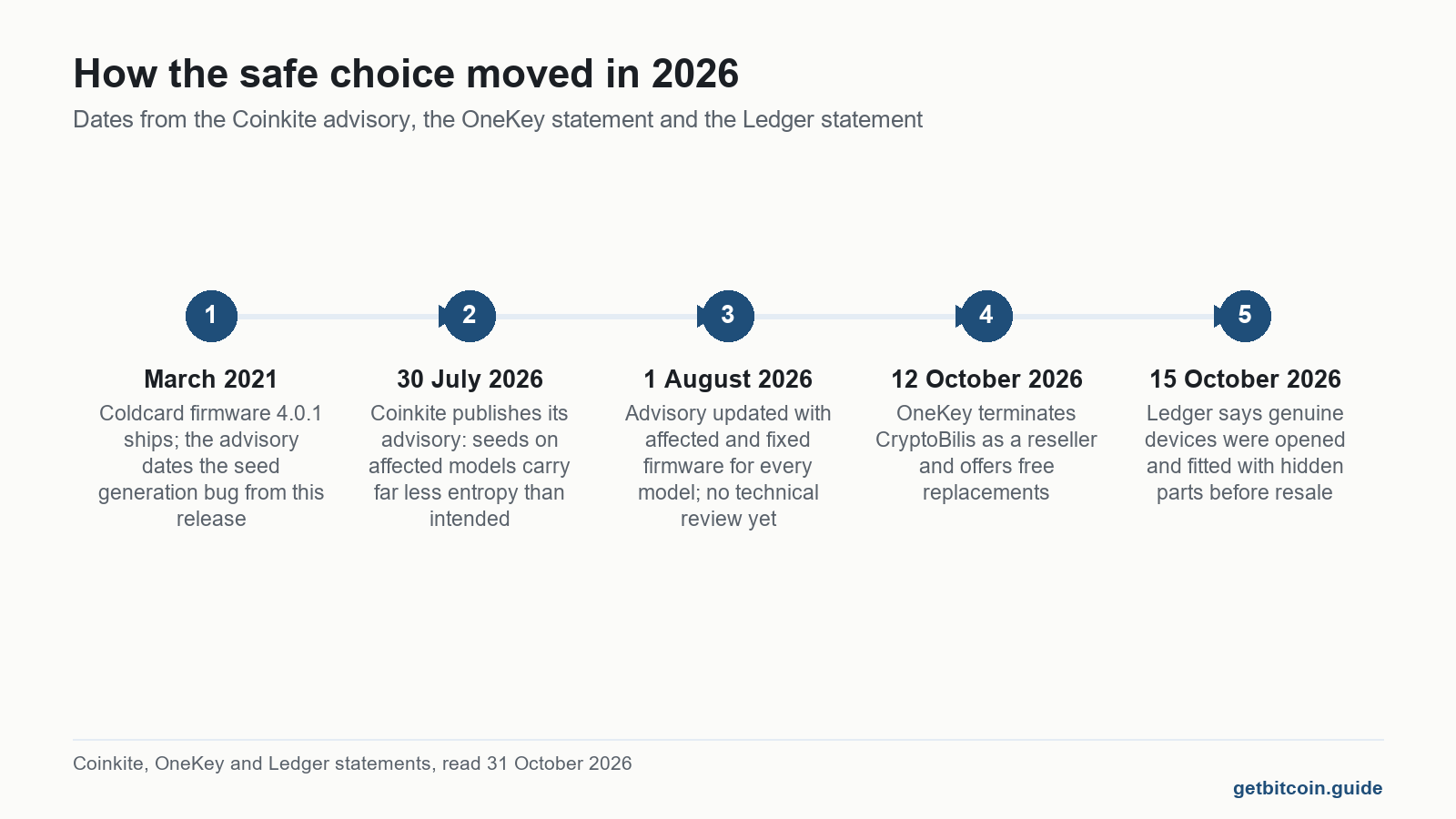
In July 2026 an attacker began draining bitcoin from Coldcard hardware wallets. Not by stealing devices, and not by tricking anyone. Coinkite, the manufacturer, disclosed in an advisory first published on 30 July 2026 and updated on 1 August 2026 that a firmware bug in releases going back to version 4.0.1 of March 2021 had weakened seed generation. The advisory calls it an RNG issue and promises a formal technical review, which had not appeared when this page was re-read on 31 October 2026, so the advisory’s own short description is still the only public account of the mechanism.
Seeds that should have carried 128 bits of entropy carried about 72 on affected Mk4, Mk5 and Q devices, and the advisory calls the Mk2 and Mk3 case, firmware 4.0.1 through 4.1.9, the most severe. That is the difference between a number nobody can guess and a number somebody eventually can. The fixed releases are 4.2.0 for the Mk2 and Mk3, 5.6.0 for the Mk4 and Mk5, 1.5.0Q for the Q, and 6.6.0X or 6.6.0QX on the Edge track, and Coinkite warns that a higher Edge number does not by itself mean a fixed one. Loss tallies circulated widely in August 2026. The advisory gives none, and as of 11 October 2026 this page no longer repeats a figure it could not trace to a source.
Every one of those devices was doing exactly what its owner believed it was doing. The keys were offline. The seed was written on paper in a safe. The failure was in how the number was generated, five years before anyone noticed. If you hold a Coldcard, read the Coinkite security advisory and act on it rather than on this summary. Its central instruction is that updating firmware does not repair a seed that already exists: migrate to a new seed generated on fixed firmware, verify the old backup first, and send a small test transaction before the rest.
The lesson is not that hardware wallets are bad. It is that they move risk rather than removing it, and that part of the risk you take on is the manufacturer’s engineering, which you cannot inspect.
So what should you actually use
Match the tool to the amount and the behaviour, which is what experienced holders converge on regardless of what they say publicly.
| Your situation | Reasonable approach |
|---|---|
| Small amount, learning | A reputable software wallet, and treat it as a hot wallet |
| Meaningful amount, rarely moved | Hardware wallet, backup stored offline and separately |
| Active trading or applications | Software wallet for the working balance only |
| Meaningful amount, and you transact | Both, with the bulk cold and a small hot balance |
| Amount you could not afford to lose | Hardware wallet plus a genuinely tested backup plan |
That last row is the one people skip. A backup you have never tested is a hypothesis, not a backup.
What are you mainly protecting against?
Pick the risk that worries you most. Each answer points to a kind of setup, not a brand and never a coin.
General information, not financial advice. Nothing here says whether to buy, sell or hold anything.
The questions that actually matter
- How much are you protecting? The answer for a few hundred is not the answer for a life changing sum, and pretending otherwise is how people either overcomplicate or underprotect.
- How often will you move it? Friction is a security feature for storage and a liability for spending. That is why one wallet rarely serves both.
- Who else could get to it? Household, workplace, anyone who knows what you hold. Physical risk is real and underweighted.
- What happens if you are hit by a bus? Unpleasant and necessary. A backup only you can find is a backup that dies with you.
- Can you actually execute the recovery? If you cannot restore from your backup onto a different device, you do not have a backup.
What to check before you buy anything
Wallet comparisons obsess over supported coins and ignore the things that actually determine whether you still have your funds in five years. The first question below is the most misunderstood, and what an open source label does and does not prove about a wallet is worth reading before you give it much weight.
- Is it open source? Not a guarantee of anything, but code nobody can inspect is trust you cannot verify. The 2026 Coldcard defect sat undiscovered in shipped firmware for five years.
- Does it use a standard recovery format? If the wallet uses BIP39, the common seed phrase standard, you can recover into a different brand later. If it uses something proprietary, you are locked to one company staying in business.
- Does it have its own screen? For a hardware wallet this is close to the whole product. Verifying the address on the device is what defeats address swapping malware.
- Who is behind it, and how long have they been there? Abandoned wallets are a real problem. Software stops being updated, then stops working on current operating systems, and your recovery options narrow.
- Can you add your own entropy? A niche feature until July 2026. The Coinkite advisory says seeds made with at least 50 independent, private dice rolls are not considered at risk from that bug alone, which made a fiddly option look rather less fiddly.
Before you put funds on a new wallet
Every item comes from the sections on this page. Tick what you have actually done.
Nobody legitimate will ever ask for your recovery phrase. Never type it into any website or app to check it.
Does it matter where you buy a hardware wallet?
For years the standard line was that the maker’s own store and an authorised reseller were equally safe places to buy. Comparison sites repeated it so often that it started to sound like a law of physics. October 2026 broke the second half of that sentence.
In a statement published on 15 October 2026, Ledger said a criminal group bought genuine devices, opened them and fitted hidden components “designed to capture the recovery phrase during setup”, then put them back into distribution through resellers in South East Asia. Ledger says there was no flaw in its chip, operating system or servers, and it asked its authorised resellers and distributors in South East Asia and Hong Kong to suspend sales. It gives no loss figure. The dollar totals in the press come from onchain analysts, not from Ledger, and this page does not repeat them.
The reseller at the centre of the reports, CryptoBilis, sold more than one brand. OneKey said in a statement updated 12 October 2026 that it had terminated CryptoBilis as an authorised reseller, stopped onboarding new resellers and would re-vet the rest. It offers a free replacement for a OneKey device of any model bought from CryptoBilis from 1 March 2026, claimed by 31 December 2026 with proof of purchase.
An implant like this cannot be spotted by looking at the box or the seal, which is why the device’s route to you is now part of the security model rather than a shopping detail. Buy from the manufacturer’s own store where it ships to you. If you already own a device from a reseller named in a vendor statement, read that vendor’s statement for your model before you set it up or keep funds on it. Any device that arrives with a recovery phrase already printed, filled in or supplied on a card is compromised: do not use it.
When one wallet is not enough
Above a certain amount, single signature custody starts to look uncomfortable, because one lost backup or one compromised device is total loss. Multisignature spreads that. What it costs one person to run properly, in devices, time and recovery drills, is worked through in what a 2 of 3 multisig really costs a single holder.
The idea is straightforward: several keys exist and a transaction needs some subset of them to be valid, for example two of three. Lose one key and you can still spend. An attacker who finds one key cannot.
The cost is complexity, and complexity is not free. Multisig setups fail in their own ways, usually because the owner did not fully understand the recovery process and could not execute it under pressure years later. It is a reasonable answer for large holdings and a poor answer for someone who has not yet mastered a single backup. The other way of splitting a key is to hand one share to a company, which is the trade a wallet with no seed phrase asks you to make and which changes what recovery depends on.
A rule that has aged well: do not adopt a setup you could not confidently recover from, alone, at two in the morning, eighteen months from now, without looking anything up. Sophistication that exceeds your understanding is a liability rather than protection.
What has changed since this was first published?
Security facts go stale quietly, so this page is rechecked on the weekly refresh and the entries below record what moved, when, and against which source.
- 11 October 2026: the Coldcard account corrected to match the Coinkite advisory as updated 1 August 2026. It describes a firmware bug and an RNG issue, not a build configuration error, and it names affected and fixed firmware by version for every model. Those versions are now on this page.
- 11 October 2026: a loss tally of about 1,816 BTC from more than 5,200 addresses removed. It could not be traced to a source that could be checked, and the advisory itself gives no figure.
- 11 October 2026: the recovery format question now links the BIP39 specification it refers to.
- 31 October 2026: the Coinkite advisory re-read. Its visible update is still dated 1 August 2026 and the promised formal technical review has still not been published. The dice roll line now gives the advisory’s own 50 roll threshold in place of a looser claim.
- 31 October 2026: a section on where to buy a hardware wallet added after the reseller implant case, sourced to the Ledger statement of 15 October 2026 and the OneKey statement updated 12 October 2026.
The rule that matters more than any wallet choice
Nobody legitimate will ever ask for your seed phrase. Not support, not a wallet developer, not an exchange, not an airdrop, not a person in your messages who is being unusually helpful about a problem you just posted about.
Never type it into anything. Never photograph it. Never store it in a password manager, a note, an email or cloud storage. The moment it touches an internet connected device it is exposed, and the overwhelming majority of self custody losses happen this way rather than through any technical break.
For specific wallet types, there is a review of the Nano X as a common hardware option, and separate pages on desktop software wallets, browser extension wallets and mobile wallets.
Frequently asked questions
Is a hardware wallet always the safest option?
No, and 2026 made that unusually clear. A hardware wallet removes one category of risk, remote compromise, and adds others: losing the device, losing the backup, and depending on the manufacturer getting their engineering right. The Coldcard entropy defect drained funds from devices that were never physically touched.
Do I need a wallet if my coins are on an exchange?
Not technically, because the exchange holds them. Whether you should move them is a separate question about who you want holding your keys, and it depends on how much is at stake and how comfortable you are being your own backup system.
Can I use more than one wallet?
Yes, and most people who have been doing this a while do. A common pattern is a hardware wallet for the bulk of holdings and a small software wallet for anything you actually transact with, so a compromised phone or browser cannot reach the main store.
What actually happens if I lose my seed phrase?
The funds are gone. There is no reset, no support line, no identity verification that recovers them. This is the single most important thing to understand before moving anything off an exchange, and it is why the backup plan matters more than the device.
Are free software wallets safe?
Reputable open source software wallets are used by a great many people without incident. The risk is not that the software is free, it is that it runs on an internet connected device that can be compromised. That is a reason to limit what you keep there, not to avoid them.
Should I write my seed phrase down or store it digitally?
Never digitally. Not in a password manager, not in a photo, not in a note, not in cloud storage. Anything that touches an internet connected device can be reached. Offline and physical is the only sensible answer, and no legitimate service will ever ask you for it.
Finished the page? The same five questions from the top, to see what stuck.
This article is educational and is not financial advice. Nothing here is a recommendation to buy, sell or hold anything. You are responsible for your own security decisions.
Leave a Reply