
Klever wallet is a self custody app: one 24 word phrase controls every chain in it, the keys stay on your phone, and Klever says it cannot recover them. What the listings skip is the company’s own blockchain, exploited for 486 million KLV in June 2026, and a Trezor link that no vendor page confirms.
Listen to this article, about 12 minutes. A synthetic voice reads the article and announces each section title as it begins; tables are read row by row and the questions at the end are left out.
Recorded 24 October 2026 from the article as published that day. Press a chapter to jump there; the highlighted line is what is playing. A play button sits beside every section heading, and once you scroll past this player a bar at the bottom of the screen keeps the controls in reach. Tap or click any sentence to hear the reading start from there.
On this page: every network count Klever has published read side by side on 24 October 2026, what Trezor’s Klever page really covers, the June 2026 exploit from Klever’s own incident report, and what the ten newest Trustpilot reviews say.
Think you already know this? Five questions, one minute.
Every answer is on this page. Answer from what you know now; the page fills in the rest.
-
1. What does Klever’s February 2026 support article say happens if you lose your seed phrase?
Klever’s seed phrase article says Klever cannot recover the phrase if it is lost, and that legitimate support will never ask for it. Read the section
-
2. How many networks did the App Store listing for version 5.9.13 state on 24 October 2026?
The App Store listing names Bitcoin, Ethereum, TRON, Solana, Avalanche, XRP and Klever Blockchain plus many others, with no total. Read the section
-
3. What is Trezor’s Klever page actually about?
Trezor’s Klever page describes KLV as the token of the Klever Blockchain, lists TRON as the only network and Trezor Suite as the app. Read the section
-
4. According to Klever’s incident report, how much KLV was created in the June 2026 exploit?
Klever’s Security Incident Report of 6 June 2026 puts the minted total at 486,357,300.26 KLV, from a flaw in its NFT marketplace settlement code. Read the section
-
5. After a restore, which accounts does Klever’s forum guide say come back by default?
Klever’s guide to restoring additional accounts says only the main account on each blockchain is restored by default; others are restored by hand. Read the section
Who actually holds the keys in a Klever wallet?
You do. That is the short version, and on this point Klever’s documents are consistent. The App Store listing, read on 24 October 2026, says “Your private key is stored only on your mobile device and never shared”, and warns that if you lose or share it, “your funds cannot be recovered”. The same listing also tells you the app is published by a developer called Klever Exchange, which is a slightly awkward name for a wallet whose whole pitch is that no exchange is involved.
The recovery side is spelled out in a support article Klever posted on its forum on 25 February 2026, Everything You Need to Know About Your 24 Word Seed Phrase. It says the app “generates 24-word seed phrases following the BIP39 standard”, that the phrase controls your coins “across all supported blockchains”, and that Klever “cannot recover it for you if it’s lost”. Older wallets made with 12 words still restore; Klever recommends moving to 24.
The same article says no legitimate company, Klever included, will ever ask for your seed phrase. Anyone who does, in a support chat, a direct message or a form, is trying to take your coins. Never type the phrase into a website, a chat window or a tool that asks for it.
So the threat model is the ordinary one for a non custodial wallet: the phone is the vault, and the 24 words written on paper are the spare key. If you have not thought hard about where that paper lives, our guide to keeping a recovery phrase safe is the place to start.
Before you keep coins in a multi chain app like Klever
A practical check drawn from Klever’s own documents. It never asks for your phrase and nothing you tick leaves this device.
Ticks are saved on this device only. This is a security checklist, not advice to buy, sell or hold anything.
How many blockchains does Klever Wallet support?
This sounds like the easiest question in the article. It is not. Every place Klever publishes a description of its wallet gives a different answer, and some give none at all. Here is what each one said when we read it.
| Where Klever describes the wallet | Date read | Network count stated | Chains it names |
|---|---|---|---|
| klever.io home page | 24 Oct 2026 | None | “BTC, ETH, POLYGON, BSC & more” |
| App Store listing, version 5.9.13 | 24 Oct 2026 | None | Bitcoin, Ethereum, TRON, Solana, Avalanche, XRP, Klever Blockchain “and many others” |
| Google Play listing, current text | 24 Oct 2026, search copy | None | 14, from Bitcoin to Reef and Dogecoin |
| Google Play listing, older regional copies | 24 Oct 2026, search copy | “over 30” and “over 40” | Not listed |
| Legacy K4 Wallet listing | 24 Oct 2026, search copy | 10, and 20 in another copy | Bitcoin, Ethereum, Reef, TRON, BNB, XRP, Litecoin, DigiByte, Dogecoin, Dash |
Our reading: the number marketing quotes has drifted over the years, and the current listings have quietly stopped quoting one. The honest answer is the list inside the app on your phone today, not a figure from a review. That matters for one practical reason: if you restore your 24 words in a different wallet later, it may not show every asset. Klever’s own seed phrase article warns that “not all wallets use identical derivation paths”, so check that the chains you hold are supported before you rely on a phrase as a way out.
If you mainly want one app to hold many coins, our piece on multi currency wallets covers the trade off: every extra chain is more code between you and your keys.
Can you use Klever Wallet with a Trezor?
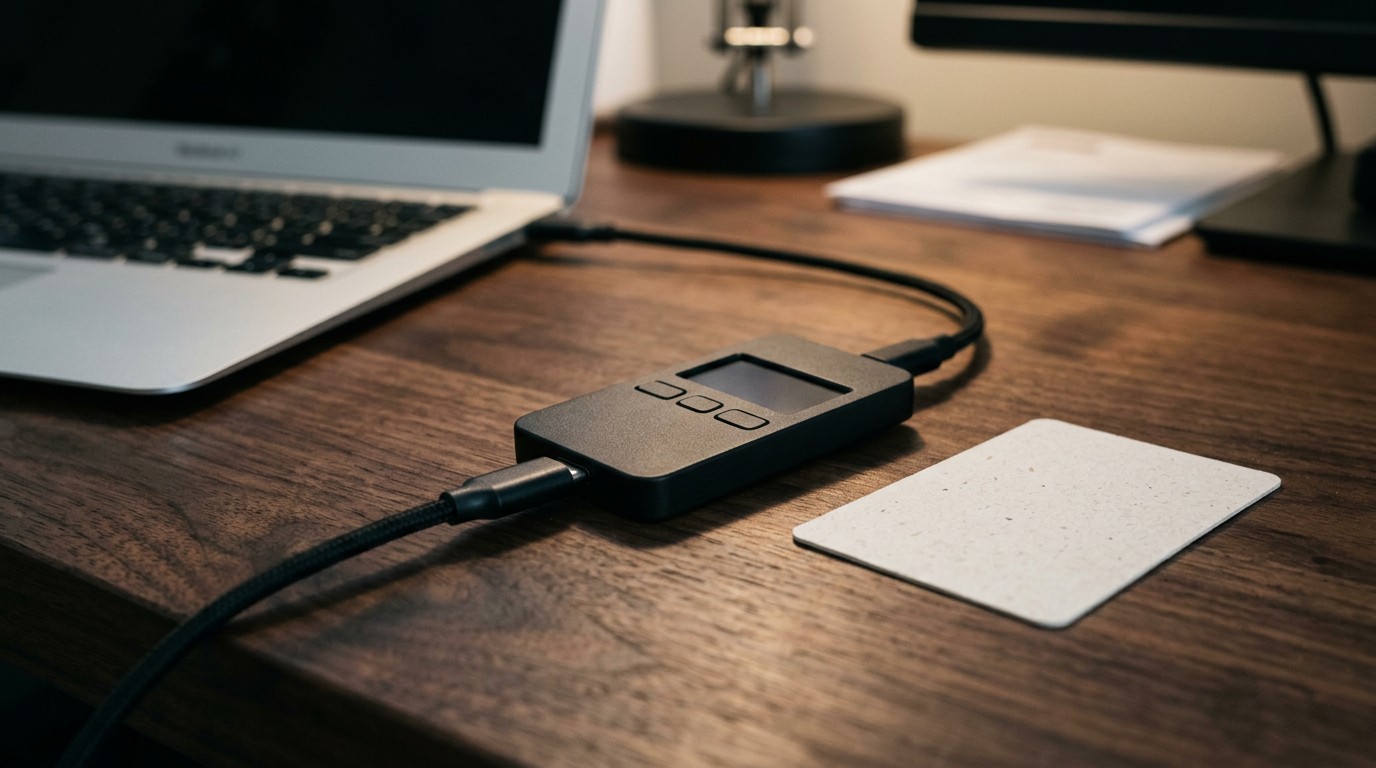
No, not on the evidence available today. Some pages that rank for this wallet imply a Trezor pairing on TRON. We went to the source. Trezor’s page titled Safe and secure Klever wallet, read on 24 October 2026, is about the KLV token, not the Klever app. It describes “Klever Coin (KLV)” as “the native utility token of the Klever Blockchain”, lists TRON as the only supported network, and names one wallet app to manage it: Trezor Suite.
Trezor’s own TRON page, read the same day, lists Trezor Suite and NuFi as the apps that work with a Trezor on TRON. Klever is not on it. And Klever’s home page does not mention Trezor at all; the hardware it promotes is its own device, KleverSafe, with the line “Waterproof for unbeatable durability”, which is a fine quality in a hardware wallet and says nothing about its security.
| Question | What the vendor page says, 24 Oct 2026 |
|---|---|
| Can the Klever app sign with a Trezor? | Not stated anywhere on trezor.io or klever.io |
| Can a Trezor hold KLV? | Yes, as a TRON token, in Trezor Suite |
| Which apps pair a Trezor on TRON? | Trezor Suite and NuFi, per trezor.io |
| Which hardware does Klever sell? | KleverSafe, its own device |
If you want a hardware device to sign for you, the difference is real. Holding KLV on a Trezor through Trezor Suite is one thing. Using the Klever app as a front end for a Trezor is another, and nothing either company published on the day says it works. Our Trezor guide covers what the device does protect.
What happened in Klever’s 2023 and 2026 security incidents?
There are two, and the affiliate reviews mention neither, which is a remarkable feat of selective reading for pages that call themselves reviews.
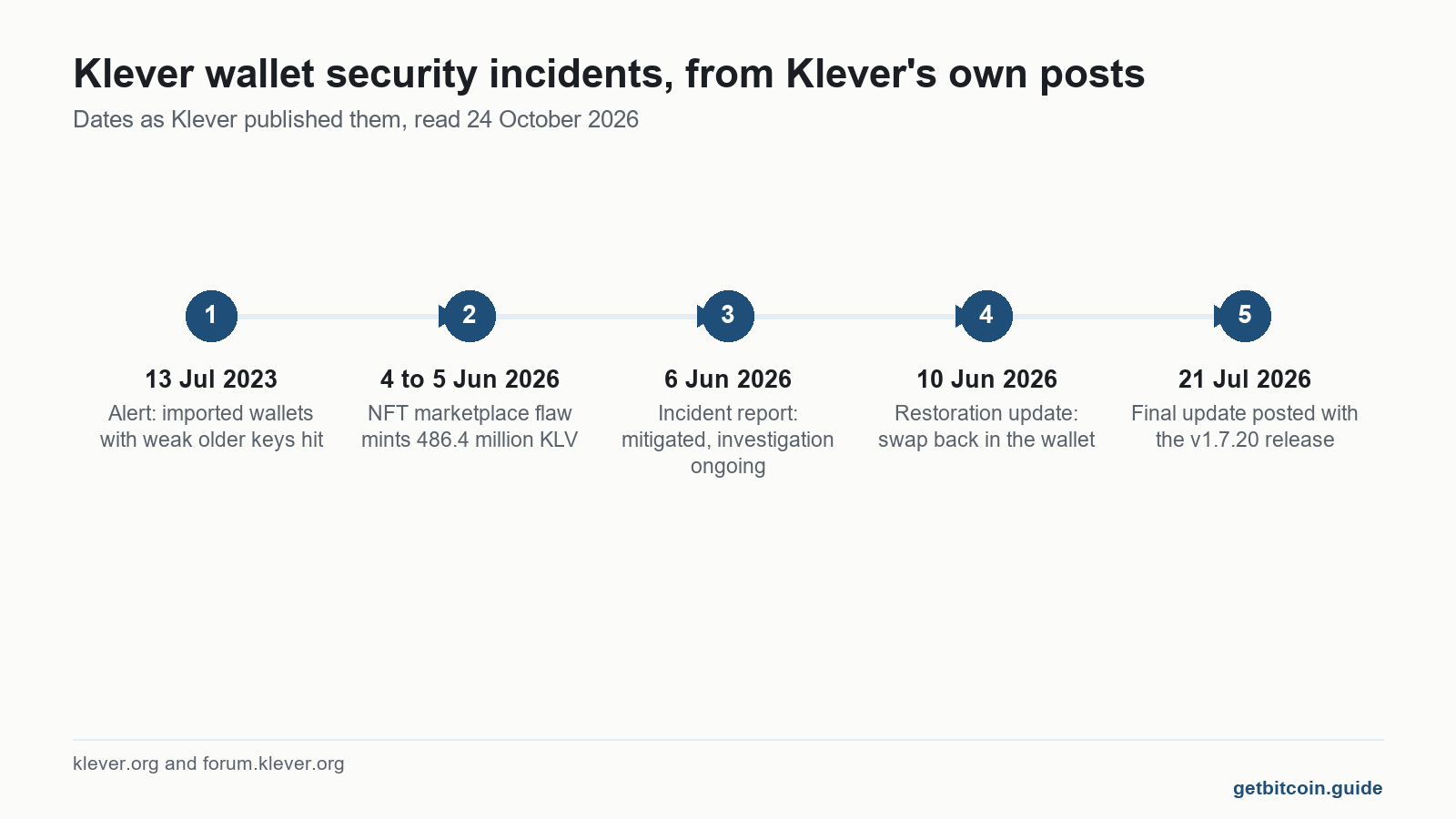
The first was in July 2023. Klever’s own security update, posted on 13 July 2023, said some wallets had been hit because of “an older algorithm used for the generation of wallet keys”, a weak random number generator in an old BIP39 implementation. The affected wallets “were created outside our Klever ecosystem” and later imported. Klever said a wallet “created from scratch in Klever Wallet K4 or K5” was not affected, and told affected users to create new wallets and move their funds. It gave no count of users or losses.
The lesson is not really about Klever. Importing a phrase into a new app does not make it safer. If the phrase was generated badly somewhere else, it stays weak wherever you take it.

The second was bigger and newer. Klever’s Security Incident Report, posted on 6 June 2026, describes an exploit window from 4 June to 5 June 2026 in which the settlement code of the NFT marketplace on Klever’s own blockchain “failed to validate” that two fee percentages could not add up to more than 100%. The attacker used it to create 486,357,300.26 KLV out of nothing. The report’s status line read “Mitigated, Investigation Ongoing”. It does not say that wallets, private keys or seed phrases were touched, and it gives users no instructions.
The repair took weeks. Klever’s restoration update of 10 June 2026 said swap was restored in the wallet and that a burn of the “unregistered” KLV was still in development, and its news forum lists a final update on the restoration and the v1.7.20 release, dated 21 July 2026. Separately, the klever-go v1.7.18 release notes on GitHub list “five coordinated-disclosure security advisories”, four rated High, all denial of service issues in the node software.
Put plainly: the keys on your phone were not the reported target. The chain and the token that sit beside the wallet were. If you only use the app to hold bitcoin, the 2026 incident mostly explains why swap was down for a while. If you hold KLV, the supply questions are still being argued on Klever’s forum.
What do Klever Wallet users report when things go wrong?
We read the ten most recent reviews on Klever’s Trustpilot page on 24 October 2026, which scored 3.0 from 97 reviews. They run from June 2024 to April 2026. Seven gave one star, three gave five. These are what people report, not findings, and none of them has been checked by anyone.
- Balances that do not show. Reviews from April 2025 and September 2025 describe deposits or balances missing in the app, and one reports being unable to withdraw.
- Purchases through the app. A January 2026 review describes a $200 purchase cancelled and refunded with no reason given, and support by email only. A July 2024 review describes a withdrawal stuck at a third party identity check.
- Coins sent somewhere else. An August 2024 reviewer says funds left their account for someone else’s, and that Klever put it down to the account being shared.
- Daily use without trouble. Three five star reviews from mid 2024. One reports more than 100 transactions with no problems; the other two praise multichain swaps and a smoother app after an upgrade.
Trustpilot notes that Klever has not replied to negative reviews recently; its replies to the older ones are all dated late January 2026. An older one star App Store review from March 2024 makes the same complaints about fees and the app working badly.
Where this meets the documentation: the missing balance complaints line up with something Klever’s forum guide on restoring additional accounts spells out. A restore brings back only the main account on each chain by default; extra accounts have to be restored by hand, and accounts imported with a private key need that key again. That is not proof every missing balance was this, but it is the first thing to check before you panic. The “sent to someone else” account is the one the guidance cannot explain away: in a self custody wallet, anyone with the phrase can spend, and nobody can reverse it.
What else sits next to the wallet in the Klever app?
Quite a lot. The home page offers buying, swapping and staking, with banners about earning “passive income”. Staking is a feature of the app, and we describe it as one. This site does not recommend staking, yield or any token, KLV included, and nothing here is a view on whether to buy anything. The app also carries KLV, the token of Klever’s own chain, and the bitcoin.me exchange sits in the same ecosystem, by Klever’s own account, which is why the June 2026 incident touched swap inside the wallet.
There is a reasonable pattern here that applies to many wallets, not just this one. The fewer of those extra screens you use, the less the company’s other businesses can affect you. Compare that with Trust Wallet, which has its own exchange in the family, or Unstoppable Wallet, which has none.
Klever’s blog has an article called Not Your Keys, Not Your Coins, which is good advice, and it is a little funny to hear it from an app whose App Store developer name ends in “Exchange”. The advice still stands. Write the 24 words on paper, keep them offline, and keep the phone updated.
Frequently asked questions
Is Klever Wallet free to download?
Yes. It is free on the App Store, Google Play and the Chrome Web Store. Swaps and purchases inside the app carry fees, and purchases go through third party providers with their own identity checks.
Does Klever Wallet use 12 or 24 words?
New wallets get 24 words, following the BIP39 standard, according to Klever’s February 2026 support article. Wallets created with 12 words still restore, and Klever suggests migrating them to 24.
Can Klever support recover my wallet?
No. Klever says it cannot recover, reset or access your seed phrase. If you lose both the phone and the written phrase, the coins cannot be recovered by anyone.
Is KleverSafe the same as Klever Wallet?
No. KleverSafe is Klever’s own hardware device, promoted on klever.io. Klever Wallet is the phone and browser app. In July 2023 Klever told users hit by that month’s key generation issue to create new wallets in K5 or on KleverSafe.
Is there a Klever Wallet browser extension?
Yes. Klever links a Chrome extension from klever.io, and its support centre has a guide to restoring a wallet in it from your recovery phrase.
Were Klever Wallet private keys stolen in June 2026?
Klever’s incident report of 6 June 2026 describes a flaw in its blockchain’s NFT marketplace that minted 486,357,300.26 KLV. It does not say that private keys or seed phrases were involved, and no source we read claimed they were.
Finished the page? The same five questions from the top, to see what stuck.
General information about wallet security, not financial advice. Theo Brandt holds no financial qualification and nothing here is a recommendation to buy, sell or hold any asset, or to use any yield, lending, staking or leverage product. Claims were verified on 24 October 2026 against the sources linked above. For your own situation, speak to a qualified professional.
Leave a Reply