
The SecuX V20 is a Bluetooth hardware wallet that, by SecuX’s own account, keeps the private key inside an Infineon secure element and sends only transaction data over an AES encrypted radio link. The documented trouble has not been the radio. On 19 October 2026 SecuX confirmed hackers had altered a banner in its phone app.
Listen to this article, about 13 minutes. A synthetic voice reads the article and announces each section title as it begins; tables are read row by row and the questions at the end are left out.
Recorded 25 October 2026 from the article as published that day. Press a chapter to jump there; the highlighted line is what is playing. A play button sits beside every section heading, and once you scroll past this player a bar at the bottom of the screen keeps the controls in reach. Tap or click any sentence to hear the reading start from there.
On this page: the V20 parts list from SecuX and Nordic with a source on every row, what crosses the Bluetooth link and what never does, SecuX’s own 19 October 2026 alert on the hacked app banner, fourteen owner accounts, and the V20 set beside the Ledger Nano X and D’CENT.
Think you already know this? Five questions, one minute.
Every answer is on this page. Answer from what you know now; the page fills in the rest.
-
1. According to SecuX’s device FAQ, what happens after five wrong PIN entries on the V20?
The SecuX device FAQ says five incorrect PIN entries reset the device to factory settings, and the recovery words are the way back. Read the section
-
2. What does SecuX say about the private key during a Bluetooth transaction?
The SecuX security FAQ says transactions are verified without the private key ever leaving the device, over a link with AES encryption and a one time password. Read the section
-
3. What did SecuX’s alert of 19 October 2026 say hackers had changed?
SecuX’s security alert of 19 October 2026 states hackers modified the banner in the SecuX App to link to fraudulent websites impersonating SecuX. Read the section
-
4. What was the SecuX Wallet rating on the App Store when read on 25 October 2026?
The SecuX Wallet App Store page showed 1.9 out of 5 from 31 ratings; 3.1 from 7 reviews was the Trustpilot profile. Read the section
-
5. Across the SecuX V20, Ledger Nano X and D’CENT incidents covered on this page, what was the cause in each case?
SecuX’s alert describes a hacked app banner; the Ledger case was a customer database and the D’CENT case its App Wallet. None came through the radio. Read the section
Every page ranking for this device is a shop or a glossary summarising the shop. None answers what the radio can actually reach. This one does, from SecuX’s own documentation checked on 25 October 2026, and then covers the week the phone app became the problem.
What is the SecuX V20 and what is inside it?
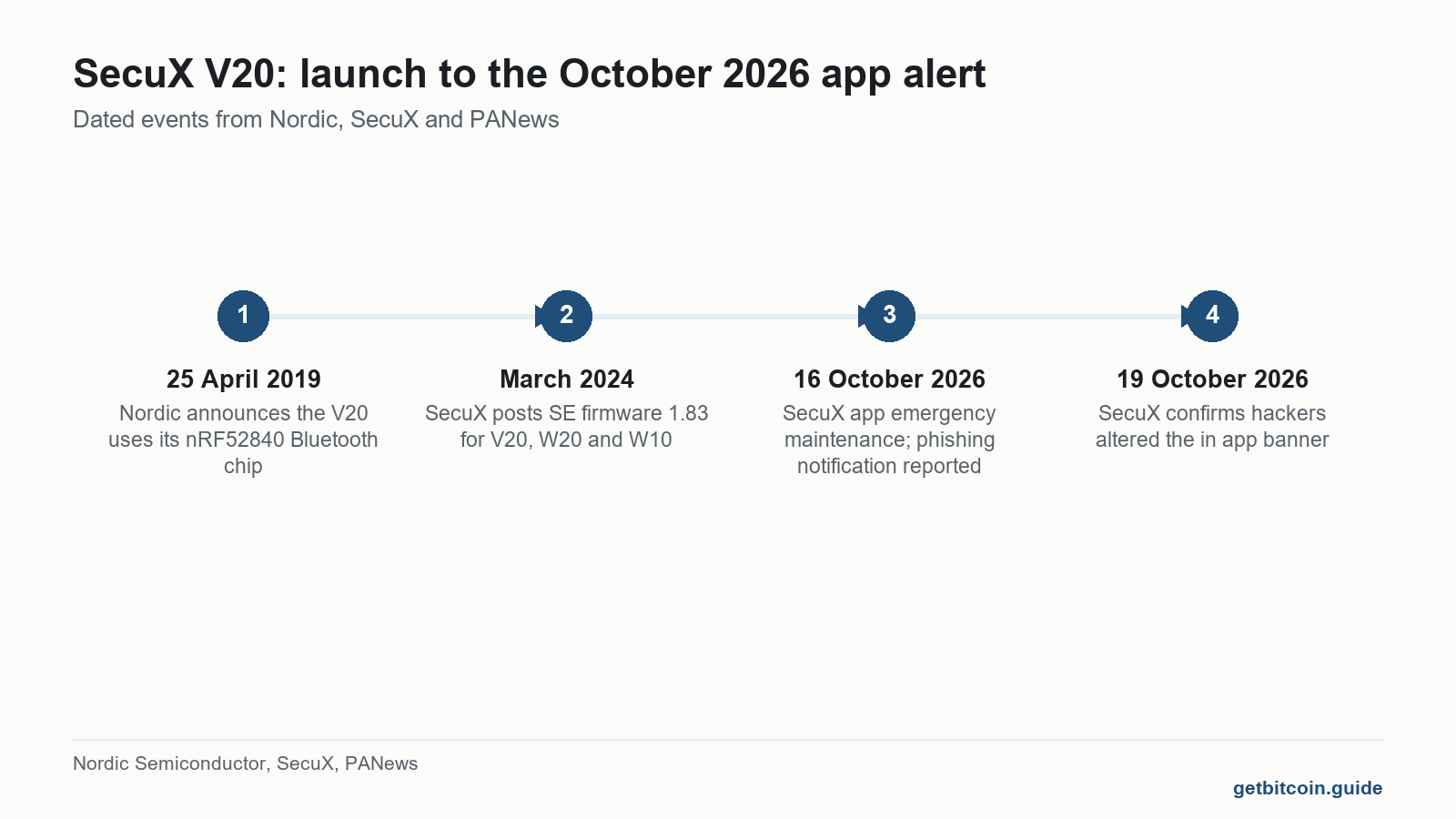
The V20 is SecuX’s round, touchscreen hardware wallet, launched in 2019. Nordic Semiconductor’s announcement of 25 April 2019 says SecuX chose its nRF52840 chip for the Bluetooth LE connection, and describes a 2.8 inch colour touchscreen and a 600mAh battery giving “up to seven hours operation between recharge”. It also connects by USB.
The keys live somewhere else. The SecuX shop listing names the secure element as an “Infineon SLE Solid Flash CC EAL 5+” chip and the wireless connection as Bluetooth 5.0, backward compatible. On 25 October 2026 the V20 XSEED bundle on that page was listed at USD 168, marked down from USD 178. Two separate chips matter here: the Nordic one runs the radio, the Infineon one holds the key.
| Part | What SecuX or Nordic says | Source |
|---|---|---|
| Secure element | Infineon SLE Solid Flash, CC EAL5+ | SecuX shop listing |
| Radio chip | Nordic nRF52840, Bluetooth LE | Nordic, 25 April 2019 |
| Radio encryption | AES, plus a one time password when connecting | SecuX security FAQ |
| Screen and battery | 2.8 inch colour touchscreen, 600mAh, up to seven hours | Nordic, 25 April 2019 |
| Wrong PIN limit | Factory reset after 5 incorrect entries | SecuX device FAQ |
| Recovery words | 12, 18 or 24 word BIP39 phrase | SecuX shop listing |
After that factory reset, SecuX’s device FAQ says the way back is to recover an existing wallet by entering your 24 recovery words in order. The device is only ever a copy. The written phrase is the wallet.
What actually passes over the SecuX V20 Bluetooth link?
Here is the honest version of how a Bluetooth signing device works, stated in SecuX’s terms. The phone app builds a transaction and sends the unsigned request across the radio. The V20 shows the details on its own screen. You approve on the device. The secure element signs, and the signed transaction goes back over the radio for the app to broadcast. The SecuX security FAQ, updated on 17 February 2024, says transactions are verified “without the private key ever leaving the device”.
Two protections sit on the link itself, again per that FAQ: Bluetooth 5 AES encryption over the data in transit, and a one time password whenever a wallet connects over Bluetooth. Nordic’s 2019 announcement adds that the nRF52840 carries an Arm CryptoCell 310 module and an AES 128 bit hardware accelerator. What neither source publishes is the pairing protocol in detail, and no independent audit of the V20 Bluetooth stack could be found on 25 October 2026. That is a gap, and it is worth naming rather than smoothing over.
| Item | Crosses the radio? | Why |
|---|---|---|
| The unsigned transaction you are asked to approve | Yes | It is how a signing device works |
| The signed transaction coming back | Yes | The app broadcasts it |
| Addresses and balances shown in the app | Yes | Public information |
| The private key | No | SecuX security FAQ |
| The PIN | No | Entered on the V20 touchscreen |
| The recovery phrase | No, unless you type it into something | It lives on paper |

Notice where the risk actually lives in that table. Someone listening to the radio gets, at worst, encrypted transaction data that is going to be public on the blockchain within minutes anyway. Someone who tampers with the request still has to get past your eyes on the V20 screen, which is the entire point of a device with its own display. The part of the system that can show you anything it likes is the phone app. Which brings us to October.
Read the address on the device screen before you approve, every time. The app screen is not the check.
What happened to the SecuX app in October 2026?
On 16 October 2026 SecuX told users its app was undergoing a major system upgrade and emergency maintenance, and later the same day said services had returned to normal, as PANews reported on 17 October 2026. That evening Ripple’s David Schwartz said the SecuX Android app had pushed him a notification linking to a page that asked for a 12 or 24 word recovery phrase. PANews also reported users still unable to reach their wallets on 17 October.
Then SecuX said what had happened, in part. Its security alert of 19 October 2026 states that hackers modified the banner in the SecuX App to link to fraudulent websites impersonating SecuX, which claimed wallets faced “critical security vulnerabilities” or needed “immediate wallet verification”. The alert names no fake domains and does not explain how the banner was changed.
SecuX’s instruction for anyone who entered a phrase on one of those pages is to treat the wallet as compromised, stop using that recovery phrase, and move the assets to a newly created wallet with a new recovery phrase. The alert also says SecuX will never ask for the phrase, including for wallet verification, security updates or firmware upgrades.
No firmware advisory for the V20 came with it. The newest V20 firmware note on SecuX’s announcements page on 25 October 2026 was the March 2024 post on SE firmware 1.83, adding Stellar support. No later V20 changelog could be found.

What do SecuX V20 owners report about the app and the device?
The accounts are thin and lopsided, and that is itself information. Fourteen were read across three platforms. The pattern is consistent: people complain about the software and rarely about the device.
- App Store, SecuX Wallet: rated 1.9 out of 5 from 31 ratings when read on 25 October 2026. Of the ten newest reviews, nine are complaints. A July 2025 reviewer reports the app freezing and closing after the hardware wallet confirmed a transaction. An October 2025 reviewer describes the app stuck on the splash screen through reinstalls. A December 2025 reviewer says the device is good but the app will not open reliably. The one positive review, dated 14 January with no year shown, reports no problems at all.
- Trustpilot, secuxtech.com profile: seven reviews, 3.1 out of 5, none in the last twelve months. The only one about using a device, from September 2024 and not naming the model, found operation awkward and the battery quick to drain. Several of the one star reviews from 2021 and 2022 read as adverts for fund recovery services rather than accounts of a product.
- Bitcointalk, a thread asking whether anyone had tried a SecuX wallet, from 2022: experienced posters objected that the code cannot be verified and that you are tied to SecuX’s own software, and one disliked Bluetooth and batteries on principle. Others liked the touchscreen.
A word on those recovery service reviews, without the jokes. A service promising to get stolen crypto back for a fee is a common second scam aimed at people who have just lost money. Nobody can reverse a confirmed bitcoin transaction.
Where the accounts agree with SecuX’s documentation: nobody reports a key extracted over the radio or a secure element failing. Where they do not: the reviewers describe an app they cannot rely on to open. These are reports, not failure rates, and 31 ratings is a small sample.
How does the SecuX V20 compare with the other Bluetooth wallets?
This site has written about two other Bluetooth wallets, the Ledger Nano X and what its Bluetooth changes and the D’CENT Biometric wallet and its App Wallet incident. Set side by side, the three tell the same story about where the trouble has been.
| SecuX V20 | Ledger Nano X | D’CENT Biometric | |
|---|---|---|---|
| Key held in | Infineon secure element, per SecuX | Secure element, per our Nano X review | ST33 secure element, EAL5+, per D’CENT, via our D’CENT review |
| Radio | Bluetooth LE, Nordic nRF52840 | Bluetooth | Bluetooth |
| Approve on the device | Yes, touchscreen | Yes, buttons | Yes, fingerprint or PIN |
| Most recent documented incident | App banner altered to phishing sites, confirmed 19 October 2026 | Customer database exposed in 2020 | App Wallet keys, alert 16 September 2026 |
| Was the radio the cause? | No, per SecuX’s alert | No, it was order data | No, per D’CENT, via our D’CENT review |
Three Bluetooth wallets, three incidents, none of them through Bluetooth. That does not prove the radio safe; no published attack is not an audit. It does say where to spend your worry. The affiliate reviews spend theirs on the radio, because “Bluetooth risk” makes a good subheading and “the app got hijacked” costs them the commission.
If the radio still bothers you, the honest alternative is a device with none, such as an air gapped signer; the trade offs of that design are laid out in the SafePal air gap review, and what cold storage actually means covers why no connection is not the same as no risk.
How do you keep a SecuX V20 safe day to day?
- Treat the V20 screen as the only screen that tells the truth. Check the amount and the full address there.
- Never type the recovery phrase into a phone, a website, a form or a support chat. SecuX’s own alert says it will never ask, for any reason.
- Ignore banners, notifications and emails about “wallet verification”. Close the app and open SecuX’s site by typing the address yourself.
- Keep the phrase written down and offline; how to store a recovery phrase covers the options.
- If you use the hidden wallet feature, the passphrase is a second secret to back up; how a wallet passphrase works explains what losing it means.
And on the closed source question the 2022 posters raised: the V20 asks you to trust SecuX’s code without reading it. Whether that matters to you is a judgement this page will not make for you, though what open source firmware does and does not prove sets out the argument both ways.
Before you approve anything on a V20
Five checks that take a minute and cover what went wrong in October 2026. None of them asks for your recovery phrase, and nothing ever should.
If you ever entered the phrase on a page that asked for it, SecuX’s 19 October 2026 alert says to treat the wallet as compromised and move to a new wallet with a new phrase.
Frequently asked questions
Does the SecuX V20 work without Bluetooth?
Yes. Nordic’s 2019 announcement and SecuX’s listing both describe a USB connection alongside Bluetooth, so the V20 can be used over a cable with a computer.
Was the SecuX V20 hardware affected by the October 2026 incident?
SecuX’s alert of 19 October 2026 describes a modified banner in the SecuX App linking to phishing sites. It does not describe any fault in the V20 hardware or firmware, and no hardware advisory was found on 25 October 2026.
What happens if I forget my SecuX V20 PIN?
After five wrong attempts the device resets to factory settings, according to SecuX’s FAQ. You then restore the wallet with your recovery words. Without them, the funds cannot be recovered.
Is the SecuX V20 firmware open source?
SecuX’s pages do not describe the firmware as open source, and forum posters on Bitcointalk have criticised that the code cannot be verified. Treat it as closed unless SecuX publishes otherwise.
Can someone near me steal my coins over Bluetooth?
SecuX says the private key never leaves the secure element and the link is AES encrypted, with a one time password on connection. No published attack on the V20 radio was found, but no independent audit of it was found either.
Should I trust a SecuX support message asking me to verify my wallet?
No. SecuX states it will never ask for the recovery phrase, including for verification, security updates or firmware upgrades. Any message asking for it is a theft attempt.
Finished the page? The same five questions from the top, to see what stuck.
This article is educational and is not financial advice. Nothing here is a recommendation to buy, sell or hold anything. You are responsible for your own security decisions.
Leave a Reply