
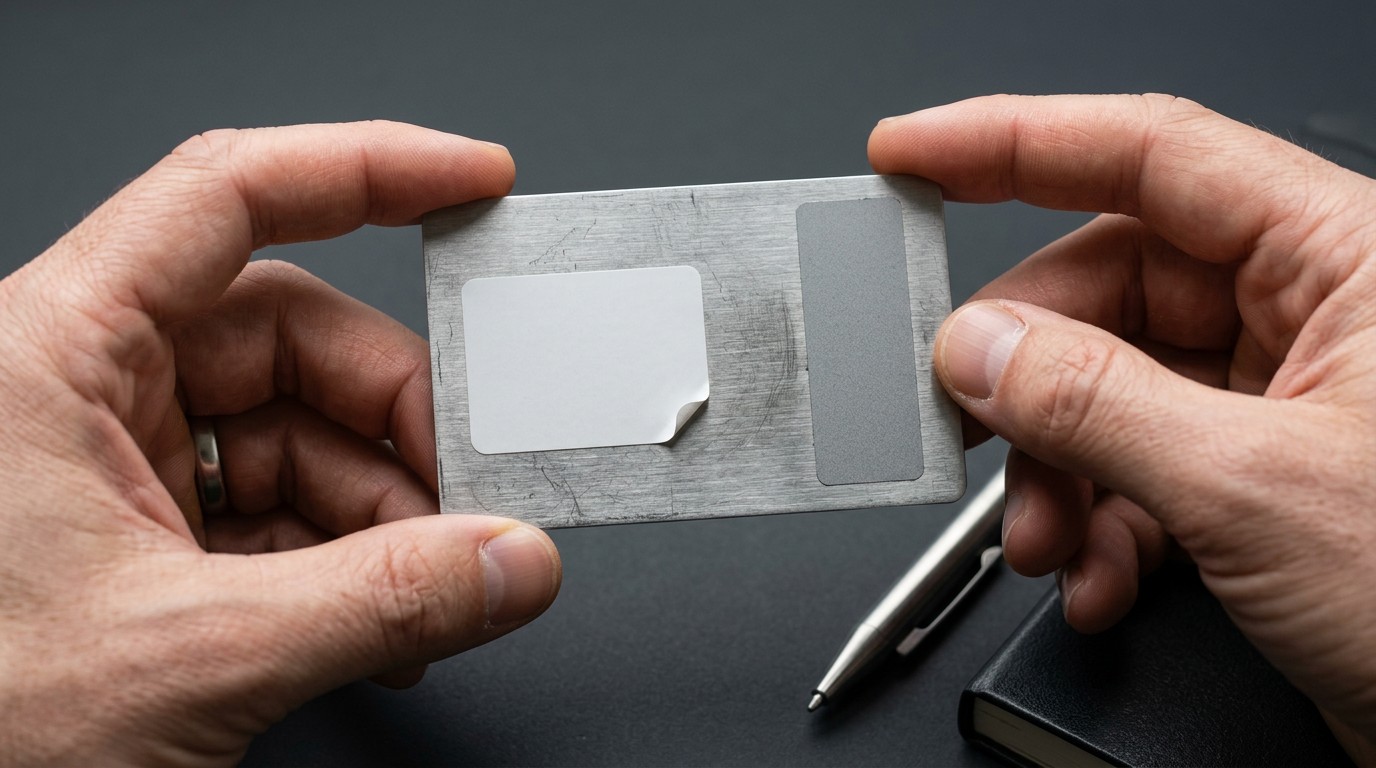
A Ballet crypto wallet is a steel card carrying a BIP38 encrypted private key under a sticker and the passphrase that decrypts it under a scratch off strip. Ballet generated both halves, the passphrase in the United States and the encrypted key in China, so the card is a trust arrangement with the maker, not a key you made.
Listen to this article, about 15 minutes. A synthetic voice reads the article and announces each section title as it begins; tables are read row by row and the questions at the end are left out.
Recorded 22 October 2026 from the article as published that day. Press a chapter to jump there; the highlighted line is what is playing. A play button sits beside every section heading, and once you scroll past this player a bar at the bottom of the screen keeps the controls in reach. Tap or click any sentence to hear the reading start from there.
On this page: what is printed where on the card and which Ballet team put it there, the two party scheme in BIP38’s own words, a trust table setting the REAL and PRO cards against a paper wallet and a hardware wallet, the send sequence from Ballet’s own guide, and what five threads of people trading sealed loaded cards report.
Think you already know this? Five questions, one minute.
Every answer is on this page. Answer from what you know now; the page fills in the rest.
-
1. Where is the passphrase on a Ballet REAL Series card?
Per the REAL Series page, the 24 character passphrase is laser etched onto the card under scratch off material, and the encrypted private key sits under the deposit address QR sticker. Read the section
-
2. In the BIP38 scheme Ballet uses, what can the printing party know?
The BIP38 specification says the printer can know the address and encrypted private key but cannot decrypt the private key without the original passphrase. Read the section
-
3. What is different about the PRO Series?
The PRO Series page says the encrypted private key can only be decrypted by the user created passphrase, and that the company cannot help reset a lost passphrase or recover the funds. Read the section
-
4. When does the full private key first exist?
Ballet’s 2FKG page says the private key is created at the moment the customer combines the two components, and that no employee can ever have access to both. Read the section
-
5. What does a hexagonal honeycomb pattern on an unpeeled sticker mean?
Ballet’s anti counterfeiting page says the pattern shows only after the sticker is peeled, so seeing it on an unpeeled sticker means the card has likely been tampered with. Read the section
Search for this product and you get a syndicated press release, a company profile, the App Store listing and a funding announcement. Not one of them has held a card, and not one explains the only question that matters: who knew your private key before you did. So this page reads Ballet’s own documentation, the open standard it is built on, and the store, all on 22 October 2026, and lays out where the trust sits. The answer is a table, not a verdict.
What is a Ballet crypto wallet and what is printed on the card?
A Ballet card is a slab of 304 stainless steel, 86 by 54 by 1.2 mm and 35 g, by the REAL Series page, which also sells a 24K gold plated edition it calls functionally identical. There are no electronics. Nothing to charge, nothing to update, nothing to pair. The official store on 22 October 2026 listed a single standard card at $49, a two pack at $79.90, a three pack at $99.90 and the gold editions at $299. The front names one primary coin; the homepage says the card supports 1,000 plus coins and NFTs and that users are securing one billion dollars plus with its products, which is the company’s own count and nobody else’s. This page names no coin as a choice.
Everything that matters is on the back. Here is what is printed where, and which Ballet team put it there, from the 2FKG page and the company’s blog post of 7 December 2022 on the two halves.
| What | Where on the card | Who produced it | What it is for |
|---|---|---|---|
| Deposit address as a QR code | Top layer of the sticker, always visible | Ballet’s printing team in China | Receiving coins and checking the balance in the app |
| Encrypted private key, 58 characters starting 6P | Bottom layer of the sticker, under the address | Ballet’s printing team in China, from an intermediate code | Useless on its own; needs the passphrase |
| Passphrase, 24 characters, laser etched | Under a lottery style scratch off strip | Ballet’s US facility, on an air gapped computer | Decrypts the encrypted key when you spend |
| Serial number, in three styles | Black on white, black on yellow, laser engraved | Ballet’s US facility | Matching all three is the first authenticity check |
| BIP38 confirmation code | Generated in China, sent to the US; engraved on the PRO Series only | Ballet’s printing team | Lets the passphrase holder confirm the address matches it |
Read the third column again. The passphrase came from one Ballet team and the encrypted key from another, which is the whole design, and the whole question. A paper wallet you print yourself has one maker. This card has two, and both work for the same company.
How does Ballet two factor key generation split the key?
The scheme is not Ballet’s invention; it is the EC multiplication mode of BIP38, a Bitcoin improvement proposal from November 2012 written for exactly this situation. Its motivation section is about physical bitcoins, and it says the quiet part plainly: a physical bitcoin that cannot be compromised by its issuer is always more intrinsically valuable than one that can. The proposal names two parties. The owner picks a passphrase and derives from it a 72 character intermediate code beginning with the word passphrase. The printer takes that code and produces an address and an encrypted key, and, in the specification’s words, cannot decrypt the private key without the original passphrase. A 75 character confirmation code starting cfrm38 lets the owner check that the address really depends on their passphrase.
Ballet’s 2FKG page maps its factory onto those two roles. The passphrase, the intermediate code and the serial number are generated on an offline, air gapped computer at its facility in the United States. The intermediate code travels to China, where the encrypted key and the address are produced and printed under the sticker. The page says the two components have never met or come into contact with each other, that no employees at Ballet can ever have access to both private key components, and that the private key first exists at the moment the customer combines them. Drives are wiped after printing, and random spot checks open a package, test the decryption and destroy the unit. The process is described as patent pending and applies to every product except the PRO Series.
One detail no listing mentions: the BIP38 page itself records its implementation comments as Unanimously Discourage for implementation. That is a note about wallet software adopting the standard, not a flaw in the maths, but it sits oddly beside a product page calling BIP38 the industry standard. The site’s piece on recovery phrases explains why modern wallets went a different way.
What does Ballet know about your card, and what does it not?
This is the table the ranking pages cannot publish, because every one of them is either Ballet or a listing. It sets the REAL card, the PRO card, a paper wallet and a hardware wallet against the same four questions, built from the 2FKG page, the PRO Series page and the BIP38 text, all read on 22 October 2026.
| Ballet REAL (2FKG) | Ballet PRO | Paper wallet | Hardware wallet | |
|---|---|---|---|---|
| Who generated the secret | Ballet, in two halves in two countries | You make the passphrase and the intermediate code; Ballet prints the encrypted key | You, with generator code you downloaded | The device, from its own random source |
| Who could have seen the whole key before you | Nobody, if the process ran as the page describes; the guarantee is procedural, not mathematical | Nobody: Ballet never held the passphrase, by the standard’s design | Nobody, if generated offline; the generator is the weak point | Nobody; the recovery phrase is your copy |
| What you can verify yourself | Serial, seals and the balance at the address; not that no copy exists | The engraved confirmation code proves the address depends on your passphrase | Everything, because you made it | The device attestation and a restore of the phrase on a second device |
| What a lost piece means | A lost or burnt card is the only copy; nothing rebuilds it | In Ballet’s words, the company cannot help you reset the passphrase or recover the funds | Gone | The phrase rebuilds it on any compatible device |
The second row is the honest one. For a REAL card the promise that nobody saw both halves rests on wiped drives, separated staff and an air gap, every one of which is a thing the company says it did. For a PRO card the promise rests on arithmetic, because the passphrase never left you. The PRO page says the units ship in packs of three identical cards, suffixed a, b and c, with the confirmation code engraved on each; it does not list a price, and a bitcointalk reply from February 2023 quoted about $299, which could not be confirmed on the day.
Ballet has said as much itself. In an interview published by CriptoNoticias on 27 November 2019, its communications director answered critics by separating security from trust: users have to trust that Ballet is honest about key generation and keeps no copies, and the method, he conceded, may be insufficient for an experienced Bitcoin user while suiting newcomers. That is a fairer description of the product than the press release, and it comes from the company.
What happens on the day you spend from a Ballet card?
Receiving is the easy half: scan the top QR code into the Ballet Crypto app and the balance appears, and Ballet’s authenticity page says you do not need to peel off the sticker to use the card. Spending is where the object changes. Ballet’s own send guide describes the sequence: add the card, tap Send, enter the destination, scratch the strip and type the 24 character passphrase, peel the sticker and scan the encrypted key, check the details, confirm. At that point the full private key exists for the first time, on your phone, in the app.

Three consequences follow, and the listings mention none. First, a sealed card cannot make a test transaction; the only way to prove the key works is to unseal it, which a bitcointalk thread of February 2023 pointed out at the time. Second, once scratched and peeled, the passphrase is readable by anyone who holds the card, so what was a sealed object is now a one address paper wallet with a steel finish, with the same change address question that page works through. Third, the phone is the signing device, and a phone that is compromised sees the key at the moment it is assembled, the trade this site described for the Tangem card, which also has no screen of its own.
Never type the passphrase or the encrypted key into a website, a browser extension or a support chat that offers to check, decrypt, sweep or recover them. No page that asks for either is legitimate. The only software that should ever see them is the wallet you are spending from, on a device you control.
What do people who trade loaded Ballet cards report?
There is a market the press release does not describe. Ballet cards change hands sealed, with coins on them, and the whole trade rests on one word: unpeeled. I read five public threads dated between February 2023 and October 2026, two on bitcointalk and three on Reddit, about 50 posts and comments in all. Testimony, not evidence, and no account below is a security finding.
On r/Currencytradingcards in April 2026 a seller offered unpeeled loaded cards at $100 for one holding 0.001 BTC and $75 for one holding 1 LTC; every reply was a private message. On the same subreddit in September 2026 a lot of three 0.001 BTC cards and eight 1 LTC cards, which the seller valued at $820 of coins, was asked at $800 shipped, with PayPal friends and family preferred, and marked sold two days later. On r/cryptocollectibles from 15 September 2026 a seller offered 45 of a 75 card custom Ballet run at $25 each and posted the count down: 17 left two days later, 13 by 21 September, 10 by 3 October, 5 by 15 October. One reply in that thread asked what a Ballet wallet actually is, and a month later another said they had no idea either. On bitcointalk in August 2025 a collector described owning five or six loaded cards and others who buy unloaded ones and load them themselves. The February 2023 bitcointalk thread ran to about twenty replies, nearly all calling the card a collectible that needs trust in the maker.
Where the accounts agree with Ballet’s documentation: the authenticity checks below exist for precisely this trade, and the sellers lean on them. Where they part company: Ballet’s page tells buyers to purchase exclusively from official and authorised channels, and the secondary market ignores that entirely. Two factor key generation is a promise about Ballet. It says nothing about the three previous owners of a card, and a payment sent as friends and family carries no protection if the seals turn out to have been lifted. None of the five threads reported a card that arrived empty; none reported checking the seals either.

How do you check a Ballet card has not been tampered with?
Ballet’s anti counterfeiting page, read on 22 October 2026, lists the checks, and notes that features may vary across product versions. The serial number appears three times, black on white, black on yellow and laser engraved, and all must match, before depositing. A hexagonal honeycomb pattern shows only after the sticker is peeled: if you see it on an unpeeled sticker, the card has likely been tampered with. The scratch off carries a Ballet watermark, and a strip without the Ballet wording is not to be used. The B logo on the sticker shifts colour at different angles. Rubbing the QR code releases a faint vanilla scent, which is the first security control this site has encountered that you perform with your nose. Under ultraviolet light the sticker’s text turns red and becomes fully visible.
If the sticker or the scratch off is damaged, the page’s instruction is to not use the card and to contact support. Those checks cover counterfeits and tampering. They cannot cover whether the process in the second section ran as described on the day your card was made. That is the trust the company’s own spokesman named in 2019, and it is why this card sits in a different column from a device whose key you watched being generated, as the site’s page on the safest storage setup and its guide to choosing a wallet both describe.
Before you load a Ballet card
Every item comes from Ballet’s own anti counterfeiting page or its 2FKG documentation. Tick what you have actually checked on the card in your hand, whoever you got it from.
A checklist about seals and copies, not a view on whether to hold anything on this or any other card. Ticks are saved on this device only.
Frequently asked questions
Is a Ballet crypto wallet a hardware wallet?
No. It has no chip, no battery and no firmware. It is a steel card carrying a printed BIP38 encrypted key and its passphrase, which makes it closer to a factory made paper wallet than to a signing device.
Does Ballet know my balance?
The deposit address is printed on the card by Ballet and is public on the blockchain, as every address is. Whether Ballet retains a record after printing is a matter of its stated process, which says drives are wiped; anyone who photographs the top sticker can watch the address too.
What happens if I lose the card?
Nothing rebuilds it. The encrypted key and the passphrase exist only on the card by design, and Ballet’s PRO page states that the company cannot reset a passphrase or recover funds. A lost or destroyed card means the coins at its address are unreachable.
Will Ballet ever ask for my passphrase or the code under the sticker?
No, and neither will any legitimate wallet or support service. A website, extension, email or chat asking for the passphrase or the encrypted key is a theft attempt, whatever it claims to be checking.
What is the difference between the REAL Series and the PRO Series?
On a REAL card Ballet generates both halves of the key in two locations. On a PRO card you create the passphrase and the BIP38 intermediate code yourself, Ballet prints the encrypted key and address from it, and a confirmation code engraved on the card lets you verify the match.
Can I keep using a Ballet card after I have spent from it?
The address still works, but the passphrase has been exposed by scratching and the key by peeling, so the card no longer hides anything. From then on it is a known key on a piece of steel, and anyone who has seen it can spend from it.
Finished the page? The same five questions from the top, to see what stuck.
This article is educational and is not financial advice. Nothing here is a recommendation to buy, sell or hold anything. You are responsible for your own security decisions.
Leave a Reply