
The Zengo crypto wallet replaces the seed phrase with two key shares, one generated on your phone and one on Zengo’s servers. What you personally hold is not a phrase but a recovery file sitting in your own Google Drive or iCloud. Lose that file and no support desk can restore the wallet.
Listen to this article, about 12 minutes. A synthetic voice reads the article and announces each section title as it begins; tables are read row by row and the questions at the end are left out.
Recorded 25 September 2026 from the article as published that day. Press a chapter to jump there; the highlighted line is what is playing. A play button sits beside every section heading, and once you scroll past this player a bar at the bottom of the screen keeps the controls in reach. Tap or click any sentence to hear the reading start from there.
On this page: the two key shares that replace the seed phrase, the recovery file sitting in your own cloud that you never wrote down, the escrow arrangement for the day Zengo stops existing and what its public repository showed on 17 September 2026, and what six of the twenty most recent one star reviews have in common.
Think you already know this? Five questions, one minute.
Every answer is on this page. Answer from what you know now; the page fills in the rest.
-
1. What replaces the seed phrase in a Zengo wallet?
Per Zengo’s Legacy Transfer white paper, only the Personal Share can initiate a signature, the shares never meet, and a complete private key is never assembled in normal operation. Read the section
-
2. What is the secret you are personally responsible for in a Zengo wallet?
Getting back in needs a magic link to your email, that file, and a liveness scan credited to FaceTec and checked on Zengo’s server; the secret was renamed and filed in a cloud account, not abolished. Read the section
-
3. What is Zengo’s Guaranteed Access arrangement?
The publication point is a public code repository; since Zengo was acquired by eToro on 15 April 2026, how that escrow contract survived the sale is a fair question to put to support in writing. Read the section
-
4. Under a written seed phrase, what happens to your wallet if the vendor goes bust?
Per the BIP39 specification; under the Zengo model a vendor failure is an event with a procedure attached, and procedures can change during an acquisition. Read the section
-
5. Can you export a Zengo wallet’s private key to a hardware wallet?
Per Zengo’s help centre; a key is reconstituted only in the Guaranteed Access scenario the company hopes never happens. Read the section
Checked on 17 September 2026 against Zengo’s own white paper, its help centre, its public code repositories and the reporting on its sale. The pages ranking for this search are affiliate reviews, and every one repeats the no seed phrase line straight off the press kit. None answers the follow up question: what happens to your coins if the company holding the other half of your key stops existing.
What does Zengo replace the seed phrase with?
A two of two threshold signature. When you create a wallet, two secret shares are generated independently: a Personal Share on your phone, tied to the device hardware, and a Remote Share on Zengo’s servers. Signing is a protocol run between them, and the shares never meet. Zengo’s Legacy Transfer white paper, version 1.0, August 2023, is explicit that only the Personal Share can initiate and sign a transaction, and that every signature is verified by the phone’s Secure Enclave or Trusted Execution Environment. The reference implementation is published as open source, which is more than most wallets offer.
The marketing word is keyless. The accurate word is halved, which nobody puts on a billboard and which is the more interesting claim: in normal operation a complete private key for your coins is never assembled anywhere at all.
If there is no seed phrase, what do you actually hold?
A file. This is the part the reviews skip. Your Personal Share lives on a phone, and phones get dropped in canals, so it cannot only exist there. Zengo’s answer, in section three of the same white paper, is to encrypt a copy of the Personal Share on your device, send that encrypted copy to Zengo’s server, and store the decryption key, which it calls the Recovery File, in your own personal cloud: Google Drive on Android, iCloud on iOS.
So the secret you are responsible for has not been abolished. It has been renamed, made unreadable, and filed in a cloud account you probably last thought about when it told you it was full. You never wrote it down because nobody asked you to.
Getting back in needs three things, which Zengo treats as three factors: a magic link sent to your email, the Recovery File from your cloud, and a liveness scan the white paper credits to FaceTec, checked on Zengo’s server rather than on your phone. The company notes, fairly, that even a malicious server cannot reach your Personal Share without the Recovery File it never sees. Telegram’s DeFi Account takes a third route, splitting the phrase between the vendor and Telegram so that the email backup only works from the Telegram account that set it up.
One line that is not a joke, and applies to every wallet: never type a recovery phrase or upload a recovery file into a website, an extension or a chat window because something told you to. A wallet that needs your secret in order to help you is not helping you. Zengo is not the only wallet that hands you a file instead of words either, as the TXT backup file a Guarda wallet is restored from shows, with the same rule attached by the vendor itself.

Before you rely on a Zengo recovery
Every item comes from Zengo’s own white paper and help centre, or from the accounts on this page. Tick each one you have actually done, not the ones you assume are fine.
A checklist about backups, not a view on whether to hold anything in this or any other wallet. Ticks are saved on this device only.
What happens to your coins if Zengo stops existing?
There is an answer, and it is better than most competitors manage. Zengo calls it Guaranteed Access. When you create an account, or run a recovery, you also receive an encrypted copy of the Remote Share. A master decryption key sits with an escrow provider, and a law firm acting as trustee is meant to confirm on a regular cycle that Zengo is still operating. If it is not, the key is released and published, the app detects it, decrypts the Remote Share on your device, and in the white paper’s words the user “regains full control over their now-reconstituted private key and can export it to another wallet”.
The publication point is a public code repository, and that is the one part of this you can inspect yourself today. On 17 September 2026 the repository at github.com/ZenGo-X/ZenGo held a one line readme and three empty directories named d, e and q, plus a fourth path, eddsa/d, which since 10 September 2026 contains a file named k.pem holding an RSA private key. It arrived through an ordinary pull request from inside Zengo’s own organisation rather than from a trustee, and a file of the same name was created and deleted twice in 2019. Zengo is trading normally, so a rehearsal or groundwork for Ed25519 chains is by far the likeliest reading. No note accompanies it, which is the only criticism worth making: a dead man switch is only reassuring while everyone can tell the difference between a drill and the real thing. A busier repository looks different: the open source Unstoppable Wallet app shipped three releases on its two GitHub repositories in October 2026 alone.
The bigger change is ownership. Zengo was acquired by eToro on 15 April 2026 in a deal reported at around seventy million dollars, with the wallet continuing as a standalone product. That is not a knock on eToro. It is that an escrow and trustee arrangement is a contract, contracts belong to companies, and no public document yet says in plain words how this one survived the sale. Anyone holding meaningful value in the app can fairly ask support that question in writing.
One caveat, stated straight: Zengo’s live explainer pages refuse automated requests, so the account above rests on the August 2023 white paper rather than on today’s wording. If the arrangement has changed since, it has not changed anywhere a reader can check.
How do seed phrase, MPC and multisig recovery compare?
Three custody models, three answers to the questions that matter, with the specification or vendor document cited on every row. This is the table an affiliate review will not build.
| Model | What you physically hold | If the vendor disappears | What an attacker needs | Source |
|---|---|---|---|---|
| Seed phrase wallet | Twelve or twenty four words. The words are the wallet and any compatible app rebuilds it. | Nothing changes. The words work offline, forever, with no company involved. | The words, or your device plus its PIN. | BIP39 specification |
| Zengo, two of two MPC | A Recovery File in your Google Drive or iCloud, plus your phone and your face. | An escrow release has to fire and the app has to detect it before you can rebuild a key. | Your email inbox, your cloud account, and a face scan that passes as you. | Zengo Legacy Transfer white paper |
| Multisig, for example two of three | Several keys and the wallet descriptor that records how they combine. | Nothing changes, provided you kept the descriptor. Any coordinator can be swapped out. | The threshold number of keys, so compromising one is not enough. | Bitcoin Core descriptors documentation |
The middle column is the whole argument. Under a written recovery phrase a vendor going bust is a non event, because you were never leaning on them. Under the Zengo model it is an event with a procedure attached, and procedures can be quietly changed or forgotten during an acquisition. Multisig sits closest to the phrase, at the cost of being fiddly enough that most people never set it up. Binance built a three share version of the same idea, covered in our piece on who actually holds your Binance keys. The older way of leaning on nobody was a single printed key, which removes the vendor and introduces a different trap entirely: where the leftover coins go when you spend part of a paper wallet.
What do people who have actually used Zengo report?
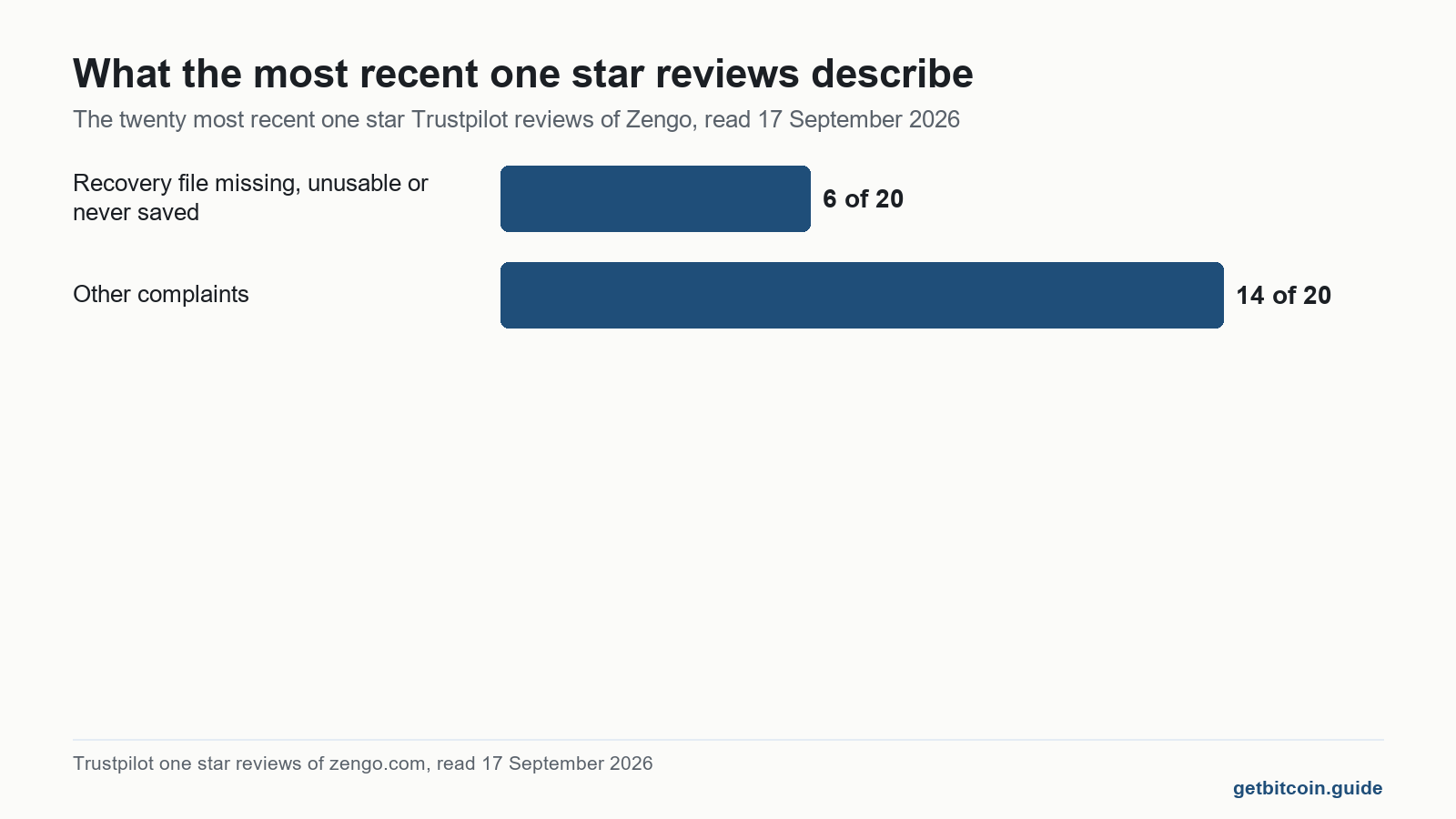
Testimony, not evidence, and labelled as such throughout. For this article we read the Zengo page on Trustpilot, where the score stands at 4.2 from 1,107 reviews with twelve per cent at one star, the twenty most recent one star reviews in full, and two threads in the small r/ZengoWallet subreddit. Six of those twenty one star reviews describe the same thing: a recovery file that was missing, unusable or never actually saved.
What people report, in their own cases and dated: a reviewer posting as Mark P on 9 September 2026 wrote that a migration failed, that support guidance led to deleting the app, and that the wallet file and the funds went with it. A reviewer posting as M Gill described roughly nine thousand dollars out of reach from 17 February 2026, saying the backup showed as created while the file itself was not there, and was still posting follow ups in June. A reviewer posting as Mr Mann wrote on 27 May 2026 about being locked out after a phone change because the backup file had not synced.
On Reddit, a user in a thread from 20 September 2025 described about two and a half thousand dollars unreachable after moving and renaming the recovery file, with support eventually saying the file supplied was not the one they needed. A second user, in a post from 11 July 2026, tested deleting an empty account and found the phone unlock code alone did it instantly and irreversibly, with neither the recovery file nor the face scan able to bring it back.
The range cuts both ways and leaving that out would be dishonest. Most reviews on that page are positive, several describe recovery onto a new phone as quick and painless, and support agents are praised by name often enough to read as genuine. The subreddit has roughly five hundred members and is restricted, so it is no neutral sample. None of this contradicts the official guidance. Zengo is right that nobody else can restore your wallet. The accounts show where that bites: the single point of failure was not removed, it was relocated into a cloud folder you did not choose and do not check. Our piece on the ways people actually lose a recovery phrase describes the same failure with different scenery.

Can you move a Zengo wallet onto a hardware wallet?
No, and this is the trade stated plainly. Zengo’s help centre says it is an MPC wallet, does not have private keys and cannot give you one, and it describes itself as genuinely keyless. There is no export, no phrase to type into a hardware device, no import into another app. Moving out means sending the coins to an address you control elsewhere and paying the network fee.
The exception runs the other way. In the Guaranteed Access scenario above, the white paper says a key is reconstituted on your device and can be exported. A Zengo private key therefore exists only in the one situation the company hopes never happens, which is an odd sentence to write about a wallet. Zengo also offers Vaults, documented as Bitcoin only, adding a time lock and a face check with withdrawals restricted to your own Zengo wallets. That is a spending control, not a second custody model. If cold storage is the alternative, start with what a cold wallet actually is.
So what does the model cost you, and what does it buy you?
It buys the removal of the most reliably exploited object in retail crypto: twenty four words that a convincing stranger can talk out of you. Nothing to phish, nothing to photograph, nothing stamped into steel for a burglar to find. Tangem chases the same goal down a different road, cloning the key onto two or three NFC cards, and what that costs a Tangem owner is a separate set of failure modes.
It costs portability and independence. You depend on a company, on its servers, on your cloud provider, on your email account, on a third party biometric check and on a file you did not choose to be responsible for. Bitget Wallet’s Google and Apple login option makes a similar trade with a cloud enclave in place of a recovery file, as our look at where Bitget Wallet keeps its keys sets out. What a wallet like this is and is not is set out in our piece on who can move your coins, and the wider trade in what self custody actually asks of you. Which column weighs more depends entirely on your circumstances, and that is a judgement no article can make for you.
Frequently asked questions
Does the Zengo crypto wallet have a seed phrase at all?
No. It uses a two of two threshold signature, so no complete private key and no recovery phrase exists in normal operation. Its white paper describes a separate escrow process that can reconstitute a key only if the company ceases to operate.
Where is the Zengo recovery file stored?
In your own personal cloud: Google Drive on Android or iCloud on iOS. Zengo holds an encrypted copy of your device share, and the recovery file is the key that decrypts it. The two live in different places on purpose, and neither party holds both.
Can Zengo staff move coins out of a wallet?
Not under the published design. Only the share on your device can initiate and sign a transaction, so the server cannot spend on its own. That is the same claim every non custodial wallet makes, and here it rests on the threshold signature scheme rather than on a promise.
Has anything changed now that eToro owns Zengo?
The wallet continues as a standalone product, reported at the time of the April 2026 deal. The open question for custody is whether the escrow and trustee arrangement behind Guaranteed Access transferred unchanged, because no public document says so in plain terms.
Is a face scan enough to protect a wallet?
It is one of three factors, not the whole lock. Access also needs your email inbox and the recovery file from your cloud. The liveness check is run by a third party vendor on the server side, and Zengo states it is not identity verification.
What is the most common way people report losing access?
Across the twenty most recent one star reviews read for this article, six described a recovery file that was missing, had not synced, or had been moved or renamed. Deleting the app or the account is also described as immediate and irreversible.
Finished the page? The same five questions from the top, to see what stuck.
This article is educational and is not financial advice. Nothing here is a recommendation to buy, sell or hold anything. You are responsible for your own security decisions.
Leave a Reply