
The best hot wallet is the one you could lose entirely without it changing anything except your mood, because that is the only test that matches how these wallets fail. Hot wallets hold keys on an internet connected device. Three mechanisms drain them: a poisoned update, a signature nobody read, and a swapped address.
Listen to this article, about 15 minutes. A synthetic voice reads the article and announces each section title as it begins; tables are read row by row and the questions at the end are left out.
Recorded 25 October 2026 from the article as published that day. Press a chapter to jump there; the highlighted line is what is playing. A play button sits beside every section heading, and once you scroll past this player a bar at the bottom of the screen keeps the controls in reach. Tap or click any sentence to hear the reading start from there.
On this page: the Trust Wallet extension incident traced through the vendor’s own advisory, a table of the three ways a hot wallet actually loses funds and what each one can reach, and why revoking approvals does nothing about a permit you have already signed.
Think you already know this? Five questions, one minute.
Every answer is on this page. Answer from what you know now; the page fills in the rest.
-
1. Trust Wallet’s own incident update says the malicious version 2.68 extension reached users by which route?
The build reached the Chrome Web Store on 24 December 2025 outside Trust Wallet’s own release process, which is why no user mistake was involved. Trust Wallet’s incident update records 2,520 affected addresses. Read the section
-
2. What does revoking in an approvals list do about a permit signature you have already signed?
ERC-2612 defines permit as an off chain signature, so no allowance exists to revoke until it is submitted on chain. Consuming the nonce, or moving the tokens out, is what invalidates it. Read the section
-
3. Which of these does this page treat as raising a hot wallet’s exposure rather than lowering it?
Blind signing is the first of the three the page names, alongside long lived unlimited approvals. Etherscan’s approvals tool is where the second one gets cleared, and it never asks for a recovery phrase. Read the section
-
4. Who publishes the best crypto hot wallets page that ranks Zengo first?
The page sits on zengo.com and ranks Zengo, Trust Wallet, MetaMask, Ledger and Casa in that order. Its stated criteria lead with multi party computation, which is Zengo’s own architecture. Read the section
-
5. Which of the four hot wallets reviewed on this site gives you no recovery phrase to hold?
Zengo splits the key material into MPC shares and never assembles a single key, so there is no phrase at all. The tradeoff is a dependence on the vendor’s infrastructure, as the Zengo review sets out. Read the section
What is a hot wallet actually exposing?
A hot wallet is one whose private keys sit on a device connected to the internet: a phone, a laptop, a browser extension. The keys are usable in one tap, which is the feature, and reachable by whatever else runs on that device, which is the bill.
Two things are exposed, not one. The key material, which in most wallets means a recovery phrase encrypted under your password or passkey. And the signing surface, which is every prompt the wallet will show you plus your willingness to approve one, because rejecting it means the thing you were trying to do does not happen.
Comparison lists measure neither, which is the whole trouble with the question. For the version that does not start from a ranking, how to choose a crypto wallet takes the long way round, and what holding your own keys does and does not protect you from sets the floor.
How do hot wallets actually lose funds?
Three mechanisms account for most of it, and the defences differ for each. Only one of the three can be undone after the fact.
One: the update channel
On 24 December 2025 an unauthorised and malicious build of the Trust Wallet browser extension, version 2.68, reached the Chrome Web Store outside the vendor’s own release process. Trust Wallet’s incident update says the code, once loaded, let the attacker access sensitive wallet data and execute transactions without authorisation. The Hacker News reported on 26 December that it walked through every stored wallet, triggered a mnemonic request, and sent the phrase to the attacker’s server once it had been decrypted with the user’s own password or passkey.
The vendor puts the damage at 2,520 addresses and roughly 8.5 million dollars traceable to 17 attacker controlled addresses, affecting people who opened the extension and logged in between 24 and 26 December 2025. The fix, version 2.69, is the clean 2.67 build rolled forward, and reimbursement is running case by case on verified ownership. Its first public figure, on 26 December, was about 7 million. The number grew as the forensics ran, which is normal and worth remembering the next time a fresh incident total arrives looking final.
Nothing the affected users did was wrong. The extension was the official one, from the official store, updating the way it was meant to. And a phrase taken this way unlocks every chain that wallet derives, native Bitcoin included. That is what separates this mechanism from the next one.
Two: the signature
On 3 January 2026 ScamSniffer reported a wallet losing about 1.08 million dollars of aEthLBTC, a tokenised Bitcoin position on Aave, to a single malicious permit signature. Not a transaction. A signature: off chain, gasless, and in most interfaces it looks like signing in. The same month, signature phishing took 6.27 million dollars from 4,741 victims, up 207 percent on December. In July 2026 another wallet lost 999,999 USDT to an approval, and the detail worth keeping is that the sweeper asked for a round million first, failed, then recalculated.
Three: the address
No key and no signature needed for this one. Check Point Research published a report on 17 June 2026 on a Rust clipboard hijacker for Windows and macOS that watches the clipboard for anything shaped like a wallet address, Bitcoin among the patterns it matches, and swaps in one of its own from a large embedded list. On 27 July 2026 a compromised Adform advertising script did the same job inside the browser, rewriting Bitcoin, Ethereum and Tron addresses on customer sites, as The Hacker News reported on 1 August 2026.

| Mechanism | What it can reach | Undoable afterwards | Dated source |
|---|---|---|---|
| Poisoned update or swapped extension | The recovery phrase, so every chain the wallet derives, native Bitcoin included | No. A new wallet, and a claim if the vendor offers one | Trust Wallet advisory, 24 to 26 Dec 2025 |
| On chain approval (approve, increaseAllowance) | One token’s balance up to the allowance, on one chain | Yes, by revoking the allowance | Etherscan token approvals documentation |
| Off chain permit signature | One token’s balance, with no on chain trace beforehand | No, not by revoking. See the next section | ScamSniffer, reported 3 Jan 2026 |
| Clipboard or script address swap | The single payment you are about to send | No. The transaction you signed was valid | Check Point Research, 17 Jun 2026 |
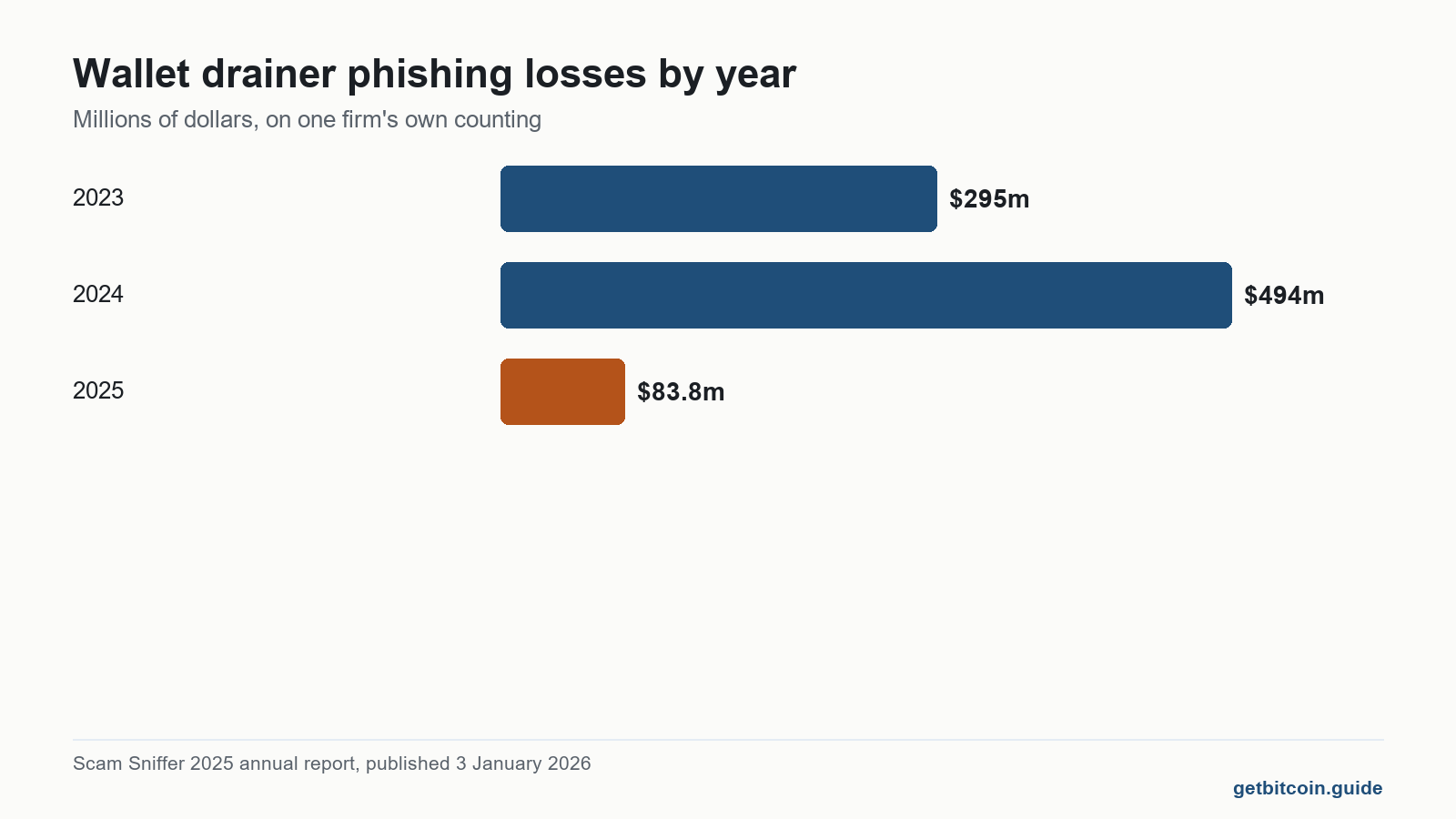
On scale, two respectable counts disagree by a factor of eight. ScamSniffer’s 2025 report, published 3 January 2026, records 83.85 million dollars lost to wallet drainer phishing across 106,106 victims, down 83 percent from 494 million in 2024 and against 295 million in 2023. CertiK’s Hack3D report, released 23 December 2025, counts 248 phishing incidents and 722.9 million dollars for the same year. Both firms are serious, and they are not counting the same thing: one tracks drainer phishing it detects on chain, the other uses a broader category that swallows large single victim cases. Quote either figure as the number for crypto phishing and you are quoting a methodology. CertiK adds the detail that matters most to the section above: phishing had the highest incident count of 2025, and supply chain attacks beat it on money lost.
The direction deserves an honest read too. Losses fell hard in 2025, and the quarter they peaked, the third at 31.04 million, was the quarter of the year’s strongest rally. Exposure tracks how much you are doing on chain, not which wallet you picked off a list.
Does revoking approvals undo a signature you already gave?
Here is where the most repeated piece of hot wallet advice quietly stops being true.
Revoking works on on chain approvals. Etherscan’s token approvals tool lists every contract allowed to spend a given address’s tokens, shows an at risk amount for each, and puts a Revoke button beside it. You search an address, then connect a wallet to revoke. It never asks for a recovery phrase. Nothing legitimate ever will, and any page that does is an attack.
A permit is a different animal, and the difference is written into the standard. ERC-2612, final since 2020, defines permit as an off chain signature. The allowance does not exist until somebody submits it on chain by calling permit, so until then there is nothing in your approvals list to revoke. The spec’s replay protection is a nonce mapping that increments by one on each permit, which means a signature referencing a spent nonce is dead.
So the remedies for a permit you have already signed are not the ones the listicles print:
- Consume the nonce, by signing and submitting a fresh permit for the same token and owner, which invalidates the outstanding one
- Move the tokens out of that address, so the allowance has nothing left to spend
- Wait out the deadline field in the signature, if the site you signed on set one anywhere close
Meanwhile the approvals list shows nothing at all, and feels exactly like a clean bill of health. That gap is not academic: ScamSniffer puts the largest single phishing theft of 2025 at 6.5 million dollars in September, in stETH and aEthWBTC, through a permit signature. Tokenised Bitcoin again, and again nothing an approvals check would have flagged in advance.
How much belongs in a hot wallet at all?
This is the question the ranking lists swap out for an easier one. No figure is named here, and nothing on this page is advice about your money.
What can be said is structural. A hot wallet’s job is spending and using things, so its balance is a working balance, and the honest test of one is whether losing all of it in an afternoon would change anything except your mood. If it would, that is not a working balance. It is savings parked in a spending account.
Three features raise exposure rather than lowering it, whatever the comparison table says:
- Blind signing, meaning any prompt that does not say in a plain sentence what it will do. A prompt you cannot read is a reason to stop, not a step to get past
- Long lived unlimited approvals, left in place from an application you used once three years ago
- Anything that pays you to leave the balance where it is, which is the commonest route by which a working balance quietly becomes a life savings
The arrangement that actually moves the exposure is splitting the interface from the keys: keep the extension as the thing you click and put the keys on a hardware device, which is what the MetaMask page argues for above pocket money. What cold storage is actually for covers the other half of that arrangement.

Before you leave a balance in a hot wallet
Six things that are checkable rather than a matter of opinion. None of them is advice about how much to hold.
Ticks are saved on this device only.
Why does every best hot wallet list look the same?
Because on this query the list is the product.
Search the phrase and you get exchange blogs, comparison sites and, high up, wallet vendors. Zengo publishes a page titled Best Crypto Hot Wallets for Individuals and Businesses. It ranks five: Zengo, then Trust Wallet, MetaMask, Ledger and Casa. Zengo is first. Zengo also sells Zengo. Read on 26 September 2026, and the keyword research behind this article, run in September 2026, recorded that page inside the top three results for the query.
This is not fraud, and the page is not even wrong about multi party computation. But its stated criteria lead with MPC, the architecture of the wallet that wrote the page, and a ranking whose first criterion is its author’s own design has settled the result before the comparison starts.
The other tell is the scoring. Chains supported, swap routing, staking, NFT display, fiat on ramp: each one a convenience, several of them widening the signing surface, none of them a security property. A wallet supporting 100 chains also supports 100 chains’ worth of contract prompts you might one day approve. It is a ranking of convenience wearing a ranking of security’s clothes, and the affiliate link at the foot of the page explains the wardrobe.
Star ratings deserve the same scepticism, in both directions. Trust Wallet’s support arm sits at 1.1 out of 5 across 953 Trustpilot reviews, checked on 26 September 2026. Yet not one review on the page covering 26 December 2025 to 8 February 2026 mentions the extension incident. Review volume measures the support queue, not the security model.
Which hot wallet suits which job?
Four of the wallets reviewed here are hot wallets, and they are not competing for one slot. The honest comparison is by job, not by coin count.
| Wallet | Where the keys live | A phrase you hold | Best treated as |
|---|---|---|---|
| MetaMask | Browser extension and phone | Yes, twelve words | An interface for applications, ideally with a hardware device behind it |
| Trust Wallet | Phone and browser extension | Yes | A mobile spending wallet. Extension users should be on 2.69 or later |
| Exodus | Desktop and phone | Yes | A desktop wallet for holding a working balance and sending from it |
| Zengo | Split MPC shares, no single key assembled | No phrase at all | A wallet for people who rate losing a phrase above depending on a vendor |
That last row is the tradeoff worth sitting with, and it runs both ways. Removing the phrase removes every failure mode a recovery phrase brings with it, and adds a dependence on one vendor’s infrastructure staying available and honest. Which of those you would rather carry is a security judgement about your own threat model, not a financial one, and this page will not make it for you. If the answer is that most of it should not be in a hot wallet at all, the storage options compared end to end is the next page.
Which of these wallets fits the job you have
Pick the job, not the coin. Each answer points at this site’s own review of the wallet, and none of them is a recommendation to buy, sell or hold anything.
Nothing here is financial advice, and no answer depends on which coin you hold.
What has changed since this was first published?
This page was published on 26 September 2026 and rechecked on 25 October 2026. Nothing above needed correcting. One new campaign belongs beside the update channel, and it is worth a line of its own because it attacks the moment people feel safest: setting up a fresh wallet.
- October 2026: Socket’s threat research team reported 16 malicious Firefox extensions dressed up as the Rabby and OKX wallets. They capture a recovery phrase or private key during the wallet import step and send it to attacker run Cloudflare Workers. Mozilla had unpublished them by 5 October 2026.
- The difference from the Trust Wallet case: these were never the official extension. They were lookalikes in the official store, so the defence is installing only from the link on the wallet vendor’s own website, not from a store search.
- Socket’s wider Firefox research found 40 malicious extensions active between March and August 2026, some of which began as harmless utilities and became wallet stealers through a later update. An extension is only as trustworthy as its most recent version.
- If a real phrase was typed into one of them, changing the extension password does not help, because the phrase itself has already left the device. Socket’s advice is a new wallet created on a clean device, with the funds moved to it.
Importing a phrase into a new extension is exactly the step this campaign waited for, which is why where MetaMask actually keeps its Secret Recovery Phrase and what the 12 words will not restore is worth reading before you import one anywhere.
Frequently asked questions
Is a hot wallet safe for Bitcoin specifically?
Bitcoin has no token approvals, so the permit and approval mechanism does not apply to native BTC at all. The other two do. A clipboard swap works on Bitcoin addresses, which is one of the patterns the Check Point report lists, and a recovery phrase taken from a compromised wallet unlocks the Bitcoin accounts it derives just as easily as the tokens. So the signature risk is narrower for Bitcoin and the key material risk is identical.
Does a hardware wallet make approvals safe?
It helps and it does not solve it. A hardware device forces a second look on a screen the compromised computer does not control, which defeats a swapped address well. A permit signed on a hardware device is still a valid permit, and if the device shows the payload as a hash rather than a plain sentence you are still signing blind. The protection comes from the prompt being readable, not from the device being separate.
Were the Trust Wallet extension victims reimbursed?
Trust Wallet said on 26 December 2025 that it would refund affected users, and its community update describes reimbursement as an ongoing process with eligibility confirmed by forensic investigation and funds sent to a newly created wallet tied to each claim. That is the vendor’s stated process. Whether individual claims have been paid is not something this page can confirm.
How often is it worth reviewing token approvals?
There is no official interval. The practical trigger is behavioural rather than calendar based: after using any application you had not used before, and before leaving a balance in an address for a stretch. The at risk column in Etherscan’s tool makes the sorting easy, because the approvals worth clearing first are the ones with something behind them.
Does supporting more chains make a wallet riskier?
It widens the signing surface, which is not the same as being badly built. Each additional chain brings its own contract standards, its own prompt formats and its own set of applications asking for approvals. A wallet supporting a hundred chains is not a hundred times more dangerous, but it does give you more chances to approve something you did not read, and chain count is the number the ranking pages weight most heavily.
What is the difference between approve, increaseAllowance and permit?
The first two are on chain transactions that set or raise an allowance, cost gas, appear in your history and can be revoked from an approvals list. Permit, defined in ERC-2612, is a signed message that costs nothing and stays off chain until somebody submits it, which is why it leaves no trace to find and no allowance to revoke until it has already been used.
Finished the page? The same five questions from the top, to see what stuck.
This article is educational and is not financial advice. Nothing here is a recommendation to buy, sell or hold anything. You are responsible for your own security decisions.
Leave a Reply