
The wallet Coinbase, Kraken and Robinhood each ship is self custody: you hold the keys and the company cannot recover them. The balance sitting in their main exchange apps is custodial, held by the firm. Same brand, opposite custody, and the app name tells you nothing.
Listen to this article, about 12 minutes. A synthetic voice reads the article and announces each section title as it begins; tables are read row by row and the questions at the end are left out.
Recorded 25 October 2026 from the article as published that day. Press a chapter to jump there; the highlighted line is what is playing. A play button sits beside every section heading, and once you scroll past this player a bar at the bottom of the screen keeps the controls in reach. Tap or click any sentence to hear the reading start from there.
On this page: a table of eight apps from four brands showing who holds the keys in each, read from the vendors’ own documentation on 28 September 2026, the two separate Robinhood legal entities behind one logo, and four dated forum accounts of people who mixed the two products up.
Think you already know this? Five questions, one minute.
Every answer is on this page. Answer from what you know now; the page fills in the rest.
-
1. Of the four self custody wallets in the table, which one gives you no recovery phrase at all?
Gemini Wallet launched on 14 August 2025 with passkey based onboarding and no recovery phrase. Coinbase Wallet, Kraken Wallet and Robinhood Wallet all hand you a phrase to keep. Read the section
-
2. According to Robinhood’s own documentation, which company operates Robinhood Wallet?
The Robinhood Wallet FAQ names Robinhood Non-Custodial, Ltd as the operator and states that Robinhood Crypto is not involved with or responsible for Robinhood Wallet activity. Read the section
-
3. When Coinbase renamed the app to Base App in July 2025 and back again in September 2026, what happened to its custody model?
The Block reported the reversal on 10 September 2026, quoting Coinbase’s Ryan Kass saying the wallet remains self custodial with users retaining their own keys. Read the section
-
4. In the bitcointalk thread dated 27 March 2024, what had the poster done?
The thread from 27 March 2024 records a wrapped Ether transfer to the exchange account, where the token was unsupported. It is one person’s account of what happened to them, not a measured rate. Read the section
-
5. Which of these is the reliable test of whether you hold the keys?
A custodian can reset you back in because it holds the keys. Self custody has no reset, which is why Kraken states it cannot recover the phrase or the backup password. Read the section
Which of these apps actually holds your keys?
Four of the biggest names in the business now sell two products with almost the same name. There is the exchange account, where the firm holds the coins, and there is the self custody wallet, where you do. The same logo goes on both, which is how a reader ends up certain they own their keys because the icon on their phone says the right word.
Here is what each vendor says about its own products, read on 28 September 2026. The links go to the vendor documentation rather than to a review site, because in this category every ranking page earns a commission on what it is describing.
| App | Who holds the private keys | What you are given to back up | Can the company restore access? |
|---|---|---|---|
| Coinbase (main app) | Coinbase | Nothing. An account login | Yes, through account recovery |
| Coinbase Wallet | You | A 12 word recovery phrase | No |
| Kraken (exchange) | Kraken | Nothing. An account login | Yes, through account recovery |
| Kraken Wallet | You | A recovery phrase or an encrypted cloud backup | No |
| Robinhood Crypto account | Robinhood Crypto, LLC | Nothing. An account login | Yes, through account recovery |
| Robinhood Wallet | You | A secret recovery phrase | No |
| Gemini (exchange) | Gemini | Nothing. An account login | Yes, through account recovery |
| Gemini Wallet | You | A passkey on your device, no phrase at all | No |
The right hand column is the one that matters, and the one nobody reads until the day they need it. Coinbase states it never has access to your Wallet recovery phrase and so cannot move funds on your behalf. Kraken states it cannot recover either the phrase or the backup password. Robinhood states that if you lose the secret recovery phrase, support cannot help, because it never has your keys. Those are not disclaimers a lawyer bolted on. They are the product working correctly.
If the whole custodial and non custodial split is new, the mechanics of who can move your coins is the piece to read first, and the same confusion on a different brand is covered in what your Binance balance actually is.
Why does one company run two opposite custody models?
The cleanest answer sits in Robinhood’s own support pages, and it is not a marketing sentence. Robinhood Wallet is operated by Robinhood Non-Custodial, Ltd. The crypto balance in the main Robinhood app is provided by Robinhood Crypto, LLC. Those are two different legal entities, and Robinhood’s documentation says plainly that Robinhood Crypto is not involved with or responsible for Robinhood Wallet activity.
That is the whole article in one line. The brand is a logo; the custodian is a company with a registration number, and here it is not even the same company. Support for one cannot reach into the other, which is exactly what you want from self custody and exactly what surprises people at the worst moment. Robinhood’s FAQ, reread on 25 October 2026, still names both entities and still says support cannot recover a lost secret recovery phrase, because the company never has access to the keys.
Kraken separates them differently: there is no tie at all. Its FAQ says you can create or import a wallet without a Kraken account, and an account is needed only for features that connect back to the exchange. Coinbase keeps both under one roof and draws the same line, which is why the site has a whole article on which Coinbase product actually has a seed phrase. Blockchain.com runs the same split inside a single app rather than two, and which Blockchain.com balances you actually hold the keys to walks through it balance by balance.
None of this is a judgement about the companies. It is a statement about where the risk sits. Custodial risk is the firm: solvency, a freeze, an account review. Self custody risk is you: a phrase on a photograph, a phrase never written down, a phrase typed into a website that asked nicely.
What happened when Coinbase Wallet became the Base App?
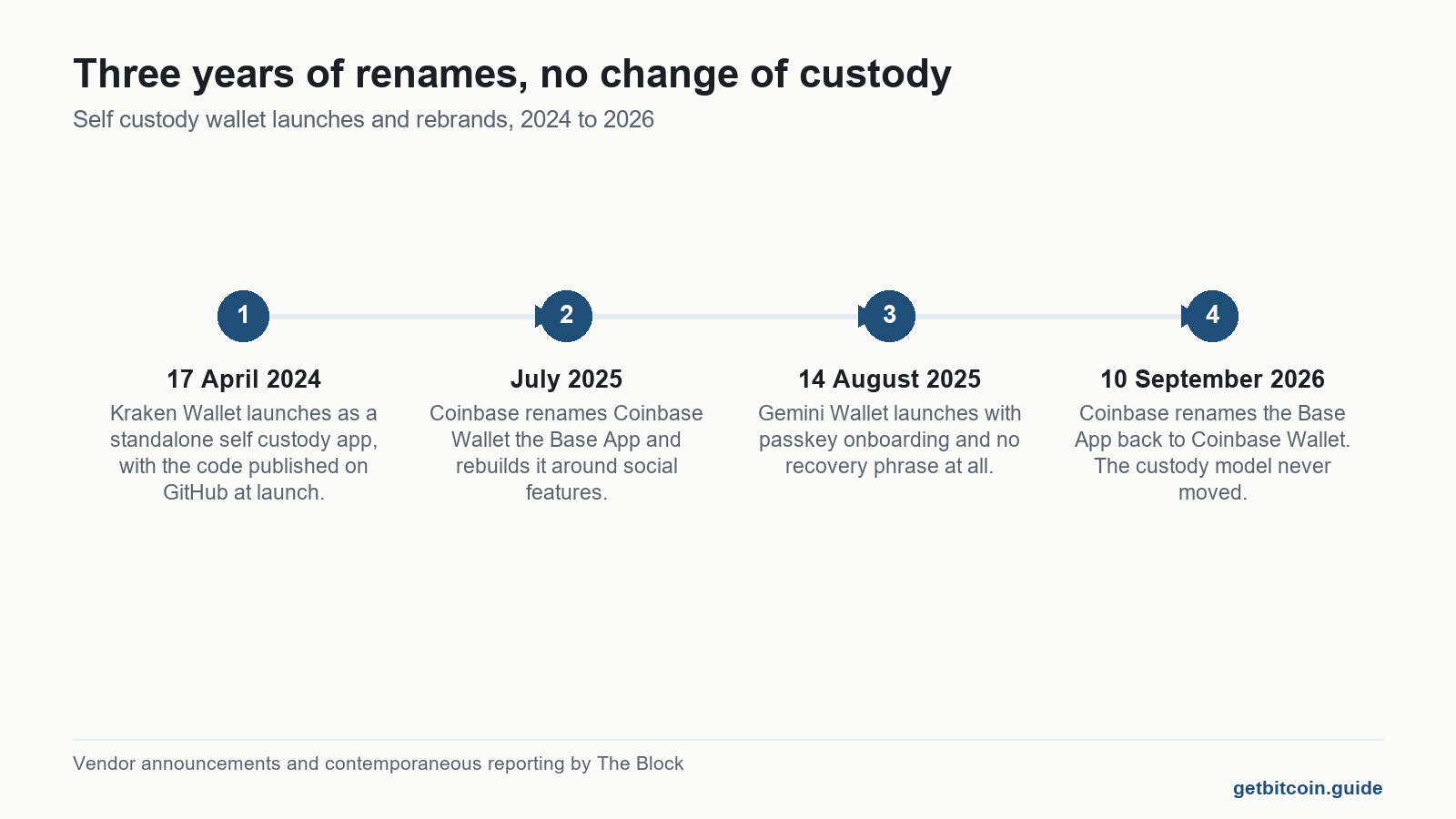
This is where the name test falls apart completely. In July 2025 Coinbase renamed Coinbase Wallet the Base App and rebuilt it around social features. On 10 September 2026 it renamed it back. The Block reported the reversal on the day, with Coinbase’s Ryan Kass quoted saying the wallet remains self custodial and users retain their own keys.
So the app changed its name twice in fourteen months, changed its stated purpose from an everything app to a trading app, and did not change its custody model once. Anyone using the name to work out who held their keys was wrong for a year and right again by accident.
The old name carried a second confusion that still catches people reading older guides. Base is also Coinbase’s layer two network, so the Base App sounded like a gateway to one chain rather than a wallet. Guides written between July 2025 and September 2026 describe an app that no longer carries that name. Their custody advice is still correct. The name on the screenshot is not.

What do people who confused the two actually report?
Vendor pages tell you the company cannot recover your phrase. Public forum threads show what that sentence looks like from the other end. These are accounts people posted about themselves, which makes them testimony and not evidence. Four dated threads on bitcointalk were read for this section, and the range ran from one scare that turned out to be nothing to three where the phrase was the entire story.
- On 27 March 2024 a poster using the name jsn999 described sending one wrapped Ether from the self custody side to the Coinbase exchange side and being told the token was unsupported there. A reply two days later pointed at another case where 29 of the same token were never recovered. Two products, one brand, and only one of them could receive that asset.
- On 8 February 2021 a poster using the name dadbody00 reported taking the save for later option at wallet setup, never writing the phrase down, then being locked out after an iPhone update with a figure they put at 15,000 to 20,000 dollars in the wallet. The thread went quiet on 16 February 2021 with nothing resolved.
- On 13 November 2020 a poster using the name JeffreyC described uninstalling the app without having saved the 12 words. Every reply said the same thing: there is no route back without the phrase.
- The counter example: on 11 June 2023 a poster using the name NIrish found a balance showing short in Coinbase Wallet, and signing out and back in the next day showed the full amount. Not every missing balance is a lost balance, and panic is a poor first move.
Where the accounts agree with the official guidance, they agree completely: every vendor page in the table says the company cannot recover the phrase, and every one of these threads is that sentence being tested. They diverge in emphasis. The vendor pages present writing the phrase down as one setup step among several. The accounts show people skipping it, often through an option the app itself offered, and finding out months later. The site’s piece on the ways people lose a recovery phrase goes through those routes one at a time.
Two honest limits. All four accounts come from one platform, because the review sites this normally draws on were unreachable today. And the two worst outcomes are from 2020 and 2021, which is old. That age is itself the finding: the failure has been reported the same way for years.
What do open source and no seed phrase actually change?
Two of these four reach the same custody position by a different route, and both routes are sold as reassurance.
Kraken Wallet launched on 17 April 2024, and Kraken published the app’s code on GitHub at launch. That is more than most of this category offers, and it is worth being precise about what it buys. Published code can be read and audited. It is not proof that the binary you installed from an app store was built from it, and it is not an audit that somebody actually did. The site’s article on what being able to read the code actually proves is entirely about that gap. The repository itself would not load for this article on 28 September 2026, so nothing here rests on what it currently says.
Gemini Wallet went the other way. It launched on 14 August 2025 with passkey based onboarding and no recovery phrase at all, separate from the Gemini exchange. A passkey is a cryptographic key held by your device and unlocked with a fingerprint, a face or a device PIN, so what you look after stops being a piece of paper and becomes a device and whatever syncs it. That raises the same questions the site put to a wallet with no seed phrase: what do you actually hold, and what happens to recovery if the company stops existing.
Neither open source nor a missing seed phrase changes who the custodian is. Both change what you have to look after, which is a different question and the one worth asking before you move anything.
How do you check which side of the line you are on?
Three checks settle it, and none of them require trusting a review site or a logo.
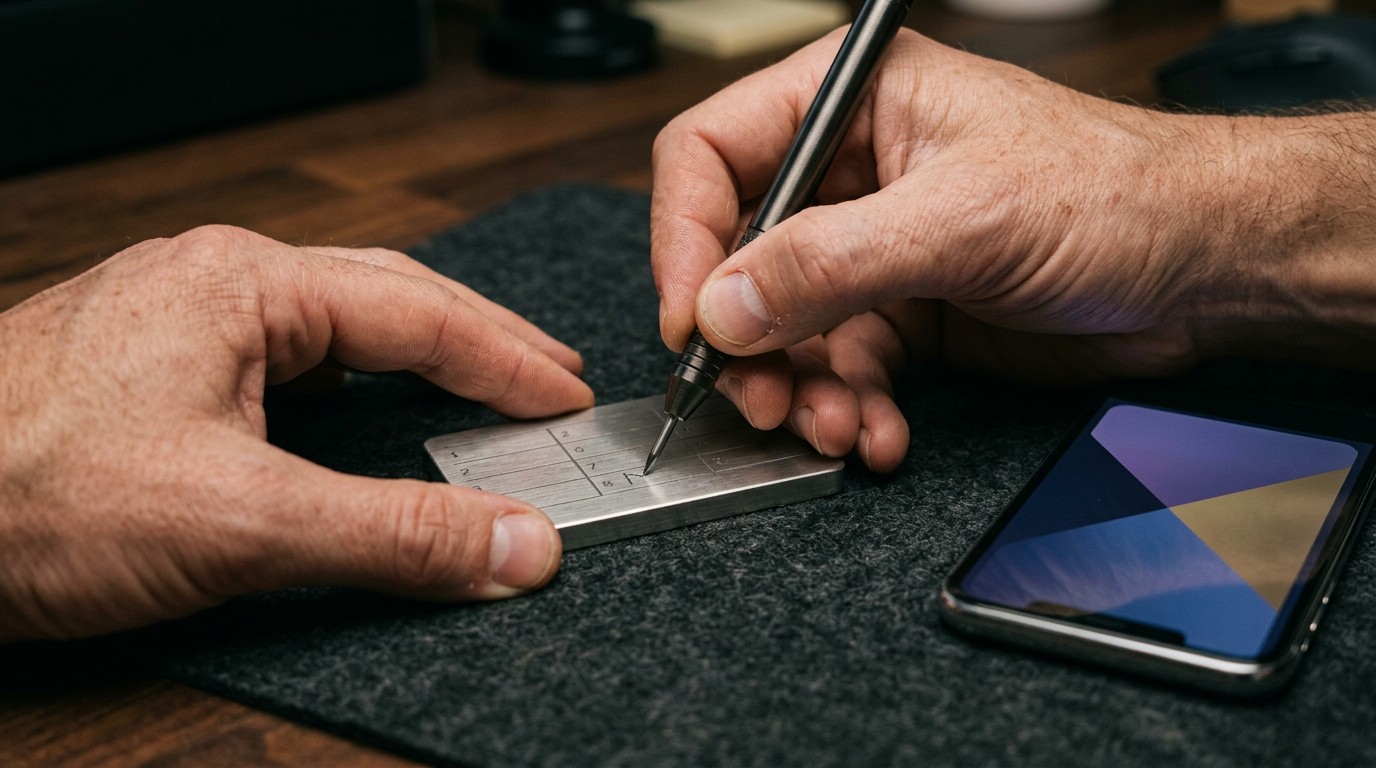
- Does the app ever show you something only you hold, a recovery phrase or a passkey prompt? If the only credentials in play are an email address and a password, the firm is the custodian.
- Is there a password reset? A custodian can let you back in because it holds the keys. Self custody has no reset, and that absence is the feature.
- Read the legal entity in the app’s own terms rather than the name on the icon. Robinhood Non-Custodial, Ltd and Robinhood Crypto, LLC are different companies wearing the same feather.
One rule holds across all eight rows of that table, and it is the only instruction in this article that is not a judgement call. Never type a recovery phrase into a web page, a support chat, a form or an app that did not generate it. None of these vendors will ever ask for it, and Robinhood says so in its own security guidance. Anything that asks is taking your coins, and the request will arrive looking like help.
Which one holds my keys?
Pick the app you actually have open. Each answer restates what that vendor says in its own documentation, read on 28 September 2026. Nothing here asks for a recovery phrase, and nothing here is advice about what to hold.
No vendor will ever ask you to type a recovery phrase into a web page, a form or a chat. Anything that asks is taking your coins.
Frequently asked questions
Is Coinbase Wallet the same app as the Coinbase app?
No. They are separate products with separate custody. The main Coinbase app holds your coins for you and can restore your access through account recovery. Coinbase Wallet is self custody, generates a 12 word recovery phrase that only you hold, and Coinbase states it never has access to that phrase.
Do I need a Kraken account to use Kraken Wallet?
No. Kraken’s own FAQ says you can create or import a wallet without a Kraken account. An eligible account is needed only for the features that connect back to the exchange, such as transferring supported assets across. The wallet works as a standalone app.
Who actually operates Robinhood Wallet?
Robinhood Non-Custodial, Ltd, which is a different legal entity from Robinhood Crypto, LLC, the provider of the crypto balance in the main Robinhood app. Robinhood’s documentation states that Robinhood Crypto is not involved with or responsible for Robinhood Wallet activity.
What happens to my coins if one of these companies shuts its wallet app down?
For the self custody wallets, the coins stay on the chain and the recovery phrase restores them in another wallet that supports the same standard, so the app closing is an inconvenience rather than a loss. For a passkey wallet with no phrase, the answer depends entirely on what the vendor lets you export, which is worth checking before you fund it. For a custodial exchange balance you are a creditor of the firm.
Does a passkey wallet mean there is nothing to back up?
It means there is no phrase to write down. There is still something to look after, which is the device holding the passkey and whatever mechanism syncs or recovers it. The work moves rather than disappearing, and the useful question is what you can export and how.
If I lose my recovery phrase, can customer support recover it?
No, for any of the self custody wallets here. Coinbase, Kraken and Robinhood all state in their own documentation that they never hold the phrase and cannot restore access without it. Anyone claiming otherwise, including a paid recovery service that asks you to enter a phrase, is a theft in progress.
Finished the page? The same five questions from the top, to see what stuck.
This article is educational and is not financial advice. Nothing here is a recommendation to buy, sell or hold anything. You are responsible for your own security decisions.
Leave a Reply