
The Ledger Flex is Ledger’s mid range signer: a 2.8 inch E Ink touchscreen, an ST33K1M5 secure element certified to CC EAL6+, Bluetooth, NFC and a Ledger Recovery Key in the box, listed at $249. Ledger Recover stays optional. The warranty excludes the battery, and your coins.
Listen to this article, about 15 minutes. A synthetic voice reads the article and announces each section title as it begins; tables are read row by row and the questions at the end are left out.
Recorded 1 November 2026 from the article as published that day. Press a chapter to jump there; the highlighted line is what is playing. A play button sits beside every section heading, and once you scroll past this player a bar at the bottom of the screen keeps the controls in reach. Tap or click any sentence to hear the reading start from there.
On this page: the Ledger Flex set against Ledger’s cheaper Nano Gen5 from both product pages on 1 October 2026, the Recover identity terms quoted at source including the four document regions it accepts, the warranty text that excludes the battery and your coins, and the three Ledger incidents separated by what each one actually reached.
Think you already know this? Five questions, one minute.
Every answer is on this page. Answer from what you know now; the page fills in the rest.
-
1. A Ledger Recovery Key now ships in the Flex box. What does it need from you to work?
Ledger’s Recovery Key page describes an NFC card that stores an encrypted, PIN protected copy of the phrase, written offline by tapping it against the device, with no subscription and no identity verification. Nothing legitimate ever asks you to type a recovery phrase into a website. Read the section
-
2. Which of these does the $179 Nano Gen5 NOT share with the $249 Flex?
The Nano Gen5 product page lists the same ST33K1M5 secure element at CC EAL6+, the same Bluetooth LE 5.2, the same NFC and the same Recovery Key in the box, at a screen of 300 by 400 behind scratch resistant glass. CoinDesk reported the launch price of $179. Read the section
-
3. Why is screen resolution the one spec on the box that is also a security spec?
Software on your computer can change an address in the clipboard, the browser and the wallet app, so the device’s own display is the last place to catch a swap. From Ledger’s comparison page, the Flex shows 480 by 600 pixels against 128 by 64 on the Nano range. The secure element is identical either way. Read the section
-
4. Ledger Recover requires identity verification. Which documents does Ledger say it accepts?
Ledger’s Recover page names exactly that list, which means the service is simply unavailable to holders whose documents come from anywhere else. The service is optional and paid, and nothing leaves the secure element unless you subscribe. Read the section
-
5. Which part of a Ledger Flex is excluded from the one year limited warranty?
Ledger’s one year limited warranty excludes “cosmetic damage or parts which are considered consumable (e.g. batteries)”, plus normal wear and tear. It also excludes loss of or damage to digital assets caused by a device malfunction, and claims must be reported within thirty days of discovering the defect. Read the section
Checked on 1 October 2026 against Ledger’s own product pages, its Recover terms, its warranty text and the reporting on its security incidents. Every page currently ranking for this search is an affiliate review, which is worth knowing before you read one, and all of them are answering a question Ledger quietly changed: the Flex is no longer the cheapest touchscreen Ledger with NFC. That matters more than anything in the box.
What is the Ledger Flex, and what is in the box?
A battery powered signing device with a touchscreen. Ledger’s own product page puts the numbers at a 2.8 inch E Ink touchscreen behind Gorilla Glass, 480 by 600 pixels in 16 shades of grey, an ST33K1M5 secure element certified to CC EAL6+, Bluetooth LE 5.2, NFC, USB type C, around ten hours of use per charge, and 57.5 grams in an aluminium frame.
The box holds the Flex, a USB-C to USB-C cable, a paper recovery sheet, the guide, and one item the older reviews predate: a Ledger Recovery Key. That is a separate NFC card that stores an encrypted, PIN protected copy of your recovery phrase, written to the card offline by tapping it against the device. No subscription, no identity check, no third party. It works only with Ledger’s touchscreen devices, which is the first honest reason to want a Flex rather than a Nano X.
The phrase itself still works the ordinary way, as our piece on the 24 word seed sets out. A card is a second copy, not a replacement for it.
How does the Ledger Flex compare with the cheaper Nano Gen5?
This is the section the affiliate reviews are missing, and the reason is not mysterious. In October 2025 Ledger announced the Nano Gen5, priced at $179, and its product page describes an E Ink touchscreen at 300 by 400 pixels, the same ST33K1M5 secure element at CC EAL6+, the same Bluetooth LE 5.2, the same NFC, and the same Ledger Recovery Key in the box. A review written before that launch cannot tell you this, and a review paid by the click has no reason to.
| Spec | Ledger Flex | Ledger Nano Gen5 |
|---|---|---|
| Price | listed at $249 | $179 at launch |
| Screen | 2.8 in E Ink touchscreen, 480 by 600, 16 greys | E Ink touchscreen, 300 by 400, monochrome |
| Front glass | Gorilla Glass, anti glare | scratch resistant glass, anti glare |
| Secure element | ST33K1M5, CC EAL6+ | ST33K1M5, CC EAL6+ |
| Bluetooth | BLE 5.2 | BLE 5.2 |
| NFC | yes, for Recovery Key and Security Key | yes, for Recovery Key and Security Key |
| Recovery Key included | yes | yes |
| Battery | about 10 hours of use | not stated on the product page |
| Weight | 57.5 g, aluminium frame | 46 g |
| Warranty | one year, battery excluded | one year, battery excluded |
Specifications read from the two product pages and Ledger’s comparison page on 1 October 2026. Ledger’s shop draws its prices in the browser, but the structured data inside each product page carries the figure, and on 1 November 2026 it read $249 for the Flex and $179 for the Nano Gen5: the same seventy dollar gap as when the Ledger Stax piece first read it on 12 September 2026. A forum thread from July 2024 was already complaining about €249, so the list price has been sitting still for a while.
Read down that table and the pattern is hard to miss. The trust boundary is identical. The radios are identical. The backup card is identical. What seventy dollars buys is a larger, denser screen, better glass, a metal frame and a published battery figure. Those are real things. They are not security things, with one exception, and the exception is the next section.
Which Ledger matches how you will actually sign?
Pick the sentence closest to how you expect to use the device. Every answer comes from the specifications Ledger publishes, not from a verdict. This tool says nothing about any coin, it never asks for a recovery phrase, and it is not a recommendation to buy anything.
Nothing is saved and nothing is sent. This matches published specifications to a stated use. It is general information, not financial advice, and says nothing about whether to buy, sell or hold anything.
What does the bigger screen actually buy you?
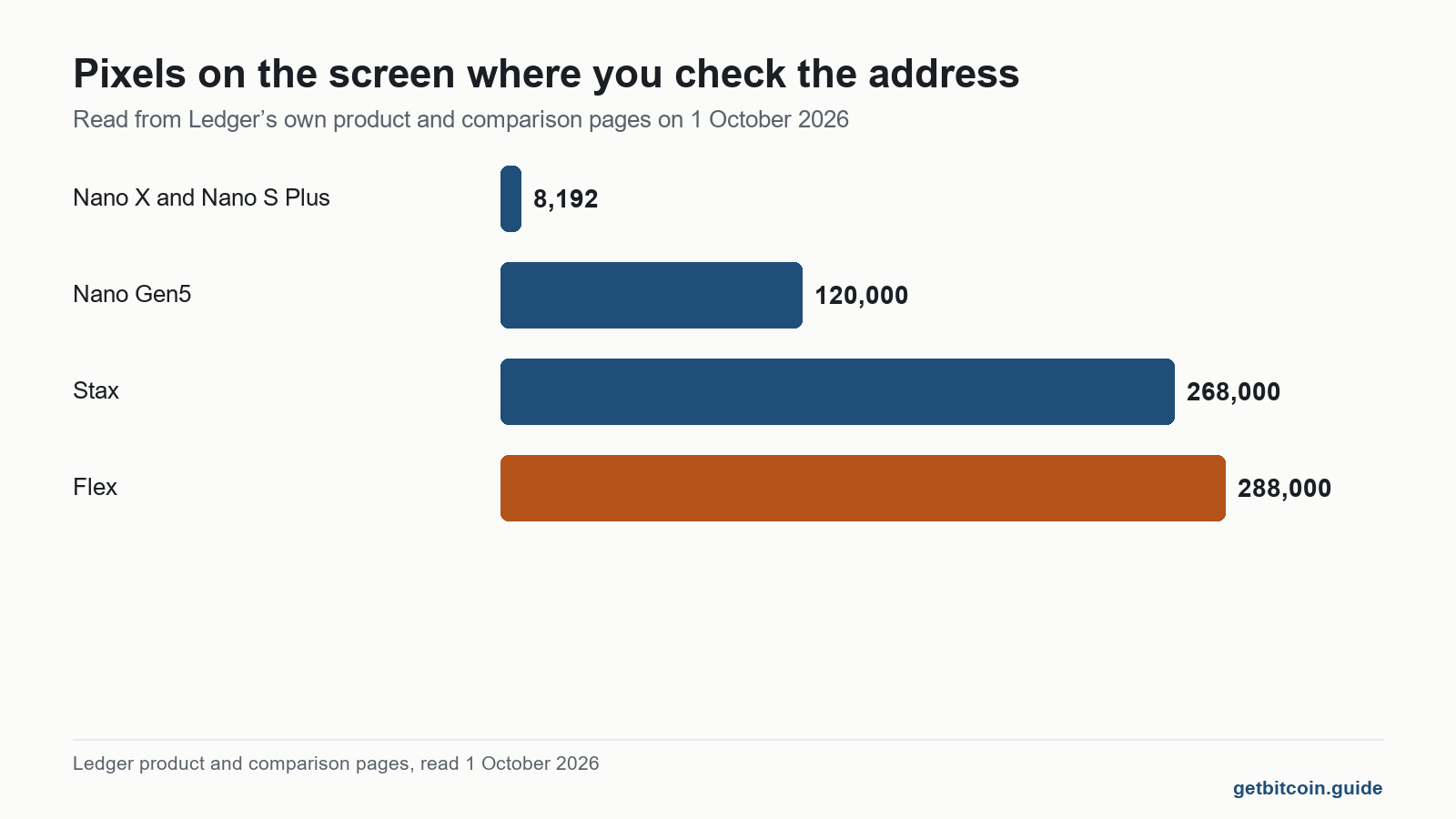
The screen is the one part of a hardware wallet an attacker cannot talk over. Malware on your laptop can rewrite the address in your clipboard, in your browser and in the wallet software, and the only place left to catch it is the device’s own display. So pixels are the one spec on the box that is also a security spec, and they are the spec the price list tracks almost exactly.
From the product pages: the Nano X and Nano S Plus give you a 128 by 64 monochrome OLED, which is 8,192 pixels. The Nano Gen5 gives you 300 by 400, which is 120,000. The Flex gives you 480 by 600, which is 288,000, and the Stax, despite the bigger diagonal, gives 400 by 670, which is 268,000. The Flex has the most pixels in the range, and on a Bitcoin address that means fewer taps between you and the end of the string you are checking.
What it does not mean is that the little ones are unsafe. A 128 by 64 screen shows a full address in chunks, and reading it in chunks is tedious rather than impossible. Our Nano S Plus piece makes the case for the cheap one on exactly those grounds. The honest summary is that the Flex makes the single most important habit in self custody less annoying, and an expensive device you check properly beats a cheap one you stopped checking.
Do read the whole address, not the first four characters and the last four. Address poisoning attacks are built specifically to defeat people who check the ends.
Does a Ledger Flex owner have to use Ledger Recover?
No. This is the question that sent the Ledger forums into orbit in 2023, so here is what Ledger’s own Recover page says, read on 1 October 2026. The service is optional and paid, provided by Coincover. If you do not subscribe, nothing leaves the device. The firmware can do it; it does not do it unless you ask, and the fact that the firmware is closed is why some people will never be satisfied with that answer. That is a fair position, and the one our Trezor and Ledger comparison takes seriously rather than waving away.
What the page does say, and what almost nobody quotes: subscribing encrypts a pre-BIP39 version of your key inside the secure element, fragments it into three pieces, and sends those to Coincover, Ledger and EscrowTech, each stored in a hardware security module, with two of the three needed to restore. Identity verification is required, and the accepted documents are narrow: a passport or national identity card issued by the EU, the UK, Canada or the US, or a Canadian or US driving licence. If your documents are from anywhere else, the service is not available to you, whatever the review you are reading implies.
It runs on Stax, Flex and Nano X through both the desktop and mobile apps, on Nano S Plus through desktop only, and not at all on the original Nano S. You cancel under Manage subscription, then Delete Ledger Recover login.
The practical point for a Flex buyer is that the Recovery Key in the box does the job most people actually wanted from Recover, offline, with no subscription and no passport. Ledger shipping the cheaper answer in the box is the most interesting thing it has done in two years, and it is not on the front of any review.
One line that is never a joke: nobody legitimate will ever ask you to type your recovery phrase into a website, an app, a support chat or a form. Not Ledger, not a wallet checker, not a recovery service. If something needs your phrase to help you, it is not helping you.
Which Ledger incidents have actually reached customers?
Three in the table below, plus a fourth from October 2026 that belongs in a different category and gets its own paragraph after it. Knowing which is which is the whole point, because the affiliate pages either skip them or present them as one undifferentiated cloud of doom. None of the three in the table extracted a seed from a device.
| Date | What happened | What was exposed | Did it reach a key? |
|---|---|---|---|
| July 2020 | Ledger’s marketing and ecommerce database was breached | around one million email addresses and roughly 272,000 records with names, postal addresses and phone numbers | No |
| December 2023 | Ledger’s Connect Kit library on npm was replaced with a wallet drainer in versions 1.1.5, 1.1.6 and 1.1.7, after a former employee was phished | at least $600,000 taken from people who approved transactions on affected websites | No, victims signed |
| January 2026 | Global-e, the ecommerce partner Ledger uses for international orders, was breached | names, emails, phone numbers, postal addresses and order data, followed within hours by phishing calls and emails | No |
The pattern is consistent and it is not reassuring in the way Ledger would like. The secure element has held. The shop, the mailing list, the ecommerce partner and a JavaScript library have not. If you buy a Flex, assume your name and address may end up on a list of people who own a hardware wallet, because twice now they have. Our Nano X review covers the 2020 breach in detail and the 24 word seed piece covers the Global-e disclosure.
What follows from that is practical. Ship to a parcel locker or a work address if you can. Treat any letter, call or email about your wallet as hostile until proven otherwise, including ones that quote your real address back at you, because that is exactly the data that leaked. Never accept a replacement device nobody asked you to expect.
The fourth is the one that changes the buying advice. On 15 October 2026 Ledger published its response to a hardware implant attack: a criminal group bought genuine devices, opened them, fitted hidden components built to capture the recovery phrase during setup, and fed them back into sale through resellers in South East Asia. Ledger says there was no flaw in its chip, operating system or servers, and it asked resellers in South East Asia and Hong Kong to suspend sales. Its statement names no reseller and gives no loss figure, so the reseller names and loss totals circulating in coverage are unverified here.
The device was genuine. The box had been opened. So the order of advice is now this: buy from Ledger directly where it ships to you, treat any reseller, authorised or not, as a link in the chain you cannot inspect, and never use a device that arrives with a recovery phrase already written down or that skips generating a fresh one in front of you. OneKey handled a reseller tampering case in the same region that month by cutting the reseller and offering free replacements, which our OneKey wallet review sets out with the dates.
What does the Ledger warranty on a Flex actually cover?
Less than you would guess from a $249 price tag, and this comes straight from the text. Ledger’s one year limited warranty, read on 1 October 2026, lists the Flex as a covered product and runs for one year from the date of original retail purchase. Two exclusions matter for a device like this one.
The first is the battery. The warranty excludes “cosmetic damage or parts which are considered consumable (e.g. batteries)”, along with normal wear and tear and damage from natural ageing. The Flex is a sealed device whose battery is the part most likely to fail first, and that part is outside the warranty from day one. The Nano S Plus has no battery at all, which quietly becomes an argument in its favour on a long enough timeline.
The second is the obvious one, and it is stated outright: the warranty excludes loss of, loss of use of, damage to or corruption of digital assets and cryptocurrency arising from a device malfunction. The device is covered. What the device protects is not. That is standard across the industry and it is the reason your backup, not your hardware, is the thing holding your coins, as our piece on the safest way to store crypto argues at length.

Claims go to Ledger Support, or for Ledger Replace customers in the US to Bolttech Device Protection Services, and must be reported within thirty days of discovering the defect. Thirty days is short. Put a note of the purchase date somewhere you will find it.
As a crude signal rather than evidence, Ledger’s Trustpilot page stood at 3.3 out of 5 from 2,726 reviews when we read it on 1 October 2026. Aggregate scores are worth roughly what you paid for them, but that one is at least checkable, which is more than a five star affiliate verdict manages.
What has changed since this was first published?
- 15 October 2026: Ledger disclosed a hardware implant attack on genuine devices resold through South East Asian resellers, per Ledger’s statement of that date. It is the first incident on this page where a tampered device, rather than a leaked list or a poisoned website, did the stealing, and the incidents section above now covers it.
- 1 November 2026: the price has not moved. The data on Ledger’s Flex page read $249, and the Nano Gen5 page $179, the same figures as at publication on 1 October 2026.
- Not rechecked on 1 November 2026: the Recover document list, the warranty wording and the Trustpilot score. Each still carries the 1 October 2026 date it was read on.
Frequently asked questions
Is the Ledger Flex worth $70 more than the Nano Gen5?
That depends entirely on how much you value a bigger, denser screen, Gorilla Glass and an aluminium frame, because on the specifications published by Ledger on 1 October 2026 those are the differences. The secure element, Bluetooth, NFC, the bundled Recovery Key and the warranty terms are the same on both. This site does not tell you what to buy, only what you are choosing between.
Can Ledger see my recovery phrase on a Flex?
Not unless you subscribe to Ledger Recover, and even then no single party holds a usable copy: the encrypted fragments are split between Coincover, Ledger and EscrowTech, and two of the three are needed. Without a subscription nothing leaves the secure element. The firmware is closed source, so this rests on Ledger’s documentation and its certification rather than on code you can read yourself.
Do I need a Ledger Recovery Key, or is paper enough?
Paper or steel works and always has. The Recovery Key is a second encrypted, PIN protected copy on an NFC card, written offline, and it ships free in the Flex box. It is a convenience and a redundancy, not a requirement, and it only works with Ledger touchscreen devices.
Which Ledger OS version should a Flex be running?
Ledger Flex OS 1.6.1, released on 11 May 2026, was the latest version at the time of writing, and it fixed a bug where Bluetooth could be disabled after an update. Check the current version in the Ledger app before you rely on any number in an article, including this one, because firmware changes and advisories are the one thing in this subject that genuinely goes stale.
Was the Ledger Flex affected by any of the Ledger breaches?
No Ledger incident to date has extracted a key or a recovery phrase from a device. The 2020 and January 2026 breaches exposed customer contact details held by Ledger and by its ecommerce partner Global-e. The December 2023 Connect Kit compromise drained funds from people who approved transactions on affected websites, which is a signing problem rather than a device problem.
Does the Ledger Flex screen have a backlight?
No. E Ink is reflective, like paper, so it needs ambient light and holds the last image without power. That is why the battery figure is ten hours rather than two, and it is also why one Flex owner posting on Trustpilot on 5 August 2026 listed the missing backlight as their main gripe while still rating the device five stars.
Finished the page? The same five questions from the top, to see what stuck.
This article is educational and is not financial advice. Nothing here is a recommendation to buy, sell or hold anything. You are responsible for your own security decisions.
Leave a Reply