
A PayPal crypto wallet is a custodial account, not a wallet you hold the keys to. PayPal’s US terms of 19 May 2026 pool your coins in omnibus accounts, partly with Paxos. US users can send BTC, ETH, LTC, BCH, SOL, LINK and PYUSD to their own wallet, up to $25,000 a week. UK users cannot.
Listen to this article, about 12 minutes. A synthetic voice reads the article and announces each section title as it begins; tables are read row by row and the questions at the end are left out.
Recorded 2 November 2026 from the article as published that day. Press a chapter to jump there; the highlighted line is what is playing. A play button sits beside every section heading, and once you scroll past this player a bar at the bottom of the screen keeps the controls in reach. Tap or click any sentence to hear the reading start from there.
On this page: PayPal’s own US terms of 19 May 2026 and UK terms of 12 October 2026 quoted on who holds the keys and whether coins can leave, the minimum send for each coin and the $25,000 weekly cap, four dated accounts from people whose transfers were stopped, and a test send checklist.
Think you already know this? Five questions, one minute.
Every answer is on this page. Answer from what you know now; the page fills in the rest.
-
1. What do PayPal’s US crypto terms say you own when you see a crypto balance?
PayPal’s US cryptocurrency terms say balances are combined in omnibus accounts and that you do not own any specific, identifiable crypto asset. Read the section
-
2. What is the standard weekly limit on crypto sent from a US PayPal crypto account?
The US terms set a weekly send limit of $25,000. The $100,000 figure is the weekly purchase limit on a PayPal linked account. Read the section
-
3. What do PayPal’s UK cryptocurrency terms of 12 October 2026 say about external wallets?
The UK terms state that transfers from the Cryptocurrencies Hub to an external wallet, and into it from one, are not currently available. Read the section
-
4. According to the US terms, what may you still be able to do if there is a hold on your account?
The US terms say that with a hold you may be able to sell, but not transfer. One account read for this article reports being unable to do either. Read the section
-
5. What does PayPal’s help page say happens to your PayPal receive address each time you generate one?
PayPal’s help page on transferring crypto says the address changes each time for privacy reasons, so an old saved address is not the one to rely on. Read the section
Checked on 2 November 2026 against PayPal’s own US cryptocurrency terms, its UK cryptocurrency terms and its help page on transferring crypto. Every rule below is quoted from those pages, not from a review site.
Who actually holds the keys to a PayPal crypto wallet?
Not you. The US terms say the balance you see “represents your ownership” of that amount, but then explain what ownership means here: PayPal Digital “combines your Crypto Asset balance with the Crypto Asset balances of other PayPal Digital accountholders” and holds them “as your agent in one or more omnibus accounts”. The next sentence is the one that matters: “You do not own any specific, identifiable, Crypto Asset.”
The same terms name the contracting party as PayPal Digital, Inc., a New York limited purpose trust company, and say some custody, trading and transfer work is done for it by Paxos Trust Company “or other appropriately licensed” providers. They promise the coins are kept apart from PayPal Digital’s corporate assets and will not be voluntarily handed to its creditors in a bankruptcy. That is a promise from a company, which is the difference between this and a non custodial wallet, where the only promise is maths.
There is no seed phrase to back up, and none to lose. If the PayPal account goes, access to the coins goes with it until PayPal says otherwise. It is the same deal as the exchange wallets at Coinbase, Kraken and Robinhood, just with a friendlier logo and a longer user agreement.
| Question | PayPal crypto account | A wallet you hold the keys to |
|---|---|---|
| Who holds the private keys | PayPal Digital or its service provider | You |
| What you own | A recorded share of a pooled omnibus balance | Specific coins at your address |
| Recovery if you lose access | PayPal account recovery | Your recovery phrase, and nothing else |
| Who can freeze it | PayPal, under its hold and limitation terms | Nobody |
| Coins you can hold | Only the assets PayPal supports | Anything the wallet software supports |
| Moving coins out | Up to $25,000 a week in the US, not at all in the UK | No cap beyond network fees |
Can you send crypto from PayPal to a wallet you control?
In the US, yes. External transfers arrived in June 2022, when PayPal’s press release of 7 June 2022 announced that users could transfer, send and receive bitcoin, ether, bitcoin cash and litecoin. The list has grown since. The current terms set a minimum external send for each asset, which doubles as the list of what can leave.
| Asset | Minimum external send | Note from PayPal’s own pages |
|---|---|---|
| Bitcoin (BTC) | 0.001 BTC | Bitcoin address only, never a Bitcoin Cash one |
| Ether (ETH) | 0.01 ETH | Ethereum network |
| Bitcoin Cash (BCH) | 0.01 BCH | Bitcoin Cash address only |
| Litecoin (LTC) | 0.01 LTC | |
| Solana (SOL) | 0.01 SOL | |
| Chainlink (LINK) | 1 LINK | Sent as an ERC20 token on Ethereum |
| PYUSD on Ethereum | 10 PYUSD | You pick the network before sending |
| PYUSD on Solana, Arbitrum or Stellar | 1 PYUSD | Stellar is listed for PayPal linked accounts only |
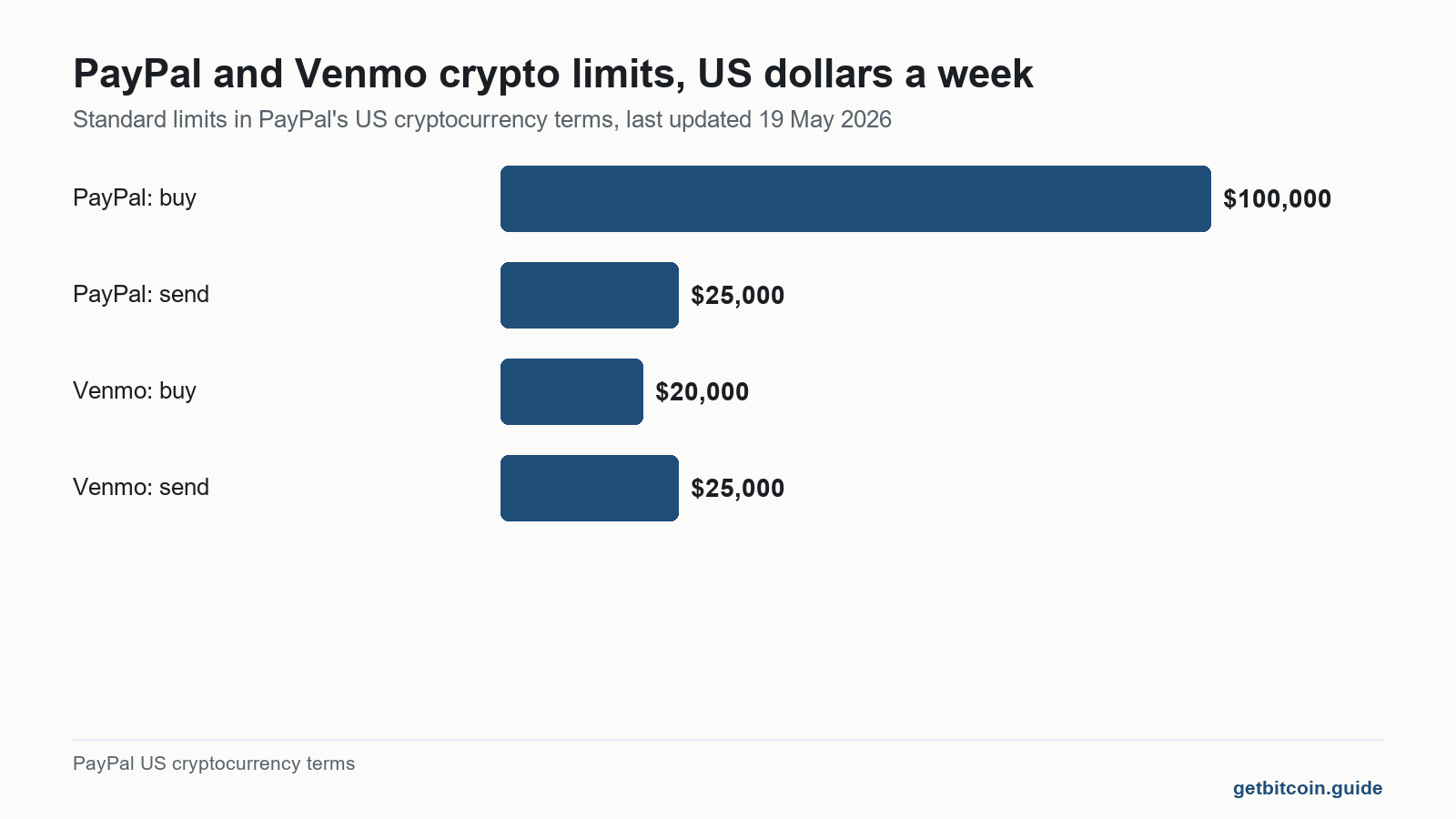
The cap is $25,000 a week in crypto sent, for accounts linked to PayPal and to Venmo alike. The help page adds that the consumer limit “resets on Thursday”. Buying has a far looser cap: $100,000 a week on a PayPal linked account. So money can arrive four times faster than it can leave, a detail the marketing emails leave out.
Every external send carries a network fee, estimated and shown before you confirm. If your balance of that asset is smaller than the fee, the terms say the transfer simply cannot be made.
Which countries can move crypto out of PayPal?
United States: yes, within the limits above. The US terms add that some features “may not be available in some U.S. locations”, so a state can still differ.
United Kingdom: no. The UK terms last updated on 12 October 2026, from PayPal UK Ltd, which the Financial Conduct Authority authorises for crypto services, say plainly that you cannot transfer crypto “from your Cryptocurrencies Hub to an external cryptocurrency wallet”, or into it from one. In the UK the custodial provider “holds the digital Cryptocurrencies themselves, including the related private keys”.
We did not verify any other country on the day. If you are outside the US and the UK, the terms page for your own country is the only answer worth trusting, and an affiliate page that says “yes, everywhere” has almost certainly not opened it.
What can stop a PayPal crypto transfer from going out?
Holds and limitations. The US terms say that if there is a hold on your account “you may be able to sell, but not transfer” your crypto, and that a hold on your linked PayPal account can be applied to the crypto account too. Transfers “may be delayed in certain situations, including if confirmation that you have authorized the transfer is needed.”
Unsettled purchases. The help page says crypto bought by bank transfer “may take multiple days to clear”, while crypto bought with a debit card is “instantly available to transfer”.
Money owed. A negative balance blocks transfers, and where a payment for crypto fails, the terms let PayPal Digital “liquidate any other Crypto Assets in your Crypto Account” to cover what is owed.
Mistakes, which nobody can undo. In the terms’ own words: “Even when a transfer is unconfirmed and pending, the transfer is irreversible.” Using the wrong address type means the coins are “irretrievably lost”, and anything PayPal does not support, sent to your PayPal address, is “permanently lost”.

What do people who tried to move coins out of PayPal report?
We read four threads on r/paypal, all from December 2025 to February 2026, with their replies. Smooth transfers rarely get posted, so these are the failure cases, and what people report, not findings about how PayPal decides.
In a February 2026 post, a user with a six month old account bought two small amounts of bitcoin two weeks apart, then sent them to their own wallet. The app showed the send as complete. About a second later, they say, a notice appeared that the account was being permanently limited, with no reason given beyond “activity on this account that we cannot process”.
In a December 2025 post, the holder of a 16 year old account says it was blocked more than a year earlier, appeals were refused, and about $300 of crypto has sat there since, neither sellable nor transferable. That is harsher than the terms’ “may be able to sell”. The top reply warned that private messages offering to recover the money are a scam.
In another December 2025 post, a user whose account was taken over says the thief took their bitcoin and ran up a $3,000 charge. PayPal returned the bitcoin but the balance stayed $3,000 negative, and that negative balance blocked any transfer out for three weeks of review.
The mildest case: a December 2025 post about settled funds refused with a message that the crypto could not be moved “just yet” because of “an added layer of security”. A reply in March 2026 says the same message cleared once they turned off their VPN and wifi and sent over mobile data. That is one person’s report, not a fix PayPal documents.
Where the accounts meet the terms: every one of them is a hold, a limitation or a negative balance, which the terms reserve the right to apply. Where they part: two report no reason given, and one reports being unable even to sell. The range runs from a few minutes’ annoyance to more than a year stuck.
How do you move coins out of PayPal without losing them?
Set up the receiving wallet first, and write its recovery phrase on paper or steel, offline, before a single coin moves. That phrase is typed into the wallet itself during setup and nowhere else, ever. No genuine PayPal page, support agent or “verification” form asks for it. Our guide to how people actually lose a recovery phrase covers the rest.
Copy the receive address from the wallet’s own screen and check it on the device, character by character at the start and the end. Pick the network that matches the coin, which matters most for PYUSD, where you choose between four. Then send the minimum first, wait until the wallet shows it as received, and only then send the rest. Two network fees cost less than one lost balance.
Two quirks catch people. PayPal’s help page says your PayPal receive address “will change for privacy reasons” each time you generate one, so an old address saved in a contact list is not the one to trust. And the $25,000 weekly cap means a large balance leaves over several weeks, not in one go. If the coins are heading for long term storage, what a cold wallet actually protects against is worth reading first.
Moving coins from PayPal to a wallet you hold the keys to
Tick each step as you go. Nothing here asks for your recovery phrase, and nothing ever should.
No genuine PayPal page, agent or form asks for a recovery phrase. Anyone who does is trying to take the coins.
What has gone wrong on the PayPal crypto side before?
Between 6 and 8 December 2022, attackers logged into PayPal accounts using passwords reused from other breaches. PayPal sent breach notices to 34,942 users, SecurityWeek reported. On a PayPal account with crypto in it, a stolen password is a stolen send button, and a crypto send cannot be reversed.
On 15 October 2025, Paxos, which issues PYUSD for PayPal, minted 300 trillion PYUSD by mistake on Ethereum, then burned it within about twenty minutes. The Block reported that Paxos called it an internal technical error and said there was no security breach and customer funds were safe. No customer losses were reported, but a custodial balance always rests on somebody else’s internal processes.
Whatever you decide about where coins live, which is your call and not ours, the safety steps on the PayPal side are simple: a password used nowhere else, the strongest sign in protection PayPal offers you, and no crypto links followed from emails. For choosing a wallet by threat rather than by brand, see how to choose a crypto wallet.
Frequently asked questions
Does PayPal give me a seed phrase or private key for my crypto?
No. PayPal’s US terms say your crypto is pooled with other customers’ in omnibus accounts and that you do not own any specific, identifiable coin. There is no phrase or key for you to export, so the account cannot be restored into another wallet app.
Can I receive bitcoin into PayPal from my own wallet?
In the US, yes, for the assets PayPal supports. Its help page says a new receive address is generated each time, so use the one shown today. In the UK, the terms of 12 October 2026 say transfers in from an external wallet are not available.
Is Venmo crypto any different?
It runs under the same PayPal Digital terms and the same $25,000 weekly send limit. The stated buying limits are lower, at $20,000 a week and $50,000 over a rolling year, and the terms list PYUSD on Stellar only for PayPal linked accounts.
Can PayPal reverse a crypto transfer I sent to the wrong address?
No. The terms say a transfer is irreversible even while it is still pending, and that coins sent to the wrong address type are irretrievably lost. PayPal says it is not responsible for those losses, which is why a small test send comes first.
Somebody says they can unfreeze my PayPal crypto for a fee. Is that real?
Treat it as a scam. Only PayPal can lift a hold on its own account, through its own help centre or phone line. Nobody else can do it, and anyone who asks for a fee, a login or a recovery phrase to do it is trying to take what is left.
Does a PayPal crypto balance count as self custody if I never sell it?
No. Holding is not the same as custody. Until the coins are at an address whose keys you alone hold, PayPal holds them for you, under terms it can change with notice.
Finished the page? The same five questions from the top, to see what stuck.
This article is general information about wallet security and is not financial advice. Nothing here is a recommendation to buy, sell or hold anything, or to use or avoid any service. Speak to a suitably qualified professional about your own situation, and remember that in self custody the security decisions are yours alone.
Leave a Reply