Both keep your private keys off your computer and both make you approve payments on a screen you hold. Trezor publishes its firmware openly, Ledger does not. That difference is real but small. What actually decides whether you still hold your coins in five years is your backup, and neither device improves it.
Listen to this article, about 14 minutes. A synthetic voice reads the article and announces each section title as it begins; tables are read row by row and the questions at the end are left out.
Recorded 1 November 2026 from the article as published that day. Press a chapter to jump there; the highlighted line is what is playing. A play button sits beside every section heading, and once you scroll past this player a bar at the bottom of the screen keeps the controls in reach. Tap or click any sentence to hear the reading start from there.
On this page: which models each company actually sells this year and which retired, what open firmware does and does not buy you, the 2026 disclosure record from both vendors side by side, what Ledger Recover really is, and the short list of practical differences left.
Think you already know this? Five questions, one minute.
Every answer is on this page. Answer from what you know now; the page fills in the rest.
-
1. What happened to the Trezor Model One and Model T in 2026?
Trezor’s own product update page states both left the shop on 8 January 2026 with limited reseller availability afterwards, and commits to critical security updates until at least 2036. Ledger, meanwhile, added the Nano Gen5 to its comparison page. Read the section
-
2. What does open firmware actually guarantee?
Trezor publishes device firmware and desktop software; Ledger publishes its apps and Secure SDK but not the secure element’s operating system. Serious flaws have been found and fixed on both sides, which is the honest reading of the difference. Read the section
-
3. What did Ledger Security Bulletin 025 of 27 August 2026 describe?
Bulletin 025 covers Ethereum app versions 1.20.0 through 1.22.2, fixed in 1.22.3; Bulletin 023 covers command interleaving that could desynchronise the screen from the signature. All three August bulletins attack the same assumption: that the screen in your hand is telling you the truth. Read the section
-
4. What was the objection to Ledger Recover in 2023?
Ledger describes the service as encrypting a pre BIP39 version of the key inside the secure element and splitting it into three fragments held by Coincover, Ledger and EscrowTech. It is optional, paid, off unless turned on, and Trezor sells no equivalent. Read the section
-
5. According to this page, what decides whether you still hold your coins in five years?
The gap between the brands is much smaller than the gap between a person who wrote the recovery words on paper and checked them, and a person who photographed them. Neither device stops you typing the words into a website that asks nicely, and the August 2026 shipping data notice is why such websites will keep asking. Read the section
This comparison was checked against both vendors on 3 September 2026. Model lineups changed on both sides during 2026, and most published comparisons, including several that rank well, describe devices that are no longer sold. That matters more than the usual feature bickering, so it comes first.
Which models does each company actually sell in 2026?
Trezor retired its two oldest devices this year. The Trezor page on support for older models states that the Model One and Model T were removed from the Trezor shop on 8 January 2026, with limited availability through official resellers afterwards, and commits to critical security updates for both until at least 2036. If you already own one, it keeps working and keeps getting fixed.
That phrase about official resellers deserves a second look since October 2026. On 15 October Ledger published its response to a hardware implant attack, in which genuine Ledger devices were opened, fitted with hidden parts built to capture the recovery phrase during setup, and sold back through resellers in South East Asia. That is a Ledger case, not a Trezor one, but the lesson is about the shop rather than the brand: a sealed box from anyone other than the maker is a link in the chain you cannot inspect, so the maker’s own store is the safer source for either device where it ships to you.
Ledger quietly added a device. The Ledger hardware wallet comparison page on shop.ledger.com now lists a Nano Gen5 alongside the Stax, Flex, Nano X and Nano S Plus. It is an E Ink model rather than another OLED stick, and it is easy to miss because the name reads like a minor revision of the old Nano line. Our existing reviews of the Nano X and the Nano S Plus predate it.
| Device | Screen | Wireless | Secure element | Battery |
|---|---|---|---|---|
| Trezor Safe 3 | 0.96 in monochrome, 128 x 64 | None | Certified EAL6+ | None |
| Trezor Safe 5 | 1.54 in colour, 240 x 240 | None | Certified EAL6+ | None |
| Trezor Safe 7 | 2.5 in colour, 520 x 380 | Bluetooth 5.0+, Qi2 charging | Two, certified EAL6+ | Yes |
| Ledger Nano S Plus | 1.1 in OLED, 128 x 64 | None | CC EAL6+ | None |
| Ledger Nano X | 1.1 in OLED, 128 x 64 | Bluetooth | CC EAL5+ | Up to 5 hours |
| Ledger Nano Gen5 | 2.8 in E Ink, 300 x 400 | Bluetooth, NFC | CC EAL6+ | Up to 10 hours |
| Ledger Flex | 2.8 in E Ink touch, 480 x 600 | Bluetooth, NFC | CC EAL6+ | Up to 10 hours |
| Ledger Stax | 3.7 in curved E Ink touch, 400 x 670 | Bluetooth, NFC | CC EAL6+ | Up to 10 hours |
Prices are harder to pin down than they should be. Ledger’s product pages carry the figure in their structured data, and on 1 November 2026 that read $249 for the Ledger Flex and $179 for the Nano Gen5; we did not recheck the other three that day. Trezor’s store pages would not load to a scripted check, so its prices stay unverified here, and the figures quoted on comparison sites disagree with each other. Check the two official stores directly. Every ranking page in this niche earns a commission on the link, so treat its pricing and its conclusion with equal caution.
Is open source firmware a real security difference?
Trezor publishes its device firmware and its desktop software. Ledger publishes its applications and its Secure SDK but not the operating system running on the secure element. That is the philosophical fault line, and it has been argued about for a decade.
The honest version is that open firmware lets independent researchers read the code instead of guessing at it. It does not mean anyone has. Nor does it make the closed code worse, and the bulletin record below shows serious flaws found and fixed on both sides.
Trezor did not skip a secure element in the older models by accident. Their position was that the certified chips available at the time came with non disclosure agreements that conflicted with publishing the firmware, so they used a passphrase and Shamir backup instead, and adopted a chip only once one existed without the restriction. That is a coherent trade off rather than a mistake, and it stopped applying once the Safe range shipped, although the Shamir backup it produced is now the default on those devices, which our review of the Trezor Safe 5 and its 20 word SLIP39 backup takes apart.
What does each company do when it finds a vulnerability?
This is the part worth reading, and the part affiliate reviews leave out because it does not sell devices. Both companies disclose. Comparing how, and how recently, tells you more than any spec sheet.
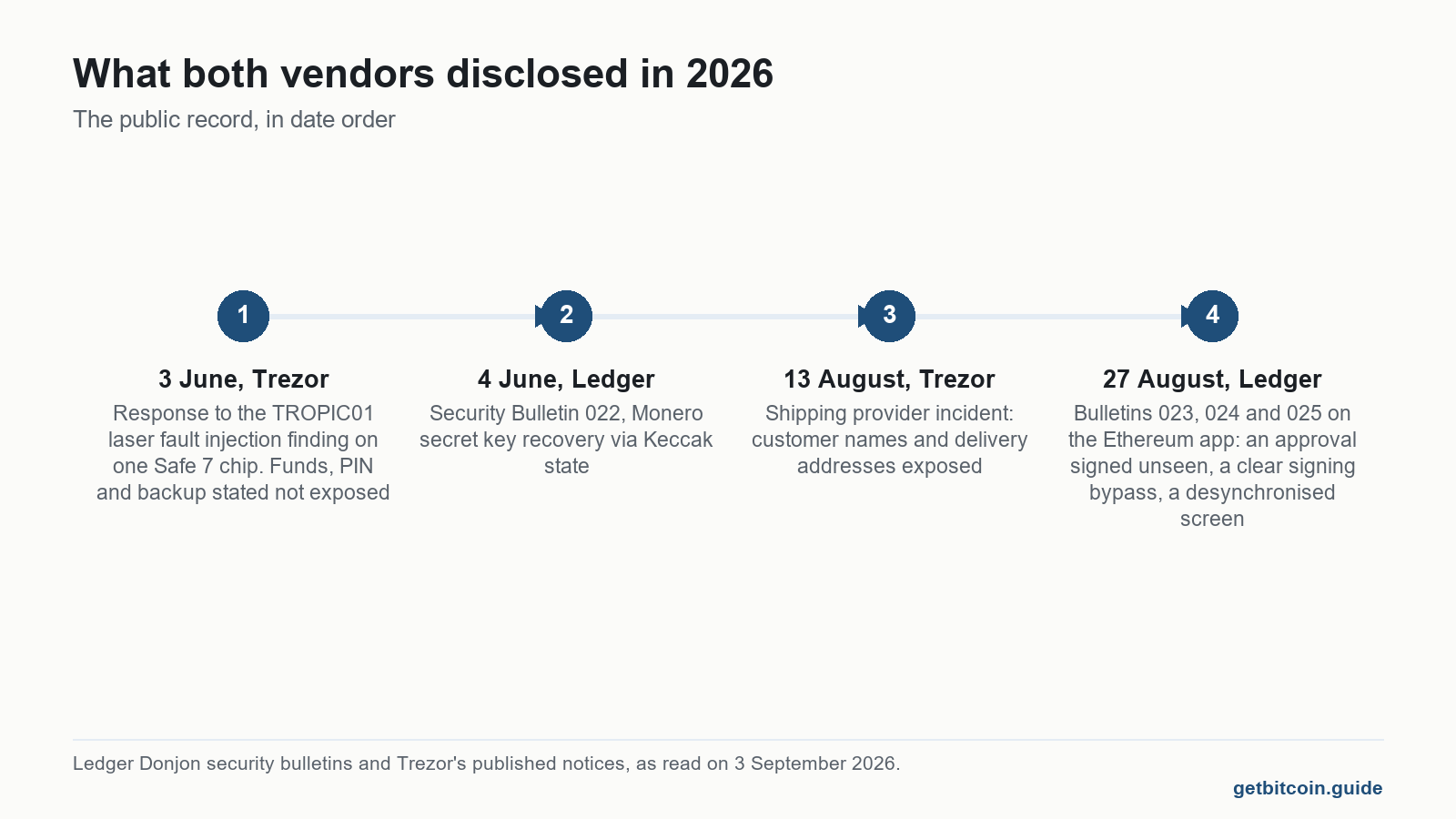
Ledger runs a public bulletin series through its Donjon security team. Three bulletins were published on 27 August 2026. Bulletin 025 describes a flaw in the Ethereum app swap path, present in versions 1.20.0 through 1.22.2, where a token approval carrying the expected address and quantity passed the checks and was signed without being displayed. The app verified the address and the amount but not the nature of the operation, so a spending permission could be signed in place of a payment. It is fixed in Ethereum app version 1.22.3.
Bulletin 024, published the same day, covers a clear signing bypass caused by array count truncation in the same app. Bulletin 023 covers command interleaving during an on screen review that could desynchronise what the screen showed from what was actually signed. That last one sat in the shared Secure SDK, so the correction reached users as an application update after the apps were rebuilt against v26.6.1 and republished on 21 August 2026.
All three attack the same assumption: that the screen in your hand is telling you the truth about the transaction. That assumption is the entire security model of a hardware wallet. Read it as evidence the model is fragile at the edges rather than as evidence Ledger is careless, because in one of these cases the finder was Ledger own team.
Trezor discloses too. On 3 June 2026 it published a response to a vulnerability in the TROPIC01 chip used in the Safe 7. Ledger Donjon found a laser fault injection attack that could extract a subset of the secrets the chip holds, and Tropic Square then found a second route using custom firmware on the chip to reach the PIN protection functions. Trezor states that funds, PIN and wallet backup are not exposed, that TROPIC01 is one of three independent layers, and that keys are not stored on that chip.
Two things there are worth noticing. Ledger security team found a flaw in a Trezor chip and it was published rather than buried. And because the flaw is in hardware, Trezor says no firmware update can fix it, leaving mitigation to future chip revisions. Exploiting it needs physical possession, disassembly, desoldering, backside decapsulation and expensive laboratory equipment, so it is a burglary problem rather than an everyday one.
| Disclosure | Vendor | Date | What it affected |
|---|---|---|---|
| Security Bulletin 025 | Ledger | 27 August 2026 | Ethereum app swap path signed an approval unseen |
| Security Bulletin 024 | Ledger | 27 August 2026 | Clear signing bypass in the Ethereum app |
| Security Bulletin 023 | Ledger | 27 August 2026 | Screen could desynchronise from the signature |
| Security Bulletin 022 | Ledger | 4 June 2026 | Monero secret key recovery via Keccak state |
| TROPIC01 chip response | Trezor | 3 June 2026 | Laser fault injection on one Safe 7 chip |
| Shipping data notice | Trezor | 13 August 2026 | Customer names and delivery addresses exposed |
The Trezor notice of 13 August 2026 is the one with a direct consequence for readers. It concerns customer order data rather than device security, and its practical result is that a set of real names and home addresses of confirmed wallet owners is now in circulation. That is a phishing list. The detail is in our Trezor review.
Nothing newer has been added on either side since. On 1 November 2026 Ledger’s bulletin index still ended at 025 of 27 August 2026, and a search that day turned up no Trezor advisory dated after June. A quiet two months is not a clean bill of health; it is just a quiet two months.
Does Ledger Recover change the answer?
Ledger Recover is the largest philosophical difference between the two brands, and it is worth understanding accurately rather than through the outrage of 2023.
It is an optional paid subscription that stays off unless you turn it on. Ledger describes it as encrypting a pre BIP39 version of your private key inside the secure element, splitting it into three fragments, and having Coincover, Ledger and EscrowTech each hold one. Subscribing requires identity verification through Onfido and a payment card.
The objection was never that the service is badly built. It is that a device sold on the promise that the key never leaves it can be instructed by firmware to export a form of that key at all. If your worry is losing your own backup, a recovery service answers your problem. If your worry is a company, a court or a hostile government reaching your coins, it is the opposite of what you want. Trezor sells no equivalent, and that is a genuine difference between the two lines.
So which one fits the way you actually use it?
Strip out the tribalism and the practical split is narrow.
- Bluetooth and phone use: Ledger has offered it longer, across the Nano X, Gen5, Flex and Stax. Trezor added it with the Safe 7.
- Bitcoin only firmware: both offer it, and it reduces the amount of code on the device that can go wrong. If that is the point that decides it for you, the device built around nothing else is weighed in our Coldcard Mk4 review.
- Auditable firmware: Trezor, without qualification.
- A recovery service you can subscribe to: Ledger, and only if you want one.
- Backup splitting on the device itself: Trezor multi share backup on the Safe range.
- A large readable screen at the cheaper end: Ledger Nano Gen5, the newest thing in this comparison.
That list is short because the devices have converged. Both now use certified secure elements. Both show the destination on a screen the computer cannot forge. Both had real vulnerabilities found this year, published by their own or each other security teams, and patched.
The boring conclusion is the correct one. The gap between these two brands is much smaller than the gap between a person who wrote their recovery words on paper, checked them, and stored two copies in separate buildings, and a person who photographed them. Word count is not the dividing line either, as the arithmetic behind a Ledger 24 word seed shows. The failure modes are set out in the ways people lose a recovery phrase, and the wider question of picking a device at all is in how to choose a crypto wallet.
Neither device stops you typing your recovery words into a website that asks nicely. No purchase changes that. If you want the underlying idea before the shopping, start with what a cold wallet actually is.
What has changed since this was first published?
- 15 October 2026: Ledger disclosed a hardware implant attack on genuine devices resold in South East Asia, per Ledger’s statement of that date, which says there was no flaw in its chip, operating system or servers. The buying advice in the models section now reflects it.
- 1 November 2026: Ledger’s prices became readable from its product pages, $249 for the Flex and $179 for the Nano Gen5. This page said in September that neither vendor showed prices; for Ledger that is no longer true.
- 1 November 2026: no new disclosures. The Donjon bulletin index still ends at bulletin 025 of 27 August 2026, and no Trezor advisory newer than the June TROPIC01 response turned up.
- Not rechecked on 1 November 2026: the Trezor Safe range specifications and the Ledger Recover terms, which carry their September 2026 dates.
Which practical difference is the one that matters to you?
The devices have converged, so pick the one thing you would actually use. Nothing here is a recommendation to buy anything.
Whatever you pick, the backup decides whether you still hold the coins in five years, and neither device improves it.
Frequently asked questions
Is Trezor or Ledger more secure in 2026?
Neither is meaningfully safer for an ordinary user. Both use certified secure elements, both show the destination address on a screen your computer cannot forge, and both published real vulnerabilities during 2026 that were then fixed. The larger risk on both sides is a person being persuaded to reveal their recovery words.
Is the Trezor Model One still supported?
Yes, although it is no longer sold. The Trezor knowledge base states the Model One and Model T left the Trezor shop on 8 January 2026, with limited reseller availability afterwards, and commits to critical security updates until at least 2036 and maintenance until at least 2031.
What is the Ledger Nano Gen5?
It is a newer Ledger device listed on the shop.ledger.com hardware wallet comparison page, with a 2.8 inch monochrome E Ink screen at 300 by 400 pixels, USB-C, Bluetooth and NFC, a CC EAL6+ secure element and a battery rated up to 10 hours of normal use. Many published comparisons do not mention it yet.
Does Ledger Recover send my seed phrase to a company?
It is optional and stays off by default. Ledger describes encrypting a pre BIP39 version of the private key inside the secure element, splitting it into three fragments, and having Coincover, Ledger and EscrowTech each hold one. Subscribing requires identity verification and a payment card. Trezor sells no equivalent service.
Was the Trezor Safe 7 chip vulnerability serious?
Trezor published a response on 3 June 2026 stating that funds, PIN and wallet backup are not at risk. The laser fault injection attack found by Ledger Donjon reaches only one of three independent security layers, and exploiting it needs physical possession of the device, disassembly and expensive laboratory equipment.
Should I switch brands because of a security bulletin?
A published bulletin usually means the flaw was found and fixed rather than left open. The useful response is to update the device firmware and the individual coin applications, since the Ledger Ethereum app fix in bulletin 025 arrived as an application update rather than a firmware one. Switching hardware does nothing about a backup that was never written down properly.
Finished the page? The same five questions from the top, to see what stuck.
This article is educational and is not financial advice. Nothing here is a recommendation to buy, sell or hold anything. You are responsible for your own security decisions.
Leave a Reply